A schoolboy has survived a direct hit by a meteorite after it fell to earth at 30,000mph.
tagged as
A schoolboy has survived a direct hit by a meteorite after it fell to earth at 30,000mph.

elfm.el is a rudimentary last.fm radio client implemented within emacs lisp. I wrote this at work to present at our internal "Radio Hackday"; dedicated to encouraging staff to experiment with the radio services and API , and make something with them in a day and a half for show-and-tell. Kind of 20% time distilled right down to an essence.
I wasn't sure if I was going to have enough time to contribute anything, so I wanted to focus on something I could hack on by myself, because I didn't want to hold a team back if I got called away. So I picked something jokey, inessential, yet hopefully thought-provoking, as per my usual idiom.
I had a real blast participating. I don't usually get time to attend things like proper hack days, being all old and family-bound. I really enjoyed the atmosphere of inspiration and industry. All the other hacks were amazing, and waiting for my turn to demo I felt quite embarrassed about my stupid cryptic toy, but it worked perfectly in the spotlight. I got almost all the laughs, and all of the bemusement I was aiming for.
The code is here . It is awful. I haven't written any coherent lisp on this scale for many years. It uses too many global variables and special buffers. It doesn't scrobble. I had to rewrite all my planned asychronous network event machine halfway through implementation, when I re-discovered the lack of lexical closures in elisp. ( I've been reading too many common lisp books in the interim, I suspect ). I think there's enough of the germ of a useful idea in there that I might just clean it up and try and extend it into a proper thing.
I built and run it using GNU Emacs 23.4.1 . I used an external library for HTTP POST , which I found on emacswiki ( HTTP GET I glued together using the built in URL libraries). I've also put a copy of the version I used in the distribution directory. I used mpg123 for mp3 playback, which I installed using Mac Ports . The path to mpg123 is hardcoded in the lisp somewhere, probably inside play-playlist-mpg123.
Here's my demo script, which I evaluated in a scratch buffer. Evaluating these forms in sequence will authorise the application, tune in the radio, and then fetch a playlist of five tracks and start playing them.
;;;; -----DEMO , this example code is out of date, see README
; will open a browser to authorise application
(authenticate-app)
; authenticate a user session
(start-user-session)
; tune the radio to this URL
(radio-tune "lastfm://user/colins/library/")
; refresh the playlist
(get-request (get-playlist-url))
; filter the playlist response to sexps, play the list
(play-playlist-mpg123 (reduce-playlist))
There is only one playback control at the moment; stop, which you can manage by killing the buffer lastfm-radio which has the playback process attached to it. You can retune the radio with any lastfm:// URL format , by re-evaluating radio-tune, and then refreshing and playing the playlist i.e. repeating the last three steps in sequence.
The internal hackday was a cracking idea. Most of the hacks were focused around radio enhancements with broad-ranging appeal, the vast majority of them looked practically useful. I suspect most of the work will filter out into site and product updates. In addition to this, and perhaps more valuably, it worked really well as a community exercise, evolving knowledge-sharing, cross-team working, and enthusiasm, and converting them into inspiration, craft, and art. More of this sort of thing, everywhere!
I've iterated on the original hack quite a lot to make it slightly less brain-damaged, and a bit cleaner to import into anyone else's emacs. Updated code is here and so is a README file with updated running instructions. It's still not really in a usable state for anyone else, but it's amusing me to fiddle with it, and I vaguely plan to get it to a releasable alpha state, at which point I will publish a repository.
Because I've been in the mood for photo housekeeping, here's the remainder of the photographs from our trip to Manhattan last Christmas. They're mostly concerned with a walk over the Brooklyn Bridge which occurred on the very morning of Christmas day.
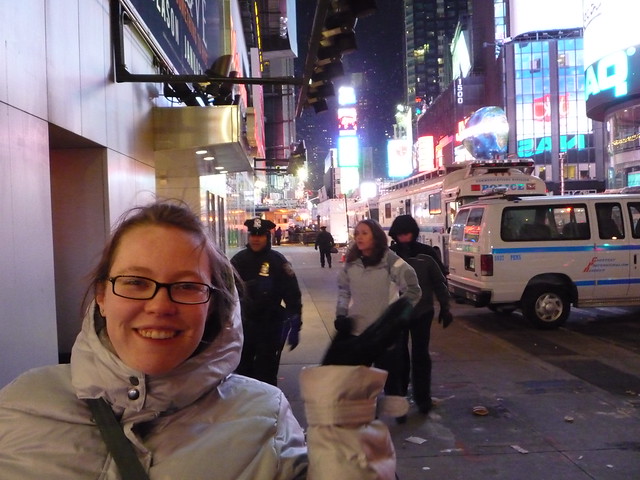
We took the train down to Brooklyn and just leisurely walked across. The weather and views were rather stunning, and the city much quieter than usual. We did run into a bit of footpath congestion at the Manhattan terminus; the comic image of a frustrated, lycra-enveloped cyclist failing to exert his right-of-way, in opposition to the crowds, camply yelling "Hello! Bicycle lane!" will stay impressed on my memory.
Thanks to some free air miles obtained when I signed up for my last credit card, we managed to get an entirely free weekend's accommodation (self-catering apartment, right in the city centre), and flights (BA, return from Gatwick) to anywhere in the closest European zone. The only catch was that they needed to be cashed-in before the end of February '09. We elected to re-visit Dublin, as Mrs S. spent several months living and working there, back when she was studying towards her degree. That was several years ago, neither of us have been back since.
It hasn't changed much. Right before we left, we discovered the exciting news that we were in the family way . This rather curtailed the traditional Dublin entertainment of drinking stout (the Guinness does taste better, you know) and bar-crawling. Perhaps the most striking change was the effect of the recent economic turmoil upon the sterling exchange rate. Dublin was never the cheapest city, but now things were positively eye-watering; a pint of Guiness was pushing five pounds, a decidedly average meal for two (with no alcohol) in a vegetarian restaurant easily overshot the forty pound mark. Luckily with free travel and accommodation leaving enough elasticity in our spending budget, we managed a relaxed weekend break without risking bankruptcy.
The February weather was cold, windy and occasionally damp. Wind-swept and grey rather suits this city by the sea. On on the evening we flew in, the night of the 14th, we somehow managed to blunder straight in and secure a last-minute table for two in a little Italian bistro, minutes after we'd unpacked; saving us from having to hurriedly improvise a meal with limited shopping options.
Most of the rest of the time we just cruised around the city streets, feeding the ducks in the park, dipping into second-hand-book shops, cafe's and what proved to be an astonishingly well-stocked Gibson guitar dealer, where I ogled an array of the fancy new auto-mechanical-tuning robot guitars. I was particularly taken by the effect of the grimy, yet bright, winter sky reflecting off the mosaic-tile pools in the Garden of Remembrance.

PatchMatch : A randomized correspondence algorithm for structural image editing.
In Britain, butterflies are also on the wane. In the 19th century, they would flock in the wild in quantities sufficient to obscure your view. Now as populations dwindle , they're a rare treat.
I've see a lot of encouraging signs of rehabilitated wildlife, as I wander round the green corridors of Bristol, walking that dog . We don't see many butterflies.
I often travel with a laptop. I almost invariably travel with a charged mobile phone. I enjoy using the fancy multi-touch trackpad in my MacBook Pro, but an odd thing happens sometimes when I've put my phone down nearby on the desk; I reach automatically to try and use the phone as a computer mouse. One of those amusing peculiarities of muscle-memory and reflex that can surprise, when you're engaged by something, within the computer, verging upon a liminal state.
It's a slightly amusing quirk, but when I think further about it, I find plenty of reasons why it perhaps ought to work.
External mice are more useful than trackpads, although not enough use to me to justify carting one around. My phone is palm-sized, about the ideal weight, is already paired with my laptop over bluetooth, has clickable buttons all over one face, and an optical camera on the reverse. In short, it already has most of the technology needed to be a wireless optical mouse.
Most but not all. I'm a bit dubious about whether it could be done in software alone. I doubt that the lens will focus well enough to motion tracking without a special surface, and it's completely lacking the light source, but it is almost tempting enough to try. It might be feasible with some sort of very recognisable surface, perhaps a monchrome checkerboard grid, which would be very easy to render and print.
For the last few weeks I've been utterly immersed in a fairly exlusive relationship with David Bowie. He doesn't know anything about it,unless he makes a habit of checking out people's play counts on last.fm . It's just me and his back catalogue. This relationship is mostly played out in trains. On headphones, music fed from iTunes or Spotify. Complete albums at a time, played through in the correct running order, naturally. As I listen my eyes are glued to an electronic book. A book about David Bowie and the same songs I'm almost obsessively listening to.
It began with the book, or perhaps I mean to say it awoke. A few weeks ago, listening to Word Podcast 188 , I heard about Peter Doggett's latest book . Commissioned as a sequel, or at least inspired by Ian MacDonald's influential song by song Beatles chronology: Revolution In The Head . I thought the idea was sound, if any classic rock canon could bear the load of similar scrutiny, it was probably Bowie. I noted the book on my 'to read' list, and the next time I found myself without an ongoing book, whilst waiting to depart St. Pancras International, having recently ended one book, I bought the Kindle edition, via "Whispernet". I do most of my book reading on trains. I thought it would probably make an interesting read, despite knowing that I didn't really enjoy listening to Bowie's music.
It wasn't always that way. At some level I would still identify myself as a Bowie fan; albeit a heavily lapsed one. We go way back together. His commercial peak as a pop star ( Let's Dance ) neatly coincides with the start of my interest in the pop charts. He still seemed a current, voguish music figure. The promo video was a new central focus of pop culture, and Bowie was of course one of the craftiest, most-prepared of the video pioneers.
Access to archive media was rare then, and fashion was forward-looking; any consciously retro styles were focused on the '50s. I remember a classmate at boarding school, with the archetypal 'older brother with record collection' filling me in on the standard mythology. The multiple identities, snatches of song titles and character names and iconography all seemed unimaginable and distant. Fascinated by the scraps, I used my sense of wonder to fill in the gaps.
I remember the first time I saw a photo of Ziggy Stardust , years later. It was in a newspaper colour supplement. There was a stock photo collage piece on 'The Many Faces of David Bowie'; probably already a cliche even then. Like anyone, I was knocked out just by the look of it. It was preposterous; somehow ridiculous and cool. A vision from the future, even 15 years out of date.
Bowie still pops up throughout the rest of the decade. He's still a face. Movie and soundtrack work. Labyrinth . Absolute Beginners . When the Wind Blows . I watch all of these at home on a VCR.
I pretend to study for 'A' levels, at the local sixth form college. A grim time for chart music, the fag end of the Stock Aitken Waterman years, just running up against the first twinklings of rave culture. There's a jukebox, with actual seven inch singles in. Most of them are by Rick Astley, or Sonia, or Michael Bolton. There's a 'Golden Oldies' section with maybe a dozen records over on the far right side. 'Ziggy Stardust' is one of them. I play it once or twice a day for weeks. After this, a little piece of me is always slightly disappointed each time I play an electric guitar and it doesn't sound very much like Ronson .
Tin Machine are next along, the sheer contrariness of this scheme just delights me; although I never get to hear much of the music, there's a near media embargo on it. As I move through the 90s, with a gradually solidfying income, I fill out my CD collection with all the back catalogue. It gets solidly played until I've commited the bulk of it to heart.
I'm amused by the negative attitude to 'Drum and Bass Bowie' from the inkies, most of these still in thrall to the last few coughs of Britpop. I like the singles more than most others from that year.
Then it's spoiled. Glastonbury 2000 kills it. Against my better judgement, I trek down to the pyramid stage to watch Bowie's headline set. Stadium Rock is not my thing. I stand in the mud for a while, and I try to watch on the giant TV screens on the other side of the crowded field. It's too slick, too caberet, I'm completely disengaged and intensely disappointed. I leave them to it after half a dozen songs. Something feels quite broken. After that, I find it hard to listen to the old records in a more than academic way.
Nonetheless, now I'm reading the book, I put a playlist together that covers all the albums it discusses. I'm mostly reading on the train, and this means I'm mostly listening as I read. It's a peculiarly immersive way to listen to records. I tried it once before, with Scott Tennent's book about Slint's Spiderland . I read that on the Northern Line, with the album on rotation. Eventually it almost felt like I'd been present at those recording sessions.
It leaks into your ears, ambiently informing your reading. Occasionally mid-passage about the invention or arrangement of a song co-incides with the track playing everything pulls into focus across multiple senses. Berlin-period Bowie plays particularly well with rail transport, with it's stations and trains and mechanical sounds. Listening to Heroes, waiting platformside in the raw concrete trenches of Stratford International .
The book itself is a solid read. Bowie remains an unsurprisingly opaque presence, and some of the speculative interpretation on lyrics and motivation feels like a stretch. The musical analysis likewise falls falls a little short of the template established by 'Revolution In The Head', occasionally quite gratingly clunky (a 'sustained fourth' chord?). Luckily the framing works just as well. Imposing a narrative upon the chronological order of recordings creates an appreciation of it as one body of work. Considered so forensically, it's an astonishing thing. Much as with the previous book, what stands out just as markedly as the quality of the songs and recordings, is the rate of progress, and the rate of change. Here's a rough calendar of the recording dates of the albums covered within 'The Man Who Sold The World'.
I still find this list astonishing. Just five years separate the psych-folk/music-hall of Hunky Dory and the ambient alienation and hyper-stylised funk of Low. A further four years between that and the proto-industrial-cum-New Romantic Pop of Scary Monsters. It's a lot of terrain to cover in a decade, banging out over an album a year interspersed with global touring. For the sake of convenience, I have left out the live album releases.
A couple of other interesting points leapt out at me after reading. I realised my instinctive dating of 'Scary Monsters' is mistakenly late. ' Ashes to Ashes ' has been so convincingly retconned as a New Romantic cornerstone, I have been unconsciously sticking it in the middle somewhere around '82-'83 amidst Culture Club and Duran and the Spandaus, and 'Come on Eileen'. The actual recording date puts it barely out of the 1970s, which means that dense, sound bricolage of such modern sounds was hand-stitched in the most analogue ways. Tony Visconti deserves even more of my respect.
The second thing I never before realised, was that the 'Art Bowie' period - the less overtly commercial works spanning from 'Station to Station' to 'Scary Monsters' does rather neatly line up with a management dispute. As I understand it, these records were produced under a settlement that meant a significant portion of royalties were due to a now estranged management organisation. Once this lapsed, he abruptly switched to the ultra-commercial, lucrative career arc prefaced by 'Let's Dance'. Which is of course, where we came in.
A final, unexpected triumph. As a side effect of the book and this entombment in the music. The joy came back. In sounding all the material out new depths, informed by fresh context, and with rested ears refreshed, I've rediscovered my original appreciation for this sequence of records. Pity my poor family.
The only fault I can find with this technique of marrying immersive listening with a scholarly reading is that it is intrinsically retrospective, and perhaps simply nostalgic, and reductive. It obviously requires you find an artist or a work that's had enough time to embed itself in it's surrounding culture, and can never be forward looking.
Best album from the set? I change my mind constantly, but think I most often settle upon 'Low'. There isn't a bad one, although I'll never consider 'Pin Ups' to be essential, and I think I might always find 'Lodger' a little underwhelming. Who's next for the treatment? I'm not sure. I notice there's a book about the rise and fall of Spacemen 3 .
Wonderful news for St. Vincent fans like me. New Album 'Actor', is on the way, due out 5th May on good old 4AD .
Hackers Documentary : Set around the Hackers Conference of 1984. Contains prototype RMS.
