Deserted: How John B. Winterburn found the lost base camp of T.E. Lawrence
tagged as
Heliotrope : This German rotating building design, was the first building in the world to generate more energy than it consumed.
Surprisingly good list : if you’re looking for a reading list of post-80s comics. I’d lose “Preacher”, and “Invisibles”, obv.
Sodium Killers : A story combining serial killers and Industrial chemistry? The BBC know how to clickbait me.
Blame The Daily Mail : Adam Curtis in wonderful form on the roots of MI5.
IDW formally announces "The Strange Death Of Alex Raymond" : That is one busy cover.
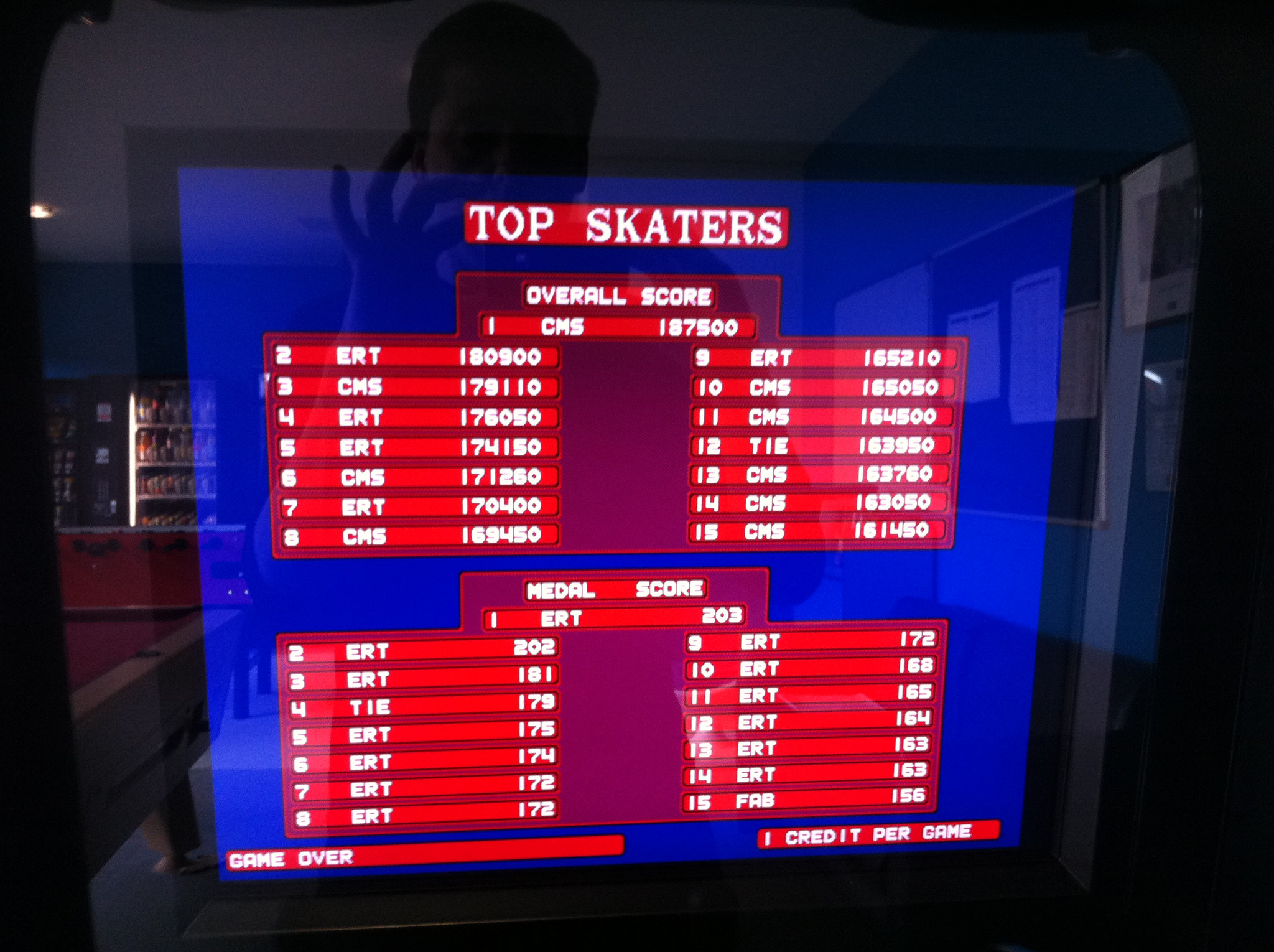
This is what my final day at last.fm looked like.
In the morning, this.

Yes, I'm working on getting a MAME cab smuggled into Moonfruit.
30 Years On : BBC News has a nice summary commemorating the closure of Chatham Dockyards
Enron Email Dataset : cleaned up, organised, and presented as part of the Internet Archives dataset collection.
Self cleaning eggs : Guillemot eggs have a surface microstructure that makes them self-cleaning eggs, like a birds egg, EGG.
Numbers Are Important : What Heidi Roizen learned from negotiating with Steve Jobs
A potential exhibition of Yellowism :Tate Britain is organising an exhibition of art that has been attacked in publlc.
This afternoon I went on a short guided tour of the decomissioned Royal Navy submarine, HMS Ocelot . It's in a dry-dock at the Royal Dockyards working museum at Chatham , just 20 minutes down the road from home.
Apologies for the poor quality of the photos. I only had my iPhone, with 15% remaining charge, and submarines do not offer much in the way of natural lightning.
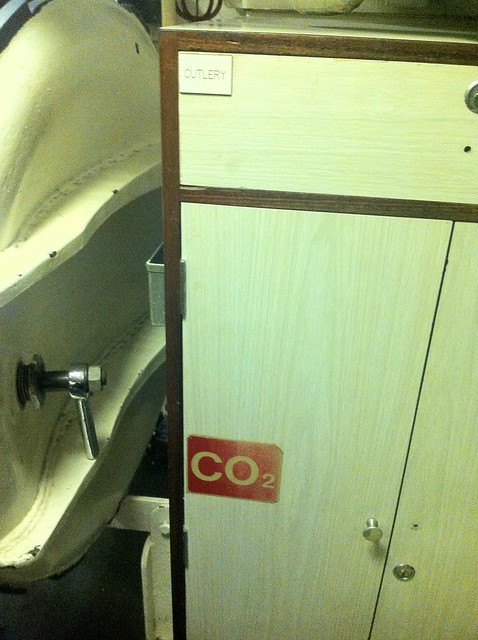
Despite having owned a year pass for the best part of a year, and frequently admired the Ocelot from the outside, this is the first time I've been aboard. The tour is short, cramped, and completely fascinating, although perhaps not for the squeamishly claustrophobic, and definitely not for the mobility impaired.
The Dockyards is a superb example of a modern lottery-assisted regeneration project. There's several large ships in dock you can wander around, huge warehouses full of boats and machinery to pore over, a ropery, an art gallery space, a working steam railway, several sub museums. Far more than you can do in a single visit, but your ticket, once purchased, is good for 12 months of repeat admission.
Fretboard Heatmaps : This is a really neat idea, although it's a pity it has so few artists.
There’s been a little flurry of le Carré activity in the British press this week , following on from release of MI5 archive files that indicate that an MI5 agent, known as Jack King ran a network of UK nazi collaborators during WWII. Highly fortunate timing for the British spooking establishment to garner some positive press, some might say. The last couple of months the news reports about them have mostly been about illegal mass surveillance techniques attempting to record and analyze all internet traffic at source , and creepy write ups of mass automated collation of private video chats . Some of them intended to be particularly private , no doubt.
Journalists had a bit of fun trying to retrospectively finger the real Jack King . The Telegraph decided King was probably John Bingham, Lord Clanmorris , whose name is usually mentioned in passing in press stories about ‘le Carré’, itself a pen-name for David Cornwell , who often mentions that Bingham is one of the component inspirations behind his super-famous fictional master spycatcher, George Smiley. The Telegraph also span off an article about Bingham’s sense of disapproval of his protégé's literary exploits . Mr Cornwell, writing under his given name, sent in a marvellously succinct letter by way of reply.
Bingham was of one generation, and I of another. Where Bingham believed that uncritical love of the Secret Services was synonymous with love of country, I came to believe that such love should be examined. And that, without such vigilance, our Secret Services could in certain circumstances become as much of a peril to our democracy as their supposed enemies.John Bingham may indeed have detested this notion. I equally detest the notion that our spies are uniformly immaculate, omniscient and beyond the vulgar criticism of those who not only pay for their existence, but on occasion are taken to war on the strength of concocted intelligence
Navigating around the little flurry of reportage about this little back and forth, I found this engrossing older Q&A with le Carré , from the Paris Review , held at the time of the US publication of “ The Tailor Of Panama ”, back in the late 1990s. It is a marvellous read, concerning the mechanics, circumstances and techniques of his fictional writing, and touches into politics. This quote leapt off the page at me.
My definition of a decent society is one that first of all takes care of its losers, and protects its weak.
Quite. He’s quite a writer, that Mr. le Carré. If all you know of his work are the mostly excellent TV and motion picture adaptations of his more famous works, you might do yourself a favour, and read a few of the source novels . They work best tackled in publication order.
DIY Mineral water : Like fancy mineral water? Why not clone it with a soda stream?
Album Shuffle : I published my playlist generating python tool onto github
They actually did it! And amazingly enough, close to my old gaff , down in Bexhill-on-sea, home town of Q, and one of my favourite buildings, the De La Warr Pavilion . In my day, I chiefly associate the De La Warr with local dance and dog shows, ropey touring comics, and humdrum seasonal panto. It seems to have fully reinvented itself in recent years, as an contemporary arts centre after a face lift from the usual lottery funding raffle committee.
The story leading here; Ceramic artist Keith Harrison, as part of his residency in London’s V&A museum last spring, created a "an experimental sculptural sound system” out of a ceramic tile sculpture, and invited Napalm Death to play a high volume live set through it , potentially involving the destruction of the sculpture through sonic assault.
So far, so awesome... It sold out quickly, and then the museum curators suddenly came to their senses/got cold feet and chickened out, as they realised they were about to stage a grindcore gig at volumes deliberately intended to destroy sculptures in their museum full of fragile objet’s d’Art, many of which are kept in darkened chambers as they’re too fragile to expose to strong light.
Aboo. So, I felt slightly better about missing out on tickets, and forgot all about it.
I subsequently discover with glee, they relocated it to the De La Warr in November, and completed the show without any particular mishaps to life or property. The installation/gig was called Bustleholme, which is the name of a degraded housing estate outside Birmingham. The sculptural components of the installation, through which the band’s amplified output was channelled, were ceramic tile structures loosely based on the dimensions of the estate. In the words of Keith Harrison...
The Bustleholme estate in West Bromwich was where I was born and lived until I was 8. Located in the Black Country, the heavy industrial centre of the Midlands, three tower blocks depicted overlooked the estate and their vivid blue and yellow ceramic tiles are one of my earliest memories. Despite the subsequent poor reputation of the blocks, at that time in the late sixties and early seventies they symbolised the optimism of a radical approach to social housing rising out of an urban landscape of motorways, canals, polluted rivers and railway lines.
The quote is taken from a short interview with the sculptor and band over at the vinyl factory where there is a fascinating short documentary film about the whole event. More of this kind of thing, please.
Cast A Kitten : Nerts! This post on dead 1920s slang terms is postively Eel's Hips.
2013 ioccc winner - Largest Small System Emulator : I am delighted by this.
Elisp lexical closures are readable forms : Lexical scoping for emacs lisp means doing some unlearning.
If you have a Mac, and you use Terminal.app to run UNIX commands, try executing this for a cool shell prompt
export PS1="\360\237\220\232 $ "
See what I did there?
If you are using a UTF-8 encoding for your terminal, which you probably are, and if you're using a recent OS X, and have the right fonts installed, which you probably do, you should have a little sea-shell graphic for your prompt. Literally a cool shell prompt.

In a recent revision to Unicode , code points were assigned for many emoji. Emoji-what-now? These are little emoticon glyphs that rose to popularity in Japan . Apple have included a nice typeface with full colour icons for a subset of these in the last couple of releases of both iOS and OS X, so you can use them in most applications that use the system type rendering library, like Messages. On OS X, this includes the bundled Terminal.app terminal emulator. So you can print little icons in your shell, if you know an encoding for a particular glyph.
Here's the ever popular 'pile of poo' ( U+1F4A9 )

Not sure what that is supposed to be used for, but it's terribly popular on the internet. "But how", I hear you ask, "do you find out the encoding sequences for these appealing novelties?"
Well, you can search for unicode code tables on the internet. On the Mac though, the easiest thing to do is probably to enable the Character Viewer tool via the Language and Text System preference pane.

This gets you a panel like this, where you can browse all the characters your computer knows how to render, including all the emoji sets, and find out their Unicode code points, and more importantly, a way to encode that code point in UTF-8.

So, as you can see in my fecal example, the UTF-8 byte sequence for 'pile of poo' ( U+1F4A9 ) is F0 9F 92 A9, and we can print that in a bash shell, using echo with the -e flag to enable interpreting of escape sequences, using the \x escape prefix to indicate bytes in hex.
Going back to the original shell trick, the shell emoji ( U+1F41A ) has the UTF-8 encoding F0 9F 90 9A. The bash shell doesn't seem to have an escape sequence for hex encoded bytes in it's prompt string, but it does interpret 3 digit codes prefixed with a plain \ as octal encoded literal bytes, so if we convert this hex string to four octal numbers, using bc or od, or emacs or just Calulator.app, we get the escape sequence from my initial shell example - "\360\237\220\232"
So far so cute. But is there anything vaguely useful you can do with this sort of thing? Sort of. A picture's worth a thousand words. So we could perhaps encode mnemonic information in icons, and somehow dynamically update the prompt to reflect this.
Bash will execute the contents of an environment variable PROMPT_COMMAND as a shell command immediately before the shell prompt is printed. Typically this is used to update terminal colours or title strings with escape sequences, or update PS1 to add some content that can't be printed using the built-in prompt escape functions. I decided to make my prompt respond to the result of my most recent command.
Here's the relevant shell glue I just stuck in my .bashrc
emoji ()
export PROMPT_COMMAND='PS1=$(emoji $?)'
This runs a shell function called emoji in a subshell, which returns a string based on the input argument. The input argument I'm using is the exit status of the last shell command. This gets me a smiley face in my shell prompt, unless the last command I ran returned a non-zero exit state, which in UNIX, indicates a problem happened. This makes my prompt draw as a 'confused smiley', if something has gone wrong.

Still cute, and almost useful!
I think I'll keep it for a while.
-AppleLanguages : Overload the locale for cocoa programs at the command line.
Jamming Avoidance Response : The etiquette of being a weakly electric fish.
Every HN Thread, ever : It's a particular flavour of Eternal September over there.
I've been using a set of superman covers I scraped from Superdickery.com as a screensaver on my Mac for a couple of years. I just dropped them all in a folder, and pointed the built in "slideshow" saver at it. Set to "Shifting Tiles" with 'shuffle slide order' it makes a nice regular grid of comic books that zip in and out regularly.
Last week I had a notion. I dusted off my old Canon LiDE A4 USB scanner , fired up VUEScan and set about scanning a couple of boxes of my own comic book collection. It was a suprisingly therapeutic couple of hours mechanical work to scan a few hundred, and the result is a more pleasingly personalised slideshow, with a larger number of member images.
After running with it for a couple of days, I'm really pleased with the results. It could do with a little more variety, because I scanned from boxes where the material was alphabetically organised by titles (what am I, some kind of nerd?). Some other observations - the 90s were really dark, both in the stupid post-Watchmen 'gritty heroism' sense, but also more literally in the colour palettes. This is really obvious contrasted against the four poster colour silliness of the classic Super titles I've switched from. Ironic that high grade reproduction technology and digital colouring options, as well as the shift to fully painted illustrations seems to have lead to a more muted spectrum of offerings. Perhaps this says a little about my youthful tastes. Also, what was I thinking sticking with that second run of ' Mage ' ("The Hero Defined"). That book was pretty terrible as I recall, and I've certainly got no urge to reread and check my assumptions. I'm leaving them in the set, because it seems dishonest not to.
I've got another dozen or so boxes to scan. I should do some sums to work out what the storage implications of that represents before I commit to bunging the rest of them on my 256GB SSD though.
As a side thought, I realised that everpix had diligently uploaded all my scan jpgs, so I can present a public gallery of the work so far for your bemusement.