1. Hanging out on LinkedIn in 2026

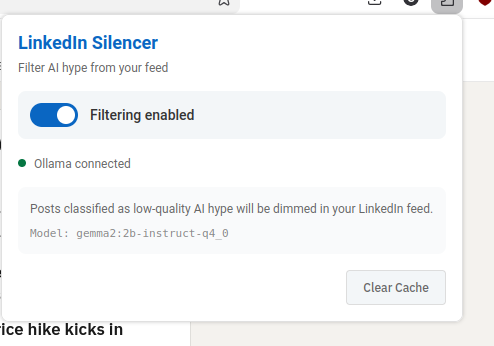
    screenshot of extension UI

    I posted about yesterday's post on LinkedIn, because it seemed like a low-key way to get people to consider my CV. Although I'm not exactly job-seeking at the moment, we ARE having a big surprise technology function re-org, and it feels like a great moment to be prepared for a role change. So, if you're reading this and you think - hey that guy sounds like someone I'd like to work with and you're hiring people for something fun, now might be the perfect time to reach out 🙏

    Anyway, LinkedIn appears to be having a bit of a cultural resurgance of late, which is interesting. People are using it a lot more like a general purpose social network than ever they used to. I have a few thoughts about why but they can wait for a different blog post. I kind of like it, because I'm always sincerely happy when people make "content" 🤮 rather than just passively consume stuff. A lot of the content is a bit awkward, because there's obviously a motive toward self-promotion, as so much of the LinkedIn audience are job seekers, recruiters and sales people, but still my feed quite often has interesting content popping up. It's kind of 'business instagram'. Instagram but all the influencers are dads, dad-dancing at the school reunion disco. It's honestly not without charm. Not all posts are equally enjoyable though.

    The robot Elephant in the room.

    AI Hypers! Of course LinkedIn loves AI hype! Now, I'm quite fascinated/entangled/repelled/enchanted with the AI boom myself. We're certainly having an industry moment, and like each crazy boom cycle I've seen in this domain, it's a bundle of awful things mixed in with amazing things, and fun things and tragic things all at the same time. One thing is certain though, there's a lot of AI opinions surfacing on LinkedIn right now. Too much I think. They're a bit repetetive, and I'm not always seeing that much valuable content from them.

    Typical AI boost content

    Jane Q. Businessguy posts something like this. (Not their real name. I made them up. I made the content up. This is satire. I am British, cynical sarcasm is what we do)

    🚀 HIRING TIP 2026: QA IS DEAD 🚀

    Yesterday I blew my own mind. I was thinking out loud in the bathroom, and minutes later, after a couple of deep inhales, I had implemented one basic Selenium script from a prompt transcribed from a voice note that runs our smoke tests automatically and honestly? We don't need QA teams anymore!!! Think about it: automation = no bugs. It's that simple. The future of software is here and frankly, any company still paying QA professionals is throwing money away. We're living in 2026 but some of you are still hiring like it's 2015. This is the kind of paradigm shift that separates the industry leaders from the dinosaurs. We've moved past the era of "manual testing." Those days are OVER. If your organization hasn't eliminated your entire QA department by Q2, you're already behind. The math is simple:

    Automation = efficiency Efficiency = no QA needed QA people = legacy cost

    Welcome to the future. You're welcome. Don't @ me if you're not ready to hear hard truths.

    #Innovation #Disruption #FutureOfWork #Automation #TechLeadership #HotTake

    that kind of thing

    🤔

    I'm pleased for Jane, although I'm quite suspicious that something like this ever actually happened.

    Wait! It didn't, I made it up! I made Jane up too!

    Phew. But what if some of the LinkedIn posts I'm seeing are also... made up. Some of them might even be made up by AI. Could I do something about this?

    I could really do with some kind of content filter. It's a shame LinkedIn doesn't allow me to train my own algorithm. Maybe something else could do this though. Maybe this is one of those mythical use cases that are great for AI?

    Fight Fire with Fire!

    LLMs are really well suited to content classification. I guess if I could find a way to put the LinkedIn content through an LLM and prompt it to identify boring unispired AI cheerleading, I could then reduce the frequency of it. Or maybe just filter it out. I guess I need a semantic ad-blocker. I wonder how hard that could be to build.

    Time to talk with Claude. I fire up claude desktop.

    How could I build a plugin that filters LinkedIn Posts ? I'd like to use an LLM to build something that removes low quality posts boosting AI or LLM from my feed, ironically

    Claude grinds away on this for a few seconds, and pulls out a couple of options. The architecture suggestion is a browser extension. Makes sense. I've built browser extensions before, they're kind of annoying, but the best way to get code control over live browser content. OK Claude, I'm listening..

    I scroll past the typescript skeleton code it's printed, unasked for. Another thing I don't want to do is let random LinkedIn content posters burn tokens and the planet for me on some kind of expensive remote AI API. But my (fairly old) desktop machine has a moderately OK recent-ish radeon (AMD Radeon RX 7600 XT iirc). I've used this quite a bit for playing with local models using transformers or llama.cpp or ollama I should be able to do sentiment analysis and tagging on this in something close to real time I reckon.

    Ok, I hit the bottom of the claude window and follow up with this

    let's do this - generate me a prompt for claude code. An extension - I'd like the UI to just dim post content on a linkedin home page if it strongly matches the criteria - lets use ollama and a small local model like gemma3:12b-it-qat

    here's what claude gives me. Let's just pass that into Claude code, see where it goes...

    To the Claudemobile!

    Ok, so I make a bare directory for the project, called 'linkedin-silencer', chdir to it and run claude , which launches vanilla claude code, updated today, no plugins or user config. Let's raw-dog this. I plop the claude generated prompt into the terminal, and sit there for five or six minutes agreeing to everything. When it's done I ask it to git init and commit what it has and then I quit claude code. Let's have a look at what it's generated for me in an editor.

    To the Zedmobile!

    I have an ongoing love/hate affair with the amazing zed editor. Much more on the love side than the hate side. What I particularly like about it is a couple of things

    • it has fantastic out of the box support for common tooling infra. Something like a browser plugin, I'll have the language servers, the linters, whatever all just immediately there and working.
    • it's not vscode
    • it's really responsive, the performance of the editor and the editing widgets is super-fast. (i guess i'm just repeating 'its not vscode')
    • i like how their UX for llm-assisted coding makes it super easy to feed whatever model you like (local, remote, different sizes), with context pulled in directly from the project files - e.g. , you can easily pop a dialog window and have a conversation that asks about just one function in the current file, with reference to a test suite in another file - using completable shortcuts, and it assembles the prompt context for you.

    zed really deserves it's own blog post at some time, but once again this is not that blog post.

    zed fires up on my project, and I immediately see a bunch of red diagnostics. Oh no, my code is full of bugs I guess. It's not even my code! 😭

    I told you LLMs make buggy code!

    Yup, this is still sadly true. This is one of the things I think upsets a lot of people who don't like to engage with them. The magic genie still doesn't perfectly perform the magic trick. I guess it would be cool if you could just say 'hey genie, make a thing that's awesome' and trust that it would just happen, but we're not quite there yet.

    To be fair to the robot, I don't write code without bugs myself. Also, it takes me much much longer to write my bugs. And, because I'm a selfish egotistical human programmer, I tend to not believe that I've made any bugs and it's sometimes a bit difficult to get my head into the right mode to debug them, because I can't immediately conceive of how or where they would exist. However, I totally get that from a certain point of view, this is breaking the enjoyment model of programming. Lots of people like writing code. Lots of people hate debugging code. Me too, to a certain extent. So now I have to debug maintainence code written for me by a dumb robot. This seems like a bad trade.

    That's not the only way to look at this though. One of my big problems is sustaining the motivation to carry through with ideas some of the time. (I have that kind of brain). Ideas are pretty cheap, but iterating on them and executing them can be quite costly. And I already wrote a bunch about the idea of higher order tools as a way to reduce programming adjacent work . This is key to the appeal boundaries I find with the current generation of assistants. The most useful stuff they offer is a way for me to delegate the really boring bits of work like 'setting up a tsc project' , or 'building a nice looking README.md' , or 'refactor that submodule name'. And they can deliver on some of this, some of it really well. Right now though, we have bugs. Well, at least zed will let me use some more assistants for debugging. Let's see how far this river goes.

    Debugging

    Zed gives me the typescript diagnostics on a separate pane. It's not too bad. there's about two dozen errors, most of them type assignment things.

    One thing pops out, it's not happy that I'm using 'chrome' apis for things like local storage. Browser extensions are a bit odd. They basically work like a little web service running in your browser. There's roughly 3 bits to it - the content script (the UI stuff for the extension, works a lot like a traditional JS document), the background service (a service worker, a javascript that runs in the background inside your browser session), and the local store (a way to get data persistence for your plugin, it's basically a KV store kind of thing wrapped over SQlite) - I assume the apis for these are something i need to add to my typescript compiler configuration - they're not part of normal JS I guess.

    I pop open a zed assistant window, set it to 'ask only' and 'claude sonnet 4.5' and type

    @service-worker.ts - why are there so many diagnostic errors about missing 'chrome' - I'm trying to write a browser extension. I suspect I'm missing some node module or type definitions?

    The assistant pulls in the diagnostics tab output and says

    The issue is that TypeScript doesn't know about the chrome global API. For browser extensions, you need to install the Chrome extension type definitions. Let me check your project setup:

    and tells me I can fix it with

    npm install --save-dev @types/chrome

    this sounds at least 99% right to me, so I do it. Yup, fixed. I commit this change to git.

    The next, and only, non-type error is a bit odd 'duplicate function' against a function called classifyPost , which is a function in the service worker that takes in post text and returns the classification - either 'KEEP' or 'FILTER'. I can see that there's also a function with the same name i the content script. I guess that all the functions in the project are getting combined into the single top level namespace. There's no implied scope then. I guess I could fix this by changing one of the function names, probably using 'rename symbol' in the language server. But maybe there's a way to namespace things ?

    I bring the assitant back and ask it

    there's a name collision because in @service-worker.ts there's a @classifyPost() but there's also a @classifyPost() in the client/side content code. why is this an error , should these be using some kind of namespace mechanism ?

    Claude says yeah, these files are getting pulled in as scripts not modules and everything is in the global scope. It suggests that if I simply add empty 'export ' statements to each they'll be loaded as modules. All I can really remember at this moment about ECMAScript modules is that they're a bit weird, relatively recent, and there's a few different ways to provide library scopes, and some back-compatibility quirks. This suggestion sounds about 75% right to me (hell, I'm no JavaScript expert), but the change is so small I figure it's worth it. It works, so much as the errors go away. Ok, makes sense, i don't need to share any symbols. Let's commit this.

    The next small tranche of errors are all about assingments, and I can see they're all coming from storage fetches. It looks like claude has implemented a local LRU cache or something, using the aforementioned local store APIs, and it's pulling values out of this in helper functions and not bothering to consider that the key lookups might return nulls. Classic type fun with database nulls! Well, I know enough to fix this, so I just manually add some intermeidate x | undefined types to the fetches, and put if guards around the reads and return paths. Close enough for jazz

    The final error flummoxes me a bit. There's a loop around the elements fetched from the page Document , and it's complaining that the ChildElementList type isn't presenting as an iterable. Sounds legit, but also the code looks fine to me. Assitant time again.

    can you tell me what's wrong about this loop - it thinks the NodeList isn't iterable @linkedin-filter.ts

    The assistant explains that my typescript configuration isn't including the necessary types to make NodeLists fully iterable. I hit a traditional search engine for confimation, and then I add "DOM.Iterable" to the lib: array in compilerOptions . Zero errors.

    I pop open zed's integrated terminal and type npm run build. It builds!

    The problem with browser extensions is you have to install them

    I'm feeling a bit cocky so I decide to try the extension in firefox. I load it manually using the dev tools as a local unpacked extension. Firefox refuses, because it says the service worker can't be found in background.scripts . I've seen this bug before though, manifest v3 support is a bit variable between browesers.

    I add background.scripts = ["service-worker.js"] to the manifest and rebuild and install.

    It loads!!! What have I done?! Look on my works, ye mighty, and despair.

    I quickly load my Linkedn Page. It's full of AI hypers though 😢 The extension doesn't work.

    I pull up the extension UI from the toolbar, and it's enabled. But there is a little red error message saying 'ollama not connected'. Oh dear. I check ollama and the server is running. More debug time.

    I figure this one out manually using the web dev tools on the service worker inspector, and playing in console. The requests that are being made to ollama are getting 403. Huh. I wasn't expecting that, it's some kind of auth problem. Ugh, I bet it's CORS stuff. That's always tricky with extensions, they're typically requesting from a weird origin.

    I know this, it's a UNIX system!

    A bit of searching and a quick chat with claude desktop, and yup, ollama is strict about request origins by default in server mode. I can't blame it. After a bit of fiddling with ollama config, and lots of cursing at systemd overrides. I figure out how to configure Ollama to trust a specific origin (firefox has generated an origin url for the extension automatically, like moz-extension://foadfadfoasdfasldjfadslfja) I can trust this origin really, because its an extension I've installed myself (although I'm not leaving it on like this until I've properly read all the code, i've been running it in the debugger and i can see the requests are pretty straightforward).

    I spend about 35 minutes messing about with systemd and restarting ollama before i get the recipe right (this is actually the longest bit of debugging) , and then all of a sudden, I notice the requests have switched to 200 and I reload linkedin and ... almost every post is dimmed and tagged as AI hype. Hmm. It's sorta working. Looking at the posts though, a lot of them are just a bit hype, rather than AI hype. So I adjust the prompt I'm sending, and everything seems good. I now have a browser extension that tags and dims annoying AI hypefluencer posts.
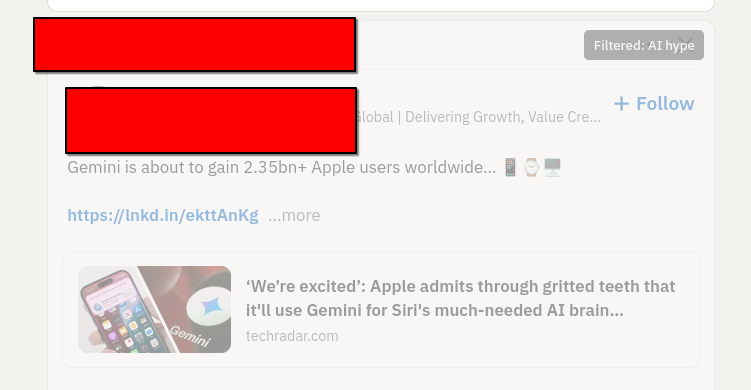
    screenshot of extension working

    I've pushed the whole thing to GitHub, if you're interested enough to peruse. I'm sure it still has plenty of errors, but it works well enough for a blog post, and maybe well enough that I'll refine it into something a bit more useful. I haven't even tested it in chrome browsers.

    Now the only thing left to do is to write an hyped up linked in post about my little project, and see if it works on my own content!

    Learnings

    • browser extensions can be pretty cool content filters
    • LinkedIn is great, but it sometimes can get a bit vapid.
    • Anyone who's still telling you code generation assistants are just autocompleters that don't actually work is probably uninformed
    • free local LLMs can do short text classification work very quickly with modest hardware
    • I like claude, but I get most value from using it from a mix of clients
    • Zed is pretty neat, if you're at all zed curious, I say .. do it.
    posted by cms on
    tagged as
  2. I Asked AI to Rebase My Git Branch and Accidentally Discovered the Future (and Uncovered the Past)

    One of the things I initially missed most, when shifting from emacs to zed was magit, which has been my main git interface for IDK, let's say about 20 years 🤷.

    I'm a bit of a sloppy worker, but a meticulous git user, lots of atomic annotated commits, many linear branches, I'm cherry picking and rebasing, and stashing, and magit integrates all of this naturally into the normal flow.

    Zed has git integration, obviously, but it's entirely basic - pull, push, commit, branch, diff, that's about it. It does let you stage incrementally, which is most of the problem solved, and of course, there is a terminal integration, so you can pop a shell and use git CLI (like a farmer 🤪).

    It's OK, but clunky, obviously. A little bit of friction and dissonance in this slick world of modern native editors that were actually made this century. I think the kids are a lot looser with git than I am, and perhaps they have a point, but I like the discipline.

    Here comes the machine mind

    You probably figured out what's coming next, if you bothered to read this far.

    I've been using the zed LLM integration to write commit messages for a while - it's pretty well suited to that, given a bit of context, you can generate a draft commit message that summarises the changes, and it's you tweak and approve them before you apply. It's a pretty good example of the kind of low-hanging, small improvement, you can achieve with even simple model, precisely applied to a narrow context that involves generating prose. Smoothing out busywork.

    Obviously, zed is pretty agentic 🤢, because that stupid word is all the rage these days. I guess you can open a chat box and ask your editor to vibe code your whole application. (Good luck with that, if you do, I think that's liable to create more work in integration than it saves in writing, maybe that's just me)

    I use the agents for a bit of boilerplate here and there - refactor this, replace these magic numbers with proper constants, redo this part to use an iterator, what is the type checker complaining about here, how do I configure the language server to disable a misfeature, again, it's not too bad at doing think kind of drone effort, and there is a small but appreciable productivity gain to be had.

    I cross the streams, and surprise myself

    This last week, I was suddenly inspired to cross the streams, and something interesting happened, surprising me enough to bother drafting a post on the topic. I don't really like to thought-leader, but occasionally something will delight me enough to want to share.

    I wanted to tidy up a messy WIP branch that collected a couple of different ideas in progress, (and had also coincided with me correctly figuring out how to enable auto-linting in zed, so I suddenly had a lot of aesthetic formatting corrections dropped suddenly into an already untidy sandbox)

    A minute or two fiddling with rebase in magit, but in zed...? Time to roll up my sleeves, and flex, and take out the ol' git pitchfork, or hitch up the rebase propagator to the reflog tractor (I do not really know what farmers do). But, wait. I wonder if...

    So I pull up the agent and ask it "can you run an interactive rebase on this branch please, and group all the white-space only changes into one commit, the other formatting changes into another, and then separate the removal of the obsolete class from the other feature work?"

    And, it kind of worked! It got stuck a couple of times, and I had to pop in and edit a couple of things, and I restarted it over with the order of the commits I wanted a little more explicitly instructed once I recognised where the conflicts were going to land, but I got the result I intended, certainly with no more fiddling about than I would have had to do if I'd been performing the task manually, maybe less? It's hard to measure, but I enjoyed the experience.

    One thing I definitely realised. It was less irritating. I was able to complete a disruptive, yet necessary chore, while in the middle of doing something more interesting, with much less context switching than performing it manually. And that got me thinking about interfaces a bit more. Chat bots are unquestionably a very ergonomic interface.

    Increasingly, I am starting to think that a key part of unlocking the value of LLMs, may be through thinking about them more as solutions for interface design problems.

    Considering git interfaces

    Git is a classic case. Git's interface sucks space balls, everyone knows it. I mean I know a few people who like it, and I'm happy for them (but I think they are weirdos). It does allow for a bunch of studly machismo and nerd flexing, for anyone who has invested enough time in learning its arcana to impress people with stunt-git trick shots, and that can be fun. I have definitely enjoyed being the knuckle-cracking "stand back everyone and stop panicking, I know how to fix this" guy on a number of occasions, but that is a sideshow. You can do circus tricks with power tools, and some people do, but it's not the reason the tools were made.

    Git has a compelling storage model, and a commit graph workflow that solves a bunch of annoying challenges with incremental and concurrent code editing and integration, efficiently and better than previous source code version systems. That's why it became a huge success.

    Git's horrible ergonomics and implicit barriers to entry, but compelling powers of sharing and integration, allowed GitHub to spring into existence, as a multi trillion zillion company from out of nowhere, just by slapping a nicer set of user abstractions on top of git's ugly robotic core. (in the process accidentally inventing some other significant ergonomic problems, like pull request based workflows, and IDK, tag driven releases, but I guess that's a different blog post)

    Git's foul ergonomics are what pulled me into learning magit, which has a reasonably steep learning curve of its own, but also follows the emacs way of having a lovely manual. It's a better thought out UI. It also leverages many common emacs behaviours, so when you're working in emacs already, which I typically was, again, you get this reduction of context switching.

    The mythical 'Flow State'

    Why is this so important? At this point, it's tempting to dive off into a side bar about "programmer flow state", a long held shibboleth of the developer community about which I don't have much truck, but many thousands of words can be found about it on the web already. - I don't like anything that reinforces programmer identity as a higher state of being, and I dislike how easily this concept is weaponised towards shunning collaboration and social work (e.g. "coders must not be interrupted during holy flow state") , again this is clearly a different adjacent blog post - but the notion is not fundamentally baseless.

    Programming tasks often require holding a lot of accrued context about a chain of thought, and carefully expressing those in a narrow, precise domain, incrementally progressing towards a well defined future state. It's not easy for a human mind to do that, it takes a bit of effort. Effortlessly breaking out of one domain into another mode of expression isn't really possible. To do that even passably well, perhaps you would need a different kind of "mind", even?

    I think version control is interesting here, precisely because it's liminal stuff. It's programming-adjacent work in a certain sense, it's a chore - any time you have to break thread to address some version control nonsense or busy work, you are in essence interrupting yourself. It makes a lot of sense to try and find a low friction simplified user interface to mediate these kind of tasks. Like GitHub, or magit. The ideal is to minimise the amount of disruption you face while working on these background or side channel threads of work. You can mitigate against this in two main ways I think. You can look for ways to simplify the UI to better suit a particular working context, as we have been discussing; alternatively you can divide the work and make the secondary context a first class task that's managed separately.

    One way to do this is to structure the way you work so you can plan your version control stories a little ahead of time, and use discipline in your task management to make it better fit onto the VC, with strategies like formal branching and ticketing protocols, rigorous task mapping that accounts for tech debt, probably integrated into a project management system.

    Another way you can do it is to make it literally someone's job and push the load out sideways - examples of this might be code review protocols, gatekeepers for merges (in the olden times, with less sophisticated version control software, I've often worked on teams where there was a nominated 'merge master', whose entire job, or a large portion of it would be to basically do the integration and harder version control work on behalf of the feature developers), also other adjacent roles like scrum masters, or DBAs.

    How about SQL ?

    That train of thought got me thinking about SQL. I think SQL is another interesting example of 'programming-adjacent work', although it might be a bit more subtle of an example than it first appears. Let's have another digression then. I really like SQL, although it's obviously covered in warts and sharp edges, I've always appreciated it's utility, and to a certain extent it's ergonomics. It does share some of the properties I've discussed with git - it's very often a boundary, and context shift away from the main thread of programming, and programmers tend to hate it, and like to avoid it, and make up nasty memes about it for slack, and that kind of thing - just like version control (or meetings 😘), it's essential and necessary work in a lot of software development, but it's another liminal place, where you have to get pulled out of the context of thinking about your feature work, and software architecture, and land in another place for a while with an annoying external syntax, and a lot of aggravating round trips into different tooling.

    Indeed, over the years, a very common programming pattern is to try and slap a more program-ergonomic abstraction layer in front of the SQL, once again to try and minimise the friction and narrow the interface - I'm thinking of things like various ORMs, 'noSQL' database engines that bring the data modelling and querying closer to the application layer, all of them moderately successful, and yet SQL still hangs around everywhere, slightly annoying everyone, like a remote senior cousin inevitably invited to every wide social gathering, tolerated, rather than enthusiastically invited.

    That's because SQL is already an ergonomic abstraction. It's kind of the ur-DSL. SQL is there because databases have a lot of inertia associated with them. All the data is often where the money is. Data is the raw stockpile of materials, the raw ingredients of the information that's necessary to run large information technology applications. Data tends to accrue value cumulatively, and you want to keep it all in a big lump in one place (this is why we have terms like 'data-mining' and 'data-warehousing'), so you can correlate it, and leverage sexy network effects from having it all integrated into one humongous data domain. Once you pass a certain critical data mass, you need to access it multi-modally , i.e. there will be many different use cases for the same information sets, different users and different applications will emerge from, or require access to, various intersectional pieces of that data blob. Now, reading and updating that data blob by hand, in your preferred programming stack would really sting. You'd still have to leave your application software context, but you'd now need to delve into a world of low level file systems, and data packing, and indexed data access, and write locking, and concurrent editing, and wire protocols, and cache invalidation, and the whole nine yards of that side of computer science.

    I pause a little here, because I realise I'm probably making it sound kind of fun to a particular audience segment (amongst which I include myself, periodically), but let's not lose track of the core point. If your intended task is to make a cool dating app that helps your users get laid, low level storage systems coding is a horrible, high effort context switch away from the feature track you're working on. And of course, all this data access code you're having to do while you go will also need tracking in your version control system, more context switches. Instead, we SQL.

    LLMs suck at SQL though

    As an aside, I have found LLM coding assistants to be generally pretty bad at SQL writing. I have two hand-wavy personal theories about why this is the case

    1. Programmers, on average, in my experience are really pretty bad at SQL, probably because of the reasons we delved into above. So the training set of the models is full of low quality material. (cheap shot, maybe? 😅 Cut me some slack, I've spent many hours of my life fixing other people's bad SQL)
    2. Effective SQL generation requires a lot of external context the model doesn't have - not only the entire database schema, but also ideas about the data contents, and distributions that a pre-trained model doesn't necessarily have any access to. I think getting good SQL results from LLMs would need a lot of context prompting, or specific training. Still doesn't entirely explain why they're so bad at basic join syntax.

    I'm tempted to infer something from those two sub-points about SQL requiring fundamentally different kinds of reasoning to other forms of writing, but I'm probably just seeing the face of Poseidon appearing in the patterns of my mental sea foam... I'll leave it there for now. (a third parallel blog post? This stuff is getting fractal). BTW - The name for that fascinating phenomenon is *pareidolia* , and it's something worth keeping in mind when discussing "AI" concepts...

    The surprising invention and nature of SQL

    Ahem... Another really interesting aside is to have a look back at the history of SQL. SQL is rather old. It's basically my age, and I've already pointed out I've been using emacs professionally for at least a few decades. SQL emerges from IBM in the 1970s, as a research project, greatly influenced by E.F. Codd's classic article 'A relational model of data for large shared data banks'

    The primary designers of SQL were Don Chamberlin and Ray Boyce, part of IBM's system R research project, who were tasked with looking into ways to apply Codd's relational / mathematical principles of database modelling to IBM's database businesses. IBM's database business at this point was most of IBM's business, and IBM's database business was pretty huge. Prior to relational databases, the existing big iron database management systems were awkward weird transactional / hierarchical databases, like IMS/360 where you pretty much had to write a specific computer program to be batch executed from a queued transaction management system. Each 'query' was more akin to an independent program. In order to change the report, you'd develop a new program, and you would need appropriate programmer time and skill to do it, and your best turnaround for results would be several hours, probably more like days.

    So the system R researchers wanted to make this more flexible, but their ambitions didn't end there. Chamberlin and Boyce wanted to make information retrieval accessible to non-programmers. Here's Chamberlin

    "Ray and I hoped to design a relational language based on concepts that would be familiar to a wider population of users. We also hoped to extend the language to encompass database updates and administrative tasks such as the creation of new tables and views, which had traditionally been outside the scope of a query language.[...] What we thought we were doing was making it possible for non-programmers to interact with databases. We thought that this was going to open up access to data to a whole new class of people who could do things that were never possible before because they didn’t know how to program."

    Can you see where I'm heading? SQL is a frantically successful example of what we used to call '4GLs', (fourth generation languages), when I was a school kid, (although by that point, the text books - and what we didn't yet call the hype cycle - were already breathlessly excited by the imminent arrival of the Fifth Generation Languages, and systems...). The terminology is dated, and stretchy, and marketing-fed, but the central gist is - 4GLs are languages that were operating at a higher abstraction level. Your inputs and controls would describe a program at an abstraction level much higher than the operation of the system, and the 4GL would write a program for you that ran at the lower level. All a bit hand-wavy, but SQL querying has some really interesting properties related to this delegation.

    • it's declarative. Your query describes the data structures you want to retrieve, and the actual details of how the data is retrieved from disk is decided for you by a query planner.
    • it's live and interactive - you can interrogate the system interactively at a REPL
    • it's got a weird-as-hell syntax full of special cases that tries valiantly to use ENGLISH LIKE words, all IN UPPER CASE SHOUTING that deal in terms of database structures and relational operators, not computer terms like bytes and loops and sorts.

    The query planner is worth a little thought - The query plan uses a bit of maths, and some heuristics and a bunch of information and sampled data about your system, and works out a series of reads and sorts and filters that produce the data structures your query is requesting. Crucially you don't tell it HOW to do it, just WHAT you want it to do. (sorry, the upper case is a bit addicting, I'll stop). Most of the time you don't think about it too much more than that. However, most SQL database systems will show you their plans if you ask them, typically by using the EXPLAIN keyword, which will show you what the planner thinks it should do to build the result set you wanted. If you don't like what it's decided you can't tell it to do things differently, but you may teach it to do things differently, typically by updating the available indexes and constraints, or maybe by re-balancing the statistics it uses to decide about cardinality and seek times, and that kind of thing.

    Here again we have a division of labour - the idea is that the structural and statistical and optimising and runtime bits of maintaining the SQL system can be delegated to the programmer and technician classes, who can be more concerned with the implementation and operational parts, and the query writer (a non programmer, if you remember) can just get on with expressing their tasks in a lower friction, narrowed domain, where they don't have to context switch out as hard from their task at hand, writing lovely business reports for the sales and finance teams to make slide decks from.

    Now I'm not saying that SQL writing is 1970s prompt engineering, but I'm also not not saying that, right?

    Here's Don again, after the fact

    "Ray and I were wrong about the predominant usage of SQL. Typically, SQL is embedded in a host programming language and used by professional programmers"

    Is SQL any good though?

    SQL was, as I have said, a spectacular success. It's still bloody everywhere, fifty years on. It was also an abject failure. The syntax is a mess of unaligned clauses with special cases everywhere (INSERT and UPDATE have such radically different approaches to clauses but sort of do the same thing. So does DELETE really). You need to understand maths to do it properly. You also need to understand the precise details of the database schema. The database schema is maintained in a separate dialect that's somehow intertwined with the querying DSL and uses the same interfaces, but again obeys a different syntax and semantics. Record locking is both implicit and explicit. The concurrency model is insane and nobody actually understands it properly. NULL breaks everything including query logic. And most damningly, it's never used as an interactive REPL by non-programmers. It's folded into programs mostly. In fact these days, an eye-wateringly huge number of applications bundle an entire SQLite embedded RDBMS inside their application deployment.

    Repeated interface patterns, and why I care

    There's a pattern emerging here I think - querying and reporting wasn't quite entirely programming adjacent busywork, but it was business-adjacent drone work, and SQL was an attempt to narrow the interface with an ergonomic DSL that got out of the user's way and reduced the scope of the context switch needed to engage with the reporting system. It kind of failed at the interface, if you ask me (and most folks who have to use it), but it did succeed amazingly at reducing the complexity of the context switch. Using SQL to mediate data persistence inside your application is kind of like using magit to fold your git operations right inside your emacs workflow, they both serve to shrink down the cost of flipping out of your primary task domain, into some other essential, dependent domain.

    Either reduce it to a tight DSL, or extract the work and organise it so it can be delegated to another worker. Sometimes, you put a DSL on top of a DSL, to tune it down even further. Sometimes you build a team to own the work in this domain. What if you build a DSL over a DSL but the DSL could sort of work like a team you can delegate tasks to? That's a compelling interface, that is.

    When I look at it like this, using an agent REPL in zed to run git operations strongly reminds me of that (failed) SQL/4GL promise. I tell the thing the result I want from it, and it builds a plan of execution, and I can iterate on that, interactively. Only this time, I'm using literal English sentences to describe the narrow domain the system has trained itself on, not some bastard awful pidgin version of it, that somehow ends up with the worst features of both natural languages, and programming languages. Sorry SQL, it has to be said. And you know what, I kind of love you anyway.

    I think this pattern can be found in several places of software development, if you squint right. Programming-adjacent work gets reduced with DSLs or narrow abstractions, which bring the benefits of reducing that tedious, expensive context switch. I guess we have lots of it in CI automation, pipeline building, that kind of thing. DevOps is built out of this stuff, infrastructure as code, deployment charts, meta deployment charts, run-books, playbooks. These domains are also places I've found LLM-based assistants super helpful - help me grind out some yaml please so I can add a pull request pipeline that does this thing I just thought of, without me having to spend quite so much time reading up the stupid YAML syntax for this weeks CI system, and spending hours sitting in a push/fail/edit/push loop on some git forge. GraphQL over REST apis - maybe? Unit test generation and test harness design is mostly busywork in a DSL following some declarable constraints. I think I already mentioned figuring out the precise type annotations for things. It makes me think that coding-assistants are perhaps more of a user interface paradigm than they are a coding one. More like a 4GL than a semantic IDE.

    In conclusion

    What's my point? I'm not completely sure (he says after several thousand words)

    • I like zed, I'm finding it more useful than I thought I would, and I've stuck using it on and off for a few months now.
    • I keep finding small useful things for LLMs to do, and I enjoy that process.
    • The most value might be in 'programming-adjacent' things - e.g. as I mentioned, I'm now personally only writing a small proportion of my commit messages by hand, and I think my commit messages are considerably better off for it.
    • Tools that reduce the context switches for 'programming-adjacent' work will win
    • Conversational interfaces are very low friction for human minds.
    • LLMs are much better than humans at context switching to a different domain, while keeping track of and applying accrued context across different tasks
    • Is there something you need to do that applies a tight but boring DSL across a defined data set? A model might actually be quite good at that. Another weird thing I've found them almost spectacularly good at is networking and debugging - describe a topology, give it a tcpdump, and watch it spit out a bunch of diagnostic suggestions and potential remedies for you to use.
    • These tools are one of the biggest tech shifts I've seen in my rather long, slightly storied, career that spans a whole bunch of tech paradigm shifts.

    Summary footnotes

    1. This is just some opinions, inspired by how astonished I was to successfully use an "agentic" tool to run some gnarly git stuff I would have had to pull out the manual to do. There's all sorts of important discourse about LLMs and the out of control tech hype cycle around them that I don't go near, and I'm not writing a manifesto
    2. I'm not a historian, or a first hand witness of the pre-RDBMS data scene, although I did work alongside people who came from that background, so I do have a lot of secondary source exposure. I haven't done much research other than light web searching, so please take my historical characterisations with the appropriate amount of salt. I know pretty much zilch about how IMS/360 actually worked, I just remember the name, I'm generalising.
    3. I wrote this blog post by hand, it's not the sort of thing I think LLMs are much use at. I'm trying to express my own opinions here, in my own voice, because I was excited about a couple of ideas and wanted to try sharing them
    4. I wrote this blog post in emacs though.
    5. I probably won't write any of those other parallel blog posts, who has time to write blog posts?
    6. I did use Claude to fact check the post. Don't laugh, they can actually do that sort of thing now. This stuff moves fast.
    7. Finally, I feel I ought to note that Ray Boyce died tragically young at 27 in 1974, shortly after the presentation of the SEQUEL design paper. He left an astonishingly outsize impact after such a short career. Put a dent in the world, as they say. Don Chamberlin, happily, is still with us so far as I know.
    posted by cms on
    tagged as