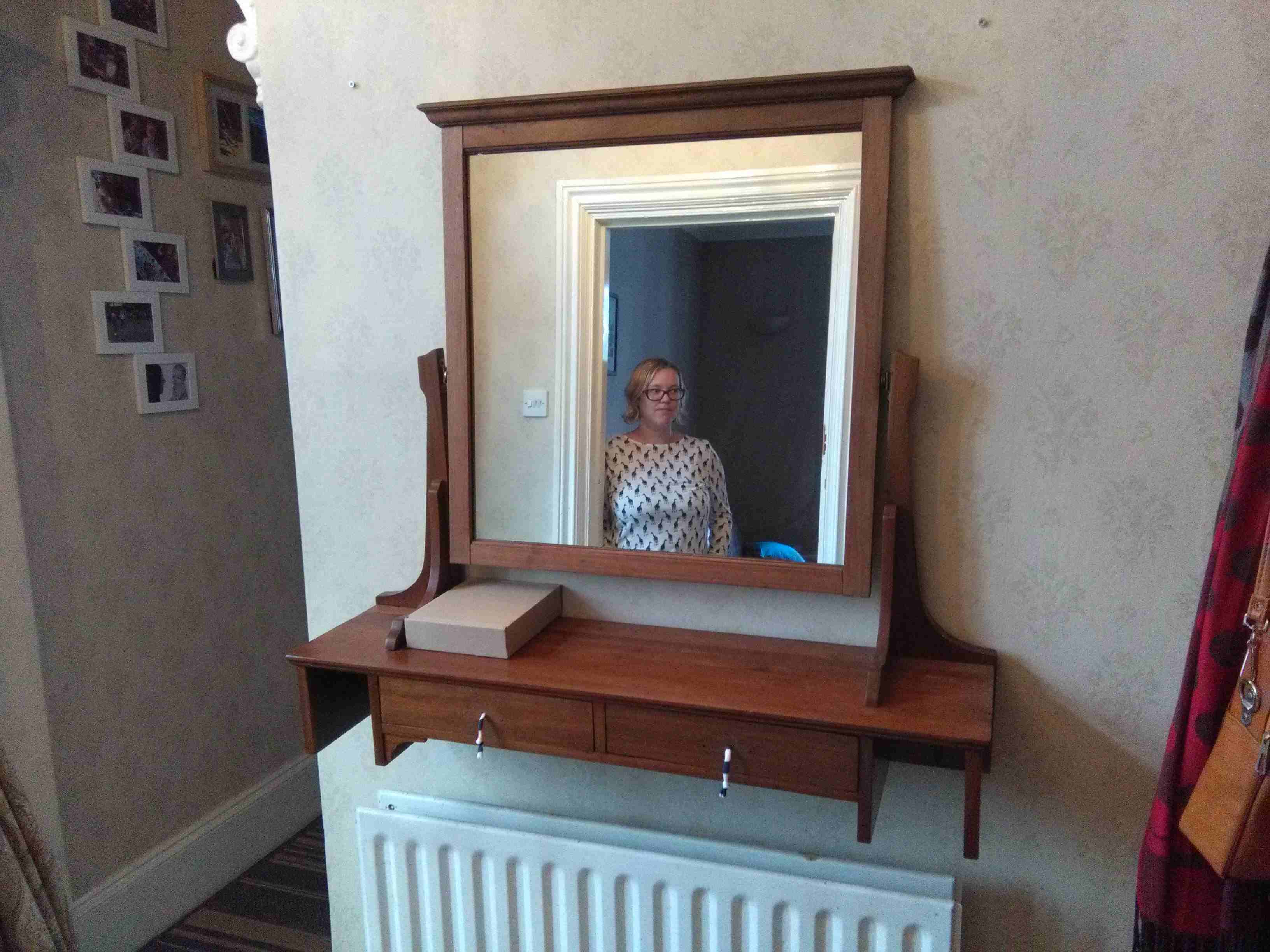
I was running out of space in the hall to keep spare hard drives, so I put up a hard drive shelf. In order to achieve this, I used the wrong screws, applied those to the wrong hammers, and then carefully glued them into the wrong fasteners. It is level. It is mostly being held up by the pliant wall fasteners acting as springs. I used my splendid Bosch-PSB 1800 , which performed its role beautifully, injuring nobody.
In November 1955, Bo Diddley was booked to play live on the Ed Sullivan show, the middle America's favourite TV variety show. As legend has it, he was booked to play a single tune, but he misinterpreted his cue card, which had his name, followed by a song title, launched into his, perhaps slightly racy for the times, eponymous calling card - "Hey, Bo Diddley!", immediately following it with the song he was booked to play, the only slightly more sedate "Sixteen tons". They tore the roof off the house, and got themselves banned from the show.
Here's a particularly rocking performance from 1965
That lady on the second rhythm guitar is known as The Duchess .
Not many musicians get to name their own beat. And in this case, it's a beat that refuses to die. Not many musicians can play it well, but that hasn't stopped them trying through the years. I put a playlist of the most egregious examples I could find up on spotify . There's some direct lifts, some re-interpretations, some slightly tenuous reaches, and hopefully some surprises. It's an editable playlist, so please feel to add any that you find.
I feel sure there ought to be a Spiritualized song in there, but for the life of me I can't find one from memory.
Once you get into the habit of spotting them, it's quite an addictive hobby. I find that I often only spot them a while after I've picked out a song as an earworm.
A pro-Corbyn Labour source insisted they were unworried by the 50% endorsement. "We have the backing of the more popular and successful UB40" they said. "Proof that splitters don't prosper".
If you find that your Mac's 'Open With' menu is growing cluttered with identical menu entries for the same application, this indicates that your Launch Services database is confused.
In the normal course of action your computer scans for entries to merge into this database at boot time, and then at login for the user domains. The Finder updates it with new application information, as and when new App or Framework bundles are encountered during it's normal operation. Unfortunately this database does seem to be capable of becoming persistently corrupted, which will result in symptoms like a duplicate-riddled 'Open With' menu, or incorrect or inconsistent Filetype/Application associations.
On Mountain Lion, you can interact with the system database from the shell, using the lsregister utility. Run it without arguments to get basic usage instructions. It is not on any default, paths, it's buried away inside /System/Library/Frameworks/CoreServices.framework .
/System/Library/Frameworks/CoreServices.framework
/Versions/A/Frameworks/LaunchServices.framework
/Versions/A/Support/lsregister -dump
will show you the current database in human readable form. To scrap and rebuild the database completely you might do something like this
The -domain argument there is specifying that we should recursively ( -r ) scan for bundle directories in the the u ser, s ystem and l ocal domains (i.e. "~/ /" , "/System/ ", and "/ " ) and register their document type bindings and other information with the Launch Services agents, which will update their database with this information. The -v switch turns on progress logging, which is all done to stderr.
If you're in the habit of installing apps or library bundles to some alternative roots than the builtin domain types, you can add those paths to the command, instead of the domain flags.
posted by cms on
Manga-Camera is a free camera filter iOS app. The intent is to render live photos in the style of a manga action frame. You pick a background effect and then snap. There doesn't seem to be a way to apply the filter to library photos, you have to shoot live, which is the way I prefer these gee-gaws to work. It takes a little practice, but I found the results can be entertaining, and occasionally even a little convincing.
A-list iOS developer shop Tapbots today released a remix of their excellent twitter client ( Tweetbot ), focused on tiny pay-subscription social network platform app.net . I think Tweetbot is probably my favourite thing about my iPhone, and so I immediately purchased it. No obvious disappointments, all the slick performance I like is there, and it brings across some features I've been lacking in ADN for a while, like the ability to swiftly upload photos. I promptly celebrated by taking photos of every last.fm staff member with an ADN I could track down . I think this will probably increase my use of ADN moderately. Mobile is an essential component of gathering the off-the-cuff asynchronous status updates a service like this is built upon.
I'm not sure that it will gigantically increase my engagement with ADN alpha. I was a bit suspicious of all the frothy cliques, with an intangible unease that I struggled to define, at least until I suddenly realised it was a cogent reminder of the very earliest days of bootstrapping the IMDb message boards . That left me feeling more comfortable with what the thing was, but no more inspired to engage. I'm still in love with the idea and the ideals of the place, and I'm reasonably confident it hasn't yet fallen into it's proper, more useful place. I'm shallow enough to enjoy my sexy low user id on some level that even I don't properly understand.
Has App Dot Net "arrived?". I think not yet. Netbot feels like a threshold event of some kind, in as much as serious developers are prepared to put enough effort into the ADN platform to produce fully realised software harnessed to it, and this degree of finish does not come cheap. ADN seems to be on a little draught of second wind recently, there's been a couple of fun toy apps, some positive press, and the recent price drop, bringing a wave of fresh users in. I'm still very positive about ADN as a concept, an indicator that there's now a long tail of internet folk interested enough in paying for stuff to make services like this potentially viable. I won't be really excited about ADN until I see the first compelling application built over it that is some mostly new and useful thing, rather than a new skin on an old one.
It was never entirely my intention to go offline for such an extended hiatus. Even though the web is intrinsically brittle and ephemeral, I like to do my bit to keep my little backwater serving 200 OK s to the half-dozen people who stop by to check in regularly, and the couple of dozen who linked to something I put up at some point. It's basic web-citizenship as far as I'm concerned.
Before we went fully dark, I'd not posted for a long time already . And before that I'd slowed my posting down to something of a crawl. I think there's a few reasons for that. It's easy to get bored with blogging for the sake of blogging, especially in our current age where everyone shares profligately across many social platforms . It's fairly common to see blogs that have fallen into a recursion of no posts for months, then a post apologising about that, and then further disuse. I don't think this is one of those, but the proof is in the posting I suppose.
There's certainly been less time in real life for auxilliary pursuits like online rambling, and that's a big part of the reason. No time for any proper content posts, concomitant with a surge of alternative social platforms to play around with, meant it often seemed a bit redundant to post arrays of short-links , when I could just throw them up on twitter / adn / diaspora* / flickr / ello / imzy /whatever, with a bigger audience, and more interaction.
I was also feeling a bit self-conscious about standing up in public. After leaving last.fm (fairly amicably, as these things go, fwiw, albeit with a slightly battered heart), which felt like a fairly visible shift sideways, I was quite deliberately courting more obscure, maybe more unexpected job roles, and I remember feeling like I really didn't want to bare my thoughts to the internet judgement machine whilst I wasn't even entirely sure what I was doing myself a good deal of the time. Also busy! Young family plus startups really left little time for anything much else.
I also was really feeling the pain of Wordpress . I never quite managed to find an authoring approach to use with it that didn't make writing anything seem like far harder work than it ought to be, also because I always insist on self-hosting, the sheer weight of it for maintainence and security updates, and backups, and DBA -ing, and having to write PHP or perhaps even plugins to do the inevitable customisations someone like myself inevitably finds themselves suckered into doing. So Wordpress was a drag, which was feeding my reluctance to contribute much of substance. So I decided to pause on updating whilst, in true wannabe-hacker style, I whipped together some kind of alternative content publishing system.
I'll just take a paragraph out to stress that I actually admire WordPress a great deal. It's a very sophisticated and flexible web platform, and a great choice for site management, in either managed or self-hosted configuration. It kept this site ticking along for years. It just isn't a particularly good fit for my requirements, which are extremely simple
I thought about using another off-the-shelf blogging system, which would have been the sensible route, but I figured that would just lead to a similar frustrated stalemate. So I started to sketch out an application that would allow me to quickly fling out tagged and dated content without much overhead of hosting or writing. And I carried on intermittantly piecing this app together, often on trains, for a couple of years. As an exercise in procrastination, it worked out better than I expected, and I carried on posting short content to twitter and others, reasonably happy to continue to defer the responsibility.
But then the site went dark. I was hosting it all on a linode instance. I've been a very enthusiastic linode user for perhaps ten or more years, I think they have an excellent product, offering well-provisioned VPS instances , inexpensively, with an easy to use management site. Generally I've been very happy with them to date.
This changed somewhat last year, and my confidence deflated a little. There was an extended outage of service across linode in December 2015 , apparently as a result of a targetted DDOS . This lasted for many days, and the communications about it from linode were muted and suspiciously vague. This isn't really what I expect from a first-tier ISP. I came away with the impressions that there were some significant architectural problems with their infrastructure, probably from acrued technical debt , and potentially some exploitable vulnerabilities in their public facing application software . I decided it was time for a change.
I did some reasearch and rented a couple of new hosts. This time I've gone for low end, physical servers. This represented another procrastination opportunity, because when I originally set up the beatworm.co.uk linodes, almost ten years ago, I just hand configured everything by remote shell. Now I like to use the ansible configuration management system to set up hosts, and I took this opportunity to port my public infrastructure across to use repeatable playbooks. This turned into another major yak-shave , because there was slightly more to it than just a WordPress deployment, I was hosting mail, calendars, media streaming, IM, DNS, the works. After getting lost in this tarpit for a couple of months, I decided to move the application tier over to use the playbooks from the sovereign project , which covers much of the same ground, but is already written, and uses more modern components. Of course it wasn't entirely straightforward to integrate these plays over my existing base provisioning, and I ran into a couple of glitches and gotchas with some of the choices they'd made for configuration, but it only took a couple of weekends worth of fiddling to get it all running in a fairly acceptable shape. I moved the DNS across, at which point the wordpress site was left behind, and everything went dark.
I was surprised at how much this bothered me.
I like an outlet for sharing things. I enjoy the idea of having a stable internet identity . I don't like the way the modern web has folded these ideas into a handful of consumer products run by just a couple of corporate gatekeepers. That's not the web I grew up with, and it's not the web I want to see either. A very loosely federated ecosystem of ad-hoc resources, all mixed together as hypermedia, aggregated and accessed via an assorted bag of user-agents. That's how it works best . I like to write, because I like the practice and discipline of working toward articulating my thoughts for a general reader.
I like being able to curate an archive, and keep control over how that information persists and is presented. This is hard enough to do when you have primary jurisdiction over the medium and material (there is plenty of bitrot on view in my archive, particularly in the really old material, which has been migrated across multiple publishing platforms now), and basically impossible if you're relying on a third party service, which periodically re-invents itself to better serve it's own objectives, which are only ever to be tangentally aligned with your own, at best.
I don't like the sense of obligation I get from formal social media platforms. There's a subliminal sense of pressure to perform, to update, to observe the conventions, to consider and measure the implied audience. I'm not a joiner by nature. I just end up gently resenting the throng. I like to feel like I have a voice, but I don't want, or even expect to reach, an automatically provided audience.
So, I picked back up my now-neglected website platform experiment, and knocked it together enough to get an MVP out of the door. It serves HTML over HTTP. It has a relatively minimal set of style rules that should allow it to work gracefully across various screen dimensions. It has rudimentary support for RSS ( not that many people use newsreaders any more ). It's simple to run in a staging environment, and I can write posts in plain text in emacs , and edit and post them without much extra grief. It's only got about 22% of the functionality I had originally planned, but I feel the urge to ship it, use it, and hopefully I'll refine it in production.
There's a couple of interesting quirks to this new hosting setup. It's an ARM -based micro-blade, hosted on a scaleways C1 . The blogging software is semi-static , in as much as it serves generated content from the filesystem. It's written in common lisp , and deployed in a different lisp to the one it's developed on There's no frameworks (aside from using zurb foundation classes to base the CSS). There's no database. There's no comments, because I haven't yet decided on a productive way to support them.
If you've ever tried to take over somebody else's detatched screen sessions, by using the su command to assume their login identity, you've probably seen an error message something like
Cannot open your terminal device /dev/pts/3
This is because your pseudo terminal device is allocated when you login to the session, and remains owned by the user id you logged in, after you've changed your effective uid by su -ing.
You can try and kludge your way around it by chmod -ing your pty device file to make it more arbitrarily readable, but that's ugly and stupid, and needs escalated privileges. A slightly smarter way to work around this is to force a new pseudo terminal for the assumed login session. A really simple way to do this that I've recently discovered is to use the script utility. script is a useful tool intended to preserve a transcription of an interactive terminal session. To do this, it creates a new pty device for the current user id. So you can use it to help you recover a detatched screen by typing this
su - someuser
script /dev/null
screen -r somesession
Passing /dev/null to script just means that the transcript is discarded.
I already mentioned in passing, St. Vincent , the band-shaped solo project brand thing of the super-engaging Annie Clark, was by far the best act I saw at Primavera Sound 2014. It was also the act I was most looking forward to seeing going in, it’s always nice when those line up.
I guess I’m a super-fan. I first spotted Annie playing with Sufjan Stevens ' touring band. I next encountered her playing solo support for the National , touring her first St. Vincent release , upon which occasion I bolted out of the auditorium by the third song, in order to make sure I got a copy of the CD she was plugging from the merch stall before she packed away. I saw another couple of shows in Bristol, with the full band, and bought all the records, including an interesting collaboration with David Byrne .
Last weekend, while idly browsing the Glastonbury live blog, I noticed that they’d just updated their description of the current iPlayer feeds to include St. Vincent streaming on the iPlayer from the park stage. I’d been avoiding the Glastonbury video feeds due to a combination of not being in the mood, and the dullness of the tv schedules, but I wasn’t going to miss out on this, so I whacked it on the TV. True to form, it was a great set, live, risky, and peppered with amusing crowd-surfing and hat theft . Even with a bit of sound problem, and some streaming glitches I enjoyed myself, and was amused to see my enthusiastic tweeting duly included in the Guardian live feed on the next page refresh.
“ That was a really good set ”, I thought to myself, afterwards, “ but it wasn’t nearly as exciting as the Barcelona one. True, that lacked crowd invasions, and nobody lost a hat, but the lighting, and the sound, and the staging, and the lack of daylight, and the crowd being really into it…A pity there’s no TV-broadcast quality stream of that night archived away somewhere ”.
Yes, I do really talk to myself like that sometimes. Especially when I’m pretending to transcribe my inner voice for a blog.
And then, I ran into this on Youtube.
Full set, multiple cameras, properly mixed sound, pretty good video quality. I have not yet watched it enough times to see if I can see myself ( front of house, stage left, VIP pen ) in the crowd, but I expect I will.
It's not exactly the done thing on today's web, but I'm a huge believer in paying for web services. I've never been comfortable with the ad-supported web. When pure advertising is the only revenue stream supporting a product or service I worry about the deleterious effect upon that product or service.
I don't like the implication that they're really working for their sponsor's interests ahead of mine. I don't like the mental effort of hunting down all the opt-outs, of second-guessing potential consequences of the creepy data-mining and covert information sharing with networks of 'trusted partners'. More straightforwardly, for many cases, I suspect the numbers don't really balance; I find it difficult to rely heavily on something with a potentially precarious revenue stream. I don't want to push too much content into, or build infrastructure around things that won't necessarily be around in a year or two.
Paying directly for things makes everything seem more explicit and straightforward. I'm the customer. I can make informed decisions about the cost and usefulness of the thing. It's in the better interests of the service provider not to abuse the relationship. A product unspoilt and unhindered by commercial marriages should stand a better chance of evolving towards it's essential form. So I'm a relatively easy sell as a consumer. Offer me a useful service, at a reasonable price, and I'm quite likely to pay you for it.
The flipside of this is that I'm really cautious about the reverse. Purely ad-supported sites, especially ones that seem to be offering far too much for free without being noticeably saturated with advertising make me feel slightly paranoid. I like to see which way the money flows.
Here's a list of the sort of internety things I currently pay for, and will happily endorse.
Spotify - I'm a long-time tenner a month customer. I think it's too expensive, but I somehow never quite unsubscribe.
DynDNS - I have a paid account, which gets me DNS zone hosting as well as a dynamic hostname
Pinboard.in - I like this bookmarking service. I was a very early adopter, and therefore my account cost a pittance due to the unique way pinboard is funded.
Lastpass - I like this service so much I subscribed, just to do my bit to ensure they stay in business
Linode - my internet hosts are linux virtual machines hosted with this service. Linode is excellent.
Word Podcast : I subscribed to the (now sadly folded) Word Magazine, primarily to access their very enjoyable podcast.
Metafilter : I don't use this site very much any more, but back in the old days, I got so much surfing out of it, I eventually bought a paid account just to contribute back.
Reddit : Similarly, I bought a founder Reddit Gold account when they appealed for cash, because I really enjoyed Reddit back before the eternal September.
iTunes : I use iTunes for quite a lot of things, apps, movie rentals and purchases, music purchases, and I have an iTunes Match subscription. If you have enough Apple gear to make an 'ecosystem', it's a good service.
Amazon Prime : I love Amazon. Some days, I wish I still worked for them.
App.net : - I signed up for an app.net account the second I heard about it.
It's not a huge list. I'd like it to be larger. There's whole categories of things I'd probably cheerfully pay for should they exist. I'd pay a subscription for a decent search engine that wasn't a front for a creepy advertising juggernaut. I might pay for a subscription 'social' network, maybe something like a family-focused Yammer . I'd love something like a cheaper netflix that just focused on pre-1960s movies and archive TV. I'd like something like the old programming.reddit or hacker news. I'd love a smart news aggregator, and if I can't find one to pay for soon, I may have to invent one.
In the olden times, there was a lot of talk about internet micropayments , and about how they couldn't possibly work, or how they were imminent and essential to safeguard the future of the web . They never really quite happened, and the shiny allure of the internet as a huge content pipe of free everything triumphed over all, but lately it feels to me like the mood is perhaps shifting a little.
People seem to be wising up to some of the privacy considerations of infinitely free stuff that is only ever paid for covertly. The mobile app store culture has engendered a user community more acclimatised to fee-paying for services. Kindle is powering a minor revolution in self-publishing . Finally, there's Kickstarter , which is perhaps the most interesting current development in internet financing.
There's nothing particularly new about the thinking behind Kickstarter. Through a combination of great execution and timing, it seems to have hit critical mass over the last 12 months. In the midst of all the long-tail nerd-bait (I recently signed on for my first funding ) and snake oil there are signs of some interesting funding efforts converging towards the mainstream. Champion self-publicist Amanda Palmer recently powered her project past the magical $1,000,000 mark, to flurries of 'old media' press interest.
App.net is a manifest demonstration that I'm not completely alone in this line of thinking. Launched slightly before twitter's recent frantic, shark-jumping, repositioning of it's terms of service , it seemed a futile, quixotic gesture when I signed up to fund it on it's kickstarter-esque ( apparently kickstarter's TOS precludes funding things like ongoing businesses, so they rolled their own thing ) signup page . I fully expected it to fall short of it's goal, but maybe pick up some positive news coverage as it flamed out, much like Diaspora did before. To my surprise it charged past the funding target ahead of the deadline, and closed way ahead of the target figure. Since then, they've launched the API, and built a sort of twitter clone built across it at alpha.app.net , which is busy enough to be an almost useful, slightly cliquey chit-chat network of it's own. It seems like app.net has the potential to self-host itself as at least a niche social network for privacy nerds and web developers. For some, that might be good enough, but I suspect the real power of app.net lies within it's potential to become a kind of ad-hoc real-time message bus for higher layered services over it's API. It remains to be seen if it can gather enough developer / user mindshare to deliver on the potential.
The most high-profile campaign I've yet seen is the Penny Arcade Sells Out . High profile, high traffic funny-picture sites are the gold-standard of high volume ad serving, with content that massive audiences enjoy, but are used to reading for "free". Although they fell short of their more extravagant targets, including the 'complete ad removal', they hit their funding target, and raised half a million dollars. An A-lister website demonstrating the ability to generate competitive income with top level ad-sales entirely from direct user funding? Nearly. Is the tide turning? I don't know, but I can feel it pull.