I love making New Year's resolutions. I'm not sure I am good at them, but I enjoy the tradition. Every year, I tend to set at least a small handful. Sometimes they're entirely private, sometimes I publicise them. I don't know that they ever tend to be that successfully realised, but to me that's part of the system. I like to think there's much that is useful to learn from how I fail to achieve them, and maybe that's some part of the benefit. Sometimes I pull them off with aplomb, and that always feels pretty good.
This year I set myself an extraordiary reading challenge. A couple of years ago, on some kind of whim, I think prompted by a positive review in either The Guardian, or Word Magazine (RIP), I purchased, and read Lives of the Novelists by John Sutherland. This is an engaging biographical chronology of the English novel. It covers 294 novelists of significance in historical sequence. The format is readable, there's a 3-4 page potted biography of each author, and then a short summary. So you end up with a sort of illuminated canon starting in the seventeeth century, and leading you up to the roughly present day. The author choices are not always obvious, but neither are they deliberately obscure, and the tone is light, cheeky and erudite, and it works as an entertainment just as much as a reference piece, I unreservedly recommend it.
Part of the summary notes at the end of each chapter, suggests a Must Read Tome, for each writer. These themselves are not always the most obvious work, and carry a little paragraph of justification alongside the choice. So for 2017, in a fit of optimism, alongside a grab-bag of other self-improvement goals, I decreed I would attempt to read every MRT in sequence. Clearly this was an overreach going in. 294 books is approaching a novel a day, and I was unlikely to chew through all of them in the year, but I figured I could keep going with it and see how well I did.
We've passed the halfway mark now, and I'm happy to report it's going awfully. I have managed four books. The most recent one is not even half-finshed. I guess I kind of suck at this. I think there are a couple of mistakes I made on the surface. One I have already skirted around - it's too big a target. Factor into that the fact that I have relatively little spare time for reading fiction, and I also decided to take on a pile of other resolutions that demand daily hobby time (I'm teaching myself a foreign language! Badly!) and it's even more daunting a target. One book a month would be quite a feat, if I'm honest.
I think I might organised little potted reviews as I finish each book, to try and gee myself along a bit. Also, I made a resolution to do more blogging in 2017. That's right, does it show? Book reports seem like easy-reach fruit. Watch this space.
Perhaps the most egregious error though, was to fix myself to the chronology. Whilst this means that I am starting out firmly in the lands of the copyright expired public domain, which makes legal book aquistion very economical, it also means that I've front-loaded the material with tough going books. We start out with challenging archaic language, and structure, and this makes an already sluggish project a little more slower going. I don't believe in changing the rules midstream, however, and I intend to persist.
I thought I'd broken the back of the slightly-too-hard-to-read-comfortably years, when I got through to Defoe, but I hadn't taken into account another pitfall of the early romantic novel. Verbiage. After Defoe I get Samuel Richardson. And the MRT is Clarissa. That's nine fricking volumes of epistolary marriage plot. It might be the longest novel published in the English language. I've nearly finished book one, and it's taken me three months. I sincerely doubt I'll get through this bugger before 2018. It's fascinating, heady stuff though, I am enjoying it. Many tribulations, and archaic mores. A terrifying insight into the political lot of even the priviliged eighteenth century englishwomen. Also, much swoon.
Could this be a ten year project? I'm not quitting.
I was running out of space in the hall to keep spare hard drives, so I put up a hard drive shelf. In order to achieve this, I used the wrong screws, applied those to the wrong hammers, and then carefully glued them into the wrong fasteners. It is level. It is mostly being held up by the pliant wall fasteners acting as springs. I used my splendid Bosch-PSB 1800 , which performed its role beautifully, injuring nobody.
A pro-Corbyn Labour source insisted they were unworried by the 50% endorsement. "We have the backing of the more popular and successful UB40" they said. "Proof that splitters don't prosper".
One of those things I generally expect to be part of the routine of running a linux desktop is a certain amount of manual effort necessary to keep things running smoothly. Sometimes this is the classic multi-decade horror story of "sound card" configuration. Sometimes its the inevitable friction between under-specified hardware and volunteer-maintained drivers. Sometimes it's the CADT principle, where everything changes around you, just because it can, as part of the generational cycle of collaborative software development. Sometimes it's just the self-induced consequence of having a system where you can tweak and configure everything to work however you'd like it to, and therefore you choose to, and sometimes that's quite a deep rabbit hole. This tale covers a small handful of these categories, although it's primarily a consequence of that lattermost case.
Mod life
Mod keys. Modifier keys, that is. Those would be the keys you hold down alongside other keys to change their behaviour. The most obvious and venerable of these is SHIFT. Hold that down and type an alpha-numeric key, and you generate a different character. With the alphabetical keys, you GET THE CAPITAL LETTER FORM. Other keys, like the numerals, get you punctuation. You may also be aware of the Alt/AltGr modifier keys, which hang around on most keyboards, and generally allow access to a different shift level, further symbols and accented characters. And then there's control, or CTRL. Maybe you know that guy as the menu-shortcut accelerator key, or maybe for a couple of shortcuts you might use in the shell, if you're a shell user. Actually the kids all call it 'terminal' these days, because that's what Apple does. And then they all use iTerm anyway, for I don't know why really but I'm sure it's great. Anyway, calm down Mac-loving readers, this story is about how terrible linux is, you're all wonderful. So CTRL in the shell - CTRL + C cancels things, CTRL + D ends a session. CTRL + A takes you to the start of the line. CTRL + E takes you back to the end. Assuming you're using a fairly standard bash shell. Those last two are slightly more interesting, and immensely relevant to this story.
Enter Emacs
They're readline bindings. Readline is a GNU library used to make command line shell editing a little more interactive. And because bash is the GNU shell, it uses readline by default. Those keybindings are the default readline bindings, and they work the same in any application that uses readline. Typically this means other interactive shells. These keybindings are taken from Emacs. Emacs is a text editor, that is to say it's an application for interactively working on so-called 'plain text' files. Not that's there's any such thing as a plain text file. Emacs is one of the most ancient, convoluted, complex, crufty, awkward pieces of software you're ever likely to encounter. It's one of the original fundamental components of the GNU system. You might say it was the standard editor. Emacs is also one of my all-time favourite things. So those readline keybindings we were discussing, are intended to bring some of the more capable text editing commands from the GNU text editor across to the GNU shell, making use of modifier keys. Emacs really really likes modifier keys.
Because Emacs is a very old piece of software, it's design was heavily influenced by the keyboards typically used on the systems of its time. Computer use was a lot more text and command oriented, and the large, pre-PC era keyboards tended to reflect this by having a large amount of mod keys and function keys available. Commonly cited examples are the MIT or symbolics lisp machine 'space cadet' keyboards, and the Knight keyboard. As a consequence of this emacs can understand a lot of different modifier keys, and has a UI that is organised around layering functionality onto different keyboard 'chord' operations. You really need at least two distinct mod keys as a bare minimum to get emacs to do anything useful at all. We already met CTRL a couple of paragraphs back, but you also need another key called META. Emacs uses them in fundamental, and interestingly composable ways. For example, you can move the cursor forward one position by typing CTRL + F, but you can move the cursor one word forward by typing META + F. It's powerful, and sort of intuitive once you understand the fundamentals quite well. Unfortunately, they mostly stopped making keyboards with META keys on them some while back.
Welcoming the X Window System to the fray
Now I am getting quite old, but I'm not ancient enough to have run emacs on pre-Internet era hardware. I did use it a little bit on 7-bit serial terminals, and limped along using ESC as a prefix modifier, like a farmer, but by the time I started really learning how to use emacs to any serious degree, I'd made the jump to UNIX machines using X11 as a graphical user terminal. Some of the UNIX workstations had a META key. Some of them didn't, but had a few other modifier keys. Increasingly, UNIX graphical workstation started to mean 'Linux and XFree86 on PC hardware'. Now IBM-derived PC keyboards don't have a META key and never did. The original PC keyboards didn't really offer many modifier keys, but by this time period, everything had mostly standardised on the 101/102 key IBM extended model archetype. This doesn't have META keys, but it does have a pair of prominent ALT modifier keys. And so, we begin to remap.
X11 is maybe one of the canonical reference points for design by committee. Fully intended to offer a portable graphical , networked user interface across a variety of dissimilar UNIX systems, it tries very hard to offer the broadest possible set of abstractions across similar base behaviours, trying to build a unifying API in all aspects. Screen dimensions and orientation, color model and layout, pointers, input devices, key-types, you name it. So you can usually configure your equipment in a bewildering, verging on frustratingly flexible manner. X11 is a very broad church and welcomes all kinds of keyboards. X11 allows you a whole byte for modifier keys (I think), so you can have Shift, Lock , Control, and then five others called Mod1 through Mod5. You can freely map key codes onto key symbols, and then assign key symbols to one or more modifiers. So obviously this all took fourteen hours to decipher in the first instance, but I gradually became reasonably adept at using the Xmodmap utility to set ALT to be both ALT and META, CAPSLK to be another CTRL and life was mostly good. You'd tweak your .Xmodmaprc file every time your keyboard changed significantly, load it in as part of your login, and everything would work. PC-104/105 keyboards came along, with windows keys, and this meant that you could perhaps add a SUPER or even a HYPER key, and bind those to other emacs macros. The system was working, and everyone got rich on the proceeds! Or not. Nonetheless, although linux desktop software was fairly terrible, it was a fine environment for running Emacs, and running Emacs was where most of the work got done after all.
A detour into Macintosh
Times have changed however, and systems have changed, and uses have changed, and so have I. Like everyone else, I started using laptops more. Modifier keys started getting scarce again, as the machines shrank down to be portable, and interfaces just grew ever more graphical. For about a decade, I used Macintosh systems, which represent their own series of keyboard configuration challenges. Macs are actually pretty good for modifiers, if I'm being fair - they have their own dedicated command key for all the system key shortcuts, and so you're free to map control and option as you see fit to control and meta. They even give you a little GUI configurator for managing and assigning modifier keys, which is way more convenient than spending hours searching for information about xmodmap. The main suckitude is that they don't have a symmetrical set of them on their laptop keyboards. You don't get a right hand CTRL. Symmetry is important for healthy typing habits with key chords, because it's vastly better for your hands if you use both of them for combinations. So you ideally want to be able to hold down CTRLMETASUPER or some combination of them with one hand whilst you type the activation keys. So CTRL + C is best expressed as a right hand finger holding CTRL, whilst your left middle finger taps the C. So my life as a Macintosh Emacs user was constantly blighted by crazy-ass schemes to find keyboard layouts that allowed unstressful ways to type CTRL key combinations.
Desktop Linux in the present day
For the last few years though, I've been back on the linux horse (and why is a different story, for another day), and my main laptop, a battered lenovo ThinkPad, has a full set of three modifiers either side of the space bar, where they were intended to go. The Debian GNOME 3 desktop is configured to use the windows and menu keys for desktop commands, and the ALTGR key, which I have on the right, as some kind of compose prefix. Even thought it's X.org now, not XFree86, and Xmodmap is heavily deprecated in favour of the XKeyboard and Xinput extensions, using the GNOME configurator and then some of my old Xmodmap ways, I could make this go away, and map ALTGR to a right meta, ALT to a left meta and the windows and menu key to SUPER and HYPER. The lenovo x220 I use has a particularly excellent keyboard and all was right in the world.
And then GNOME 3.22 switched to Wayland as a display server, rather than X. And this year's Debian defaulted to this. Even though there is an X11 compatibility layer, GTK+ and GNOME on Wayland do not talk to X11 directly for mediated key events any more, and this meant that Xmodmap can't be used to universally set modifier maps. GNOME 3 on wayland will still use xkb for key configurations, and this meant another fourteen hours of fiddling about in order to come up with a keyboard scheme that works for both GNOME and legacy X using the XKeyboard extension (XKB). This was not made any easier by the fact that all the attempts to search for information on this get bogged down in legacy explanations about Xmodmap or how to enable XKB for X11. But I got there in the end
It seems like there's not actually any supported, or easily documented way to load user configurations into GNOME 3 + Wayland's XKB environment, so I ended up slightly disappointedly hacking them into the system options files. Of course this meant that several months after I did this, a system upgrade overwrote all of my changes, and I was left without a keyboard, and a scant recollection of how I ever did it, or what any of the bits were even called.
Finally I fix it
So this morning I figured out how to assemble it all again from first principles. To make it more worth my while, this time I decided to transpose all of the mod keys as I went, so I can have CTRL on the inside of META as it was originally intended to be, and push the other modifiers to the outside edge. To save myself the bother the next time this breaks underneath me, I thought I'd write down the exact sequences here. I am not going to try and attempt to explain XKB here. There are a several documents on the web that do that job, to varying degrees of success. I'm not going to pretend that I understand how it all works, I just experimented with xsetkbmap and xkbcomp under an X11 desktop until I understood how to express what I needed to work under Wayland. Here are the steps.
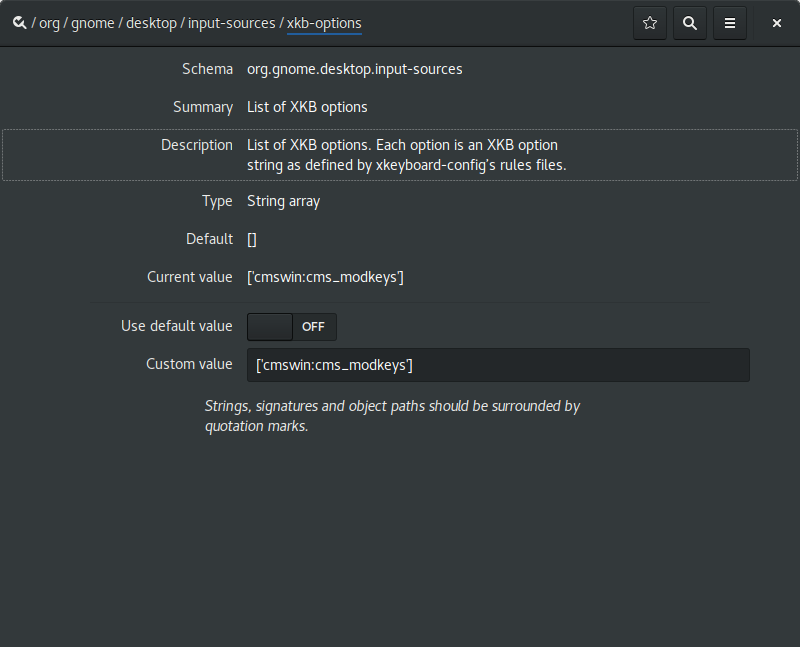
System-wide keyboard configuration is fine for configuring the basic keyboard layout - using the Debian keyboard configurator, I can pick either a ThinkPad or a pc-105 model with a gb layout. The modifier layout can then be selected using xkboptions. I can tell GNOME what XKB options to apply from its database, using the dconf configuration key /org/gnome/desktop/input-sources/xkb-options.
If you're playing along at home, you may have spotted that cmswin is not the name of any valid xkb layout. The wrinkle is that none of the built-in options offer quite the right set of combinations. So this is how I added my own custom XKB option.
1: Define an option
I added a new file usr/share/X11/xkb/symbols/cmswin to define my partial keymap.
Further to this, I modified /usr/share/X11/xkb/rules/evdev
adding the line
cmswin:cms_modkeys = +cmswin(cms_modkeys)
to the section
! option = symbols
I believe this is adding an option named cmswin:cms_modkeys to the dataset assigning it to parsing the 'cms_modkeys' entry from the 'cmswin' file, in the symbols subdirectory. The convention in xkb is to name all the different symbols using the same substrings, and it's terribly confusing when you're trying to remember which part does what, although slightly helpful when you're trying to perform the reverse map and locate which file is responsible for which option, I suppose.
3: Make it available for GNOME
The final step is to add the line
cmswin:cms_modkeys fix keys for emacs
into the file /usr/share/X11/xkb/rules/evdev.lst
I think this does something like import the option into the environment. There is also an evdev.xml file in the rules directory, which looks like it marks up the options to be used by the GNOME gui, but I didn't bother with that one, because life is too short to hand write XML for computers to parse, and I'd already spent half a day setting this all up. To give you an idea of how tedious this all was, for a while I'd added the evdev option into the section marked !option = types rather than symbols, and this caused wayland to stick to a crash loop as soon as I loaded the XKB option into the dconf key (with no visible error logs! yum!)
4: Retire, rich from the proceeds
With all of this in place however, everything works fine. For now. GNOME seems to be in a bit of a transitory phase with regards to keyboard and input configuration, it looks like they're reworking everything to use IBUS in the long term, so I expect I'll be doing some form of this dance again within a year. Until then though, this document can serve as a reference for the next time I, or anyone else interested enough needs to figure out how to do this.
2017 then, and nothing seems to have really changed that much at all. Desktop Linux is still terrible, and desktop linux is still awesome. Emacs is still terrible, and Emacs is still the best tool I have.
I've been very gradually upgrading this site back to life for a few years now. Very gradually #amirite . However, after earlier this year having found myself accidentally on the front page of Reddit, HN etc. with my post about building the IMDb boards , I found myself slightly embarrassed, not only by the amount of attention ( 40k+ uniques in the first two days, holy shit! ), but also by people pointing out how clunky the site is to read. Often several times a day.
The styling on the blog section, much like the rest of the blog section, wasn't in a terribly well developed state of completion. I just threw together some hand-written CSS to approximate the look and colours of my last existing Wordpress theme, which I had been fairly happy with. Now that theme was set up maybe ten years ago, and my initial port over to this 'new', self-build CMS maybe four or five years old itself, and I had given no thought at all to mobile, or in fact any screen device very much different from my own laptop display. And my main laptop display is a 1024x768 pixel non- IPS Lenovo ThinkPad x220. That is probably a significantly worse screen than your phone has.
In 2017 it's pretty stupid to build web pages just to be viewed by desktop browsers, so today I'm pushing out a rebuild of the display layer and theme, that hopefully works a little more responsively across varied devices. It should also be easier for me to evolve. I hope it improves things for my handful of select readers. I'm not terrifically good at front-ending, and my heart isn't often in it, but I have tried my best.
I'd like to be updating this site more frequently again, he writes, like one of those bloggers apologising for never blogging , but a large part of getting any kind of schedule working there, is streamlining the publishing workflow. To that end, as well as a more modernised front-end and theme, today I've also released a new site deployment system, that allows me to update the site software more easily. This is clunky, but at least automated. Previously everything was just checked out into a home directory, hand compiled and run on the server. Now that's mostly still happening , but now it's all scripted with configuration management tools so I can release updates like this without having to remember exactly how to set it all up again by hand from first principles.
Of course, for writing articles, I'm still shelling into the server and hand writing html files like a farmer , but it's all steps in the right direction. Sometimes I don't shell in to the server, I author the posts directly using emacs tramp-mode which practically counts as using a GUI round here.
It was never entirely my intention to go offline for such an extended hiatus. Even though the web is intrinsically brittle and ephemeral, I like to do my bit to keep my little backwater serving 200 OK s to the half-dozen people who stop by to check in regularly, and the couple of dozen who linked to something I put up at some point. It's basic web-citizenship as far as I'm concerned.
Before we went fully dark, I'd not posted for a long time already . And before that I'd slowed my posting down to something of a crawl. I think there's a few reasons for that. It's easy to get bored with blogging for the sake of blogging, especially in our current age where everyone shares profligately across many social platforms . It's fairly common to see blogs that have fallen into a recursion of no posts for months, then a post apologising about that, and then further disuse. I don't think this is one of those, but the proof is in the posting I suppose.
There's certainly been less time in real life for auxilliary pursuits like online rambling, and that's a big part of the reason. No time for any proper content posts, concomitant with a surge of alternative social platforms to play around with, meant it often seemed a bit redundant to post arrays of short-links , when I could just throw them up on twitter / adn / diaspora* / flickr / ello / imzy /whatever, with a bigger audience, and more interaction.
I was also feeling a bit self-conscious about standing up in public. After leaving last.fm (fairly amicably, as these things go, fwiw, albeit with a slightly battered heart), which felt like a fairly visible shift sideways, I was quite deliberately courting more obscure, maybe more unexpected job roles, and I remember feeling like I really didn't want to bare my thoughts to the internet judgement machine whilst I wasn't even entirely sure what I was doing myself a good deal of the time. Also busy! Young family plus startups really left little time for anything much else.
I also was really feeling the pain of Wordpress . I never quite managed to find an authoring approach to use with it that didn't make writing anything seem like far harder work than it ought to be, also because I always insist on self-hosting, the sheer weight of it for maintainence and security updates, and backups, and DBA -ing, and having to write PHP or perhaps even plugins to do the inevitable customisations someone like myself inevitably finds themselves suckered into doing. So Wordpress was a drag, which was feeding my reluctance to contribute much of substance. So I decided to pause on updating whilst, in true wannabe-hacker style, I whipped together some kind of alternative content publishing system.
I'll just take a paragraph out to stress that I actually admire WordPress a great deal. It's a very sophisticated and flexible web platform, and a great choice for site management, in either managed or self-hosted configuration. It kept this site ticking along for years. It just isn't a particularly good fit for my requirements, which are extremely simple
I thought about using another off-the-shelf blogging system, which would have been the sensible route, but I figured that would just lead to a similar frustrated stalemate. So I started to sketch out an application that would allow me to quickly fling out tagged and dated content without much overhead of hosting or writing. And I carried on intermittantly piecing this app together, often on trains, for a couple of years. As an exercise in procrastination, it worked out better than I expected, and I carried on posting short content to twitter and others, reasonably happy to continue to defer the responsibility.
But then the site went dark. I was hosting it all on a linode instance. I've been a very enthusiastic linode user for perhaps ten or more years, I think they have an excellent product, offering well-provisioned VPS instances , inexpensively, with an easy to use management site. Generally I've been very happy with them to date.
This changed somewhat last year, and my confidence deflated a little. There was an extended outage of service across linode in December 2015 , apparently as a result of a targetted DDOS . This lasted for many days, and the communications about it from linode were muted and suspiciously vague. This isn't really what I expect from a first-tier ISP. I came away with the impressions that there were some significant architectural problems with their infrastructure, probably from acrued technical debt , and potentially some exploitable vulnerabilities in their public facing application software . I decided it was time for a change.
I did some reasearch and rented a couple of new hosts. This time I've gone for low end, physical servers. This represented another procrastination opportunity, because when I originally set up the beatworm.co.uk linodes, almost ten years ago, I just hand configured everything by remote shell. Now I like to use the ansible configuration management system to set up hosts, and I took this opportunity to port my public infrastructure across to use repeatable playbooks. This turned into another major yak-shave , because there was slightly more to it than just a WordPress deployment, I was hosting mail, calendars, media streaming, IM, DNS, the works. After getting lost in this tarpit for a couple of months, I decided to move the application tier over to use the playbooks from the sovereign project , which covers much of the same ground, but is already written, and uses more modern components. Of course it wasn't entirely straightforward to integrate these plays over my existing base provisioning, and I ran into a couple of glitches and gotchas with some of the choices they'd made for configuration, but it only took a couple of weekends worth of fiddling to get it all running in a fairly acceptable shape. I moved the DNS across, at which point the wordpress site was left behind, and everything went dark.
I was surprised at how much this bothered me.
I like an outlet for sharing things. I enjoy the idea of having a stable internet identity . I don't like the way the modern web has folded these ideas into a handful of consumer products run by just a couple of corporate gatekeepers. That's not the web I grew up with, and it's not the web I want to see either. A very loosely federated ecosystem of ad-hoc resources, all mixed together as hypermedia, aggregated and accessed via an assorted bag of user-agents. That's how it works best . I like to write, because I like the practice and discipline of working toward articulating my thoughts for a general reader.
I like being able to curate an archive, and keep control over how that information persists and is presented. This is hard enough to do when you have primary jurisdiction over the medium and material (there is plenty of bitrot on view in my archive, particularly in the really old material, which has been migrated across multiple publishing platforms now), and basically impossible if you're relying on a third party service, which periodically re-invents itself to better serve it's own objectives, which are only ever to be tangentally aligned with your own, at best.
I don't like the sense of obligation I get from formal social media platforms. There's a subliminal sense of pressure to perform, to update, to observe the conventions, to consider and measure the implied audience. I'm not a joiner by nature. I just end up gently resenting the throng. I like to feel like I have a voice, but I don't want, or even expect to reach, an automatically provided audience.
So, I picked back up my now-neglected website platform experiment, and knocked it together enough to get an MVP out of the door. It serves HTML over HTTP. It has a relatively minimal set of style rules that should allow it to work gracefully across various screen dimensions. It has rudimentary support for RSS ( not that many people use newsreaders any more ). It's simple to run in a staging environment, and I can write posts in plain text in emacs , and edit and post them without much extra grief. It's only got about 22% of the functionality I had originally planned, but I feel the urge to ship it, use it, and hopefully I'll refine it in production.
There's a couple of interesting quirks to this new hosting setup. It's an ARM -based micro-blade, hosted on a scaleways C1 . The blogging software is semi-static , in as much as it serves generated content from the filesystem. It's written in common lisp , and deployed in a different lisp to the one it's developed on There's no frameworks (aside from using zurb foundation classes to base the CSS). There's no database. There's no comments, because I haven't yet decided on a productive way to support them.
I already mentioned in passing, St. Vincent , the band-shaped solo project brand thing of the super-engaging Annie Clark, was by far the best act I saw at Primavera Sound 2014. It was also the act I was most looking forward to seeing going in, it’s always nice when those line up.
I guess I’m a super-fan. I first spotted Annie playing with Sufjan Stevens ' touring band. I next encountered her playing solo support for the National , touring her first St. Vincent release , upon which occasion I bolted out of the auditorium by the third song, in order to make sure I got a copy of the CD she was plugging from the merch stall before she packed away. I saw another couple of shows in Bristol, with the full band, and bought all the records, including an interesting collaboration with David Byrne .
Last weekend, while idly browsing the Glastonbury live blog, I noticed that they’d just updated their description of the current iPlayer feeds to include St. Vincent streaming on the iPlayer from the park stage. I’d been avoiding the Glastonbury video feeds due to a combination of not being in the mood, and the dullness of the tv schedules, but I wasn’t going to miss out on this, so I whacked it on the TV. True to form, it was a great set, live, risky, and peppered with amusing crowd-surfing and hat theft . Even with a bit of sound problem, and some streaming glitches I enjoyed myself, and was amused to see my enthusiastic tweeting duly included in the Guardian live feed on the next page refresh.
“ That was a really good set ”, I thought to myself, afterwards, “ but it wasn’t nearly as exciting as the Barcelona one. True, that lacked crowd invasions, and nobody lost a hat, but the lighting, and the sound, and the staging, and the lack of daylight, and the crowd being really into it…A pity there’s no TV-broadcast quality stream of that night archived away somewhere ”.
Yes, I do really talk to myself like that sometimes. Especially when I’m pretending to transcribe my inner voice for a blog.
And then, I ran into this on Youtube.
Full set, multiple cameras, properly mixed sound, pretty good video quality. I have not yet watched it enough times to see if I can see myself ( front of house, stage left, VIP pen ) in the crowd, but I expect I will.