 I think she is smitten.
  introducing Snoop Dogg, a three year old Bedlington rehome
 A post content would go here
Even I get surprised by how often I dream about my Thinkpad x220. #dreamsaboutmyex 2018-01-12
Even I get surprised by how often I dream about my Thinkpad x220. #dreamsaboutmyex
tagged as
Even I get surprised by how often I dream about my Thinkpad x220. #dreamsaboutmyex
I am a fairly sanguine UK rail commuter. I do not understand why they schedule the annual price hike for exactly the same week the holiday maintenance work is likely to have overrun, affecting all the services. Surely it would make more sense to raise the price at the start of the financial year, in April?
Old Street station has a popup "Black Mirror" shop. I am not sure how I feel about this. I am fairly sure I know how Dan Ashcroft would feel about this.
Day one of no twitter feels very strange. This gives me some confidence that it is probably a useful exercise.
I've been writing a couple of things in hy again this week. What's Hy? It's a cute idea. It's a lisp that compiles? (transpiles? I never get the difference) to the Python AST. I guess the elevator pitch might be something like clojure but for python. So yeah, a rich, super stable class-tree sort of OO language, with enormous portablility and twenty-odd years of library support for everything you might want to do, but with a nice, dynamic, lispy language and a repl.
I've played with hy a little bit on and off over the years. Actually, when I was working at SMR, I actually deployed some in production. (Somehow, I doubt that's still a thing). Python is my go-to scripting language, because it's very plain, very portable, batteries included, somewhat modern, probably already installed everywhere I work. I try to use it for scripty things, rather than shell or perl or something. Lisps are my favourite programming language. I just like how it fits together. I know lots of people don't, and I'm fine with that, but I always enjoy it.
So over the holiday weekend I found myself wanting a couple of almost throwaway scripts, and I decided to reach back into the hy bucket, and give that another try. I wrote a script to grab my selfie tweets from a twitter archive, and a rough script to publish formatted micro-blog entries directly from the shell.
It was a fun exercise. Hy has moved on a bit since I last tried. (They seem to have removed let, and car, and cdr, and lambda which I feel funny about), but by and large it works really well.
I don't think I would choose to use it to build any complicated systems. (Typically this is true of Python as well to be fair). I'd love to see something like an idomatic web framework in it. I could imagine using it to build serverless workers over something like apex up or chalice perhaps. I should totally try that!
I am not really very good at it yet, so I doubt I'm writing optimal programs. My scripts often look like Dr. Moreau designs halfway between a python script and something more lispy. This could well improve as I understand the underlying sequence / itertools glue a bit more, I'm often routing around confusing sequenced things. I absolutely enjoy writing little scripts like this in it, and I think I maybe enjoy it more than I would if I was writing plain python. I gave some thought about why this might be and I think I figured it out.
It could just be as simple as being all about the code editing. Python, and it's whitespace delimited blocks, is fine, and super readable, but it's always slightly fiddly to edit. Some of this is my toolchain, I'm sure. There's a lot of bells and whistles you can glue over emacs for Python work, and they're pretty good, but I do always find it a slightly fiddly experience. Balanced expressions and sexprs though are obviously an absolute joy to edit in emacs, alongside an embedded inferior lisp repl, and although it's nowhere near as integrated an experience as using slime with a "real" lisp, it's closer to that than editing Python ever feels, and for me that's a significant productivity win. So I think it will stay in the toolbox.
I recommend Hy to anyone who is interested in interesting lightweight languages, especially scripting languages. Obviously it's particularly relevant to anyone who likes python or lisps, even if just as a curiosity. If you work with Python and like using emacs though, and like the sound of 'Python but with structured editing' I would strongly recommend you look at how it might integrate into your workflow.
This is a merry dance.
One of those things I generally expect to be part of the routine of running a linux desktop is a certain amount of manual effort necessary to keep things running smoothly. Sometimes this is the classic multi-decade horror story of "sound card" configuration. Sometimes its the inevitable friction between under-specified hardware and volunteer-maintained drivers. Sometimes it's the CADT principle, where everything changes around you, just because it can, as part of the generational cycle of collaborative software development. Sometimes it's just the self-induced consequence of having a system where you can tweak and configure everything to work however you'd like it to, and therefore you choose to, and sometimes that's quite a deep rabbit hole. This tale covers a small handful of these categories, although it's primarily a consequence of that lattermost case.
Mod keys. Modifier keys, that is. Those would be the keys you hold down alongside other keys to change their behaviour. The most obvious and venerable of these is SHIFT. Hold that down and type an alpha-numeric key, and you generate a different character. With the alphabetical keys, you GET THE CAPITAL LETTER FORM. Other keys, like the numerals, get you punctuation. You may also be aware of the Alt/AltGr modifier keys, which hang around on most keyboards, and generally allow access to a different shift level, further symbols and accented characters. And then there's control, or CTRL. Maybe you know that guy as the menu-shortcut accelerator key, or maybe for a couple of shortcuts you might use in the shell, if you're a shell user. Actually the kids all call it 'terminal' these days, because that's what Apple does. And then they all use iTerm anyway, for I don't know why really but I'm sure it's great. Anyway, calm down Mac-loving readers, this story is about how terrible linux is, you're all wonderful. So CTRL in the shell - CTRL + C cancels things, CTRL + D ends a session. CTRL + A takes you to the start of the line. CTRL + E takes you back to the end. Assuming you're using a fairly standard bash shell. Those last two are slightly more interesting, and immensely relevant to this story.
They're readline bindings. Readline is a GNU library used to make command line shell editing a little more interactive. And because bash is the GNU shell, it uses readline by default. Those keybindings are the default readline bindings, and they work the same in any application that uses readline. Typically this means other interactive shells. These keybindings are taken from Emacs. Emacs is a text editor, that is to say it's an application for interactively working on so-called 'plain text' files. Not that's there's any such thing as a plain text file. Emacs is one of the most ancient, convoluted, complex, crufty, awkward pieces of software you're ever likely to encounter. It's one of the original fundamental components of the GNU system. You might say it was the standard editor. Emacs is also one of my all-time favourite things. So those readline keybindings we were discussing, are intended to bring some of the more capable text editing commands from the GNU text editor across to the GNU shell, making use of modifier keys. Emacs really really likes modifier keys.
Because Emacs is a very old piece of software, it's design was heavily influenced by the keyboards typically used on the systems of its time. Computer use was a lot more text and command oriented, and the large, pre-PC era keyboards tended to reflect this by having a large amount of mod keys and function keys available. Commonly cited examples are the MIT or symbolics lisp machine 'space cadet' keyboards, and the Knight keyboard. As a consequence of this emacs can understand a lot of different modifier keys, and has a UI that is organised around layering functionality onto different keyboard 'chord' operations. You really need at least two distinct mod keys as a bare minimum to get emacs to do anything useful at all. We already met CTRL a couple of paragraphs back, but you also need another key called META. Emacs uses them in fundamental, and interestingly composable ways. For example, you can move the cursor forward one position by typing CTRL + F, but you can move the cursor one word forward by typing META + F. It's powerful, and sort of intuitive once you understand the fundamentals quite well. Unfortunately, they mostly stopped making keyboards with META keys on them some while back.
Now I am getting quite old, but I'm not ancient enough to have run emacs on pre-Internet era hardware. I did use it a little bit on 7-bit serial terminals, and limped along using ESC as a prefix modifier, like a farmer, but by the time I started really learning how to use emacs to any serious degree, I'd made the jump to UNIX machines using X11 as a graphical user terminal. Some of the UNIX workstations had a META key. Some of them didn't, but had a few other modifier keys. Increasingly, UNIX graphical workstation started to mean 'Linux and XFree86 on PC hardware'. Now IBM-derived PC keyboards don't have a META key and never did. The original PC keyboards didn't really offer many modifier keys, but by this time period, everything had mostly standardised on the 101/102 key IBM extended model archetype. This doesn't have META keys, but it does have a pair of prominent ALT modifier keys. And so, we begin to remap.
X11 is maybe one of the canonical reference points for design by committee. Fully intended to offer a portable graphical , networked user interface across a variety of dissimilar UNIX systems, it tries very hard to offer the broadest possible set of abstractions across similar base behaviours, trying to build a unifying API in all aspects. Screen dimensions and orientation, color model and layout, pointers, input devices, key-types, you name it. So you can usually configure your equipment in a bewildering, verging on frustratingly flexible manner. X11 is a very broad church and welcomes all kinds of keyboards. X11 allows you a whole byte for modifier keys (I think), so you can have Shift, Lock , Control, and then five others called Mod1 through Mod5. You can freely map key codes onto key symbols, and then assign key symbols to one or more modifiers. So obviously this all took fourteen hours to decipher in the first instance, but I gradually became reasonably adept at using the Xmodmap utility to set ALT to be both ALT and META, CAPSLK to be another CTRL and life was mostly good. You'd tweak your .Xmodmaprc file every time your keyboard changed significantly, load it in as part of your login, and everything would work. PC-104/105 keyboards came along, with windows keys, and this meant that you could perhaps add a SUPER or even a HYPER key, and bind those to other emacs macros. The system was working, and everyone got rich on the proceeds! Or not. Nonetheless, although linux desktop software was fairly terrible, it was a fine environment for running Emacs, and running Emacs was where most of the work got done after all.
Times have changed however, and systems have changed, and uses have changed, and so have I. Like everyone else, I started using laptops more. Modifier keys started getting scarce again, as the machines shrank down to be portable, and interfaces just grew ever more graphical. For about a decade, I used Macintosh systems, which represent their own series of keyboard configuration challenges. Macs are actually pretty good for modifiers, if I'm being fair - they have their own dedicated command key for all the system key shortcuts, and so you're free to map control and option as you see fit to control and meta. They even give you a little GUI configurator for managing and assigning modifier keys, which is way more convenient than spending hours searching for information about xmodmap. The main suckitude is that they don't have a symmetrical set of them on their laptop keyboards. You don't get a right hand CTRL. Symmetry is important for healthy typing habits with key chords, because it's vastly better for your hands if you use both of them for combinations. So you ideally want to be able to hold down CTRL META SUPER or some combination of them with one hand whilst you type the activation keys. So CTRL + C is best expressed as a right hand finger holding CTRL, whilst your left middle finger taps the C. So my life as a Macintosh Emacs user was constantly blighted by crazy-ass schemes to find keyboard layouts that allowed unstressful ways to type CTRL key combinations.
For the last few years though, I've been back on the linux horse (and why is a different story, for another day), and my main laptop, a battered lenovo ThinkPad, has a full set of three modifiers either side of the space bar, where they were intended to go. The Debian GNOME 3 desktop is configured to use the windows and menu keys for desktop commands, and the ALTGR key, which I have on the right, as some kind of compose prefix. Even thought it's X.org now, not XFree86, and Xmodmap is heavily deprecated in favour of the XKeyboard and Xinput extensions, using the GNOME configurator and then some of my old Xmodmap ways, I could make this go away, and map ALTGR to a right meta, ALT to a left meta and the windows and menu key to SUPER and HYPER. The lenovo x220 I use has a particularly excellent keyboard and all was right in the world.
And then GNOME 3.22 switched to Wayland as a display server, rather than X. And this year's Debian defaulted to this. Even though there is an X11 compatibility layer, GTK+ and GNOME on Wayland do not talk to X11 directly for mediated key events any more, and this meant that Xmodmap can't be used to universally set modifier maps. GNOME 3 on wayland will still use xkb for key configurations, and this meant another fourteen hours of fiddling about in order to come up with a keyboard scheme that works for both GNOME and legacy X using the XKeyboard extension (XKB). This was not made any easier by the fact that all the attempts to search for information on this get bogged down in legacy explanations about Xmodmap or how to enable XKB for X11. But I got there in the end
It seems like there's not actually any supported, or easily documented way to load user configurations into GNOME 3 + Wayland's XKB environment, so I ended up slightly disappointedly hacking them into the system options files. Of course this meant that several months after I did this, a system upgrade overwrote all of my changes, and I was left without a keyboard, and a scant recollection of how I ever did it, or what any of the bits were even called.
So this morning I figured out how to assemble it all again from first principles. To make it more worth my while, this time I decided to transpose all of the mod keys as I went, so I can have CTRL on the inside of META as it was originally intended to be, and push the other modifiers to the outside edge. To save myself the bother the next time this breaks underneath me, I thought I'd write down the exact sequences here. I am not going to try and attempt to explain XKB here. There are a several documents on the web that do that job, to varying degrees of success. I'm not going to pretend that I understand how it all works, I just experimented with xsetkbmap and xkbcomp under an X11 desktop until I understood how to express what I needed to work under Wayland. Here are the steps.
System-wide keyboard configuration is fine for configuring the basic keyboard layout - using the Debian keyboard configurator, I can pick either a ThinkPad or a pc-105 model with a gb layout. The modifier layout can then be selected using xkboptions. I can tell GNOME what XKB options to apply from its database, using the dconf configuration key /org/gnome/desktop/input-sources/xkb-options.
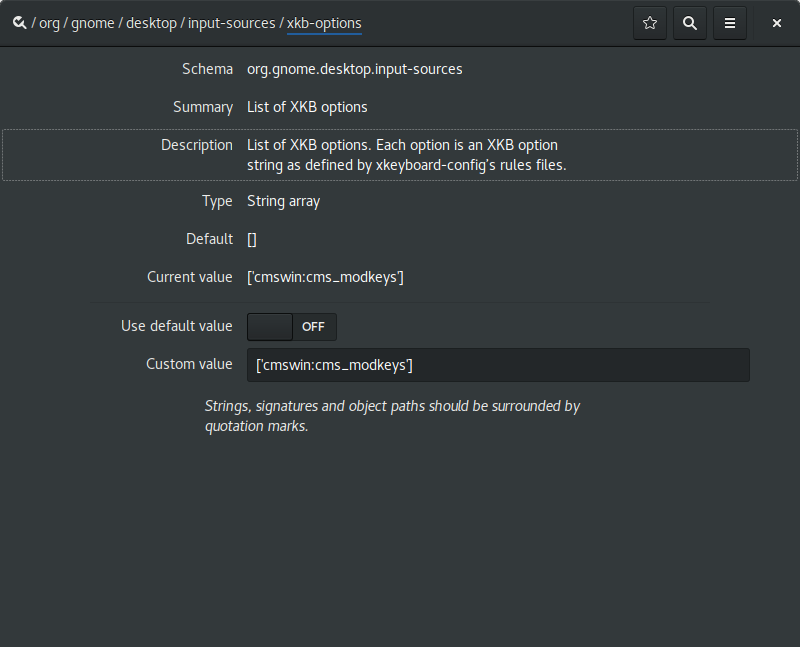
If you're playing along at home, you may have spotted that cmswin is not the name of any valid xkb layout. The wrinkle is that none of the built-in options offer quite the right set of combinations. So this is how I added my own custom XKB option.
I added a new file usr/share/X11/xkb/symbols/cmswin to define my partial keymap.
Its contents:
// alts are ctrls, winkeys are metas, ctrls are supers
partial modifier_keys
xkb_symbols "cms_modkeys" {
            replace key <LALT> { [ Control_L, Control_L ] };
            replace key <LWIN> { [ Alt_L, Meta_L ] };
            replace key <LCTL> { [ Super_L ] };
            replace key <RALT> { [ Control_R, Control_R ] };
            replace key <MENU> { [ Alt_R, Meta_R ] };
            replace key <RCTL> { [ Super_R ] }; };
}; // end
that defines the option.
Further to this, I modified /usr/share/X11/xkb/rules/evdev
adding the line
cmswin:cms_modkeys = +cmswin(cms_modkeys)
to the section
! option = symbols
I believe this is adding an option named cmswin:cms_modkeys to the dataset assigning it to parsing the 'cms_modkeys' entry from the 'cmswin' file, in the symbols subdirectory. The convention in xkb is to name all the different symbols using the same substrings, and it's terribly confusing when you're trying to remember which part does what, although slightly helpful when you're trying to perform the reverse map and locate which file is responsible for which option, I suppose.
The final step is to add the line
cmswin:cms_modkeys fix keys for emacs
into the file /usr/share/X11/xkb/rules/evdev.lst
I think this does something like import the option into the environment. There is also an evdev.xml file in the rules directory, which looks like it marks up the options to be used by the GNOME gui, but I didn't bother with that one, because life is too short to hand write XML for computers to parse, and I'd already spent half a day setting this all up. To give you an idea of how tedious this all was, for a while I'd added the evdev option into the section marked !option = types rather than symbols, and this caused wayland to stick to a crash loop as soon as I loaded the XKB option into the dconf key (with no visible error logs! yum!)
With all of this in place however, everything works fine. For now. GNOME seems to be in a bit of a transitory phase with regards to keyboard and input configuration, it looks like they're reworking everything to use IBUS in the long term, so I expect I'll be doing some form of this dance again within a year. Until then though, this document can serve as a reference for the next time I, or anyone else interested enough needs to figure out how to do this.
2017 then, and nothing seems to have really changed that much at all. Desktop Linux is still terrible, and desktop linux is still awesome. Emacs is still terrible, and Emacs is still the best tool I have.
I've been very gradually upgrading this site back to life for a few years now. Very gradually #amirite . However, after earlier this year having found myself accidentally on the front page of Reddit, HN etc. with my post about building the IMDb boards , I found myself slightly embarrassed, not only by the amount of attention ( 40k+ uniques in the first two days, holy shit! ), but also by people pointing out how clunky the site is to read. Often several times a day.
The styling on the blog section, much like the rest of the blog section, wasn't in a terribly well developed state of completion. I just threw together some hand-written CSS to approximate the look and colours of my last existing Wordpress theme, which I had been fairly happy with. Now that theme was set up maybe ten years ago, and my initial port over to this 'new', self-build CMS maybe four or five years old itself, and I had given no thought at all to mobile, or in fact any screen device very much different from my own laptop display. And my main laptop display is a 1024x768 pixel non- IPS Lenovo ThinkPad x220. That is probably a significantly worse screen than your phone has.
In 2017 it's pretty stupid to build web pages just to be viewed by desktop browsers, so today I'm pushing out a rebuild of the display layer and theme, that hopefully works a little more responsively across varied devices. It should also be easier for me to evolve. I hope it improves things for my handful of select readers. I'm not terrifically good at front-ending, and my heart isn't often in it, but I have tried my best.
I'd like to be updating this site more frequently again, he writes, like one of those bloggers apologising for never blogging , but a large part of getting any kind of schedule working there, is streamlining the publishing workflow. To that end, as well as a more modernised front-end and theme, today I've also released a new site deployment system, that allows me to update the site software more easily. This is clunky, but at least automated. Previously everything was just checked out into a home directory, hand compiled and run on the server. Now that's mostly still happening , but now it's all scripted with configuration management tools so I can release updates like this without having to remember exactly how to set it all up again by hand from first principles.
Of course, for writing articles, I'm still shelling into the server and hand writing html files like a farmer , but it's all steps in the right direction. Sometimes I don't shell in to the server, I author the posts directly using emacs tramp-mode which practically counts as using a GUI round here.
I'm sick of Twitter, folks. I've decided to do something both mild and drastic about it. For 2018, I have resolved to stop using it.
I am not sure what it is for anymore, it certainly doesn't feel like it is for me. I think I've been disengaging slowly for the last couple of years, and in 2017 I repeatedly found it too aggravating, and depressing to engage with. I think I would have already ragequit, had one of last year's resolutions not been that silly selfie thing. Thus a seed was planted about resolutions and exits. Brains often work that way. (Referendums are silly though)
I was late to twitter. I downloaded my twitter archive, whilst I was scraping out all of the 2017 selfies, and apparently my first tweet is from Dec 2007.
gearing up to watch new BSG
— cms the vampire queen (@colinstrickland) December 18, 2007
I was late to Battlestar Galactica as well.
I probably spent a little while reading twitter before registering, although I don't remember anything specific. I can't remember why I signed up in the first place. Looking at that first month of odd, stilted entirely quotidian status posts, I can tell I'm working on Logical Bee, mostly alone, babysitting that dog. It's winter. Maybe I'm lonely? I have a dim memory of thinking it was pretty dumb for a long while before getting involved at all. I remember fiddling about connecting it to things, and experimenting with SMS tweets and emails. I don't think it really clicked for the longest while. I remember a sense of a clique I wasn't ever going to be able to get into. That first wave of web-natives, younger than my generation. More entuned to a web of application services and APIs than hypertexts and data servers. I remember tweetups being a thing, and a Bristol one being announced, and spending an hour or two before deciding firmly I wasn't the kind of person that went to that kind of thing. I quite wish I had gone now. I didn't used to be a very good joiner-in of things. I'm not much better at that now. A little bit, perhaps. Now I know to try.
It took the longest while, but eventually it clicked. I liked the lightness of it. It was sort-of social networking, but social networking at arms length. Lots of irony, lots of whimsy. I just remembered the earliest phase of my binning Facebook was to convert my facebook to just echo my tweets back into it, for the muggles to read. I remember being very snobby and standoffish about things like hashtags and @replies. My first reply wasn't until August 2008.
@davehodg , also for consideration; twot, and perhaps twerped
— cms the vampire queen (@colinstrickland) August 12, 2008
To Daveh! Either I don't know how to reply yet, or the Twitter archive has incorrectly threaded that reply back together. Either seems plausible.
I didn't use a hashtag until May 2009. Even then I was repurposing "get off my lawn" meta-commentary. Amused to see that my next half dozen hashtags are complaining about moonfruit's use of them for viral marketing. Many years later I ended up working there for a season. Again we see the seeds are sown, and the fruit is reaped.
Still fascinated by how rapidly people have started to game twitter trends, and thoroughly amused by #theBNParetwats
— cms the vampire queen (@colinstrickland) May 12, 2009
Not too ashamed of that one. It's interesting looking back at tweets like that, I have a sense that the prevailing vibe of Twitter at the time was that the cool kids were beating out the idiots. I don't get that vibe off Twitter now.
By this point it was clearly very firmly entrenched in my daily desktop routine. Once I got hold of smartphones that could run twitter, I think my usage ramped up. I remember by the time I got to last.fm, I was tweeting all the things, curating a couple of hashtags (#fantasypeelsessions for serendipitous word groups that sounded like band names, #fisharecool for cool fish facts), running multiple joke twitter accounts, writing bots, and generally really enjoying it. I remember when I got to Makeshift, and twitter seemed to be used as the wiring behind at least half of everything there, it then seemed like a necessary internet plumbing for web apps. With hindsight I think that was the peak. It was downhill from there. I don't like it any more, I have detected an opportune moment, and I have decided to leave. At least for one year.
I'm not going to use this post for arguing about why I think it's broken. One of the largest problems I have with it is the sheer concentration of negativity. And one of the reasons I want to move away from it is to focus on building things that are more positive. It's not just Twitter. I'm pretty broken-hearted with the state of the web in 2017 - it's very far from what I signed on to help build as one of those idealistic Gen X web 1.0 types. And again, rather than just bemoan that, I'd rather start focusing on ways to think about fixing that. And for me, in 2018, this means I'm going to go small, and focus on building things and content I can own, in the sidelines. I expect I will be updating here more. I plan to double-down a bit harder on indieweb things, and federated stuff. POSSE all the things. Death to silos. I've been experimenting with micro.blogs and mastodon.social, and I want to play more with beaker and dat, and blockstack and IPFS and other idealistic p2p proto-webs. Maybe even frogans?. The real web looks more like that. Maybe I can help figure out how to make it a bit easier for everyone to clamber onboard.
First off, that's flattering, almost-certainly-entirely-imaginary-cms-fan, thanks! I like you too! Occasionally some of my tweets get as many as five or six engagements, and I do enjoy keeping up with some lovely people. Some of whom I met or perhaps only know through twitter. I'm sorry if this feels like a breakup; It's not you, it's me, as they say in the rom-coms. (Actually, I'm not dumping anyone.)
Something else I want to push for in 2018 is better quality, stronger, social engagement. I want to cultivate more real contact, more high bandwidth engagement and connection with all the good people. This can work two ways of course. If you only really interact with me on a tweet by tweet basis, and you think you're going to miss that, then do please reach out. We can have coffee, or get beers, or just go fish in a lake or something else entirely. And I'm going to be pushing myself to reach out to more people in turn myself, something I'm astronomically poor at. Please help me with this if you can!
IRL networking I plan to ramp up a bit. More meetups, tech and maybe otherwise. Maybe I'll rescind my conference ban. Maybe I'll start some of these things, or start helping to organise them more.
I'm not doing an *infocide*. As well as publishing things hanging from here, which has plenty of RSS feeds, if you can still figure out how to integrate those into your workflows then I'll probably never be very far away. Also, if you look at the home page, there's a list of dozens of other not-Twitter platforms you can stalk me on or connect to me via (maybe we are already!) - If my plan comes together, I hope to be syndicating and updating the useful ones of these more actively.
I don't intend to delete or remove my twitter account, and I will set things up so I still get notifications, so nobody gets ignored. I might even automate some notifications to my twitter feed about updates to things elsewhere. I'm just not going to be participating as a human. I expect I will remove all the apps, so my turnaround on mentions might slow right down.
If you're in the select category of people who only know how to contact me with twitter, there are many options. I haven't changed my phone number, should you know me well enough to have one of those. If you're looking for a way to DM to me, I cannot endorse keybase strongly enough. I think they're trying to do something really interesting, and could do with some more network effect. Sign up to keybase, and keybase message me, I love getting keybase messages, and I always respond. Invite me to your keybase groups! Also, please share your slacks and your newsletters and your mailing lists with me, if you think I'd like them, or they'd like me.
Email still works, and I still read it. My address is even on my website.
Finally, if you're reading this, and we've Twitter interacted in some way, let me say a goodbye for now. If I was annoying, or argumentative, I'm sorry, I can be hard work soemtimes. Maybe some of that might have been caused by the platform? If I was fun or charming or interesting, then let's work to stay in touch! If you don't really care, you're not even sure how you got here from off of twitter, that's cool too, maybe I'll see you again in a year from now.
With all this focus on RSS generation for micro blog, I've been optimising my engine. I've learned how to use SBCL's profiler, and I have shaved a third off the cost of generating indexes

It's been a month now, and I ought to be used to it, and in many ways I am, but in surprisingly many ways I'm still not; I don't have a dog anymore. He got too old, and he got too sick, and tired, and uncomfortable, and he had to be put to sleep, back on the 28th of November. How does it feel? Terrible.
It was an enlarged heart that did for him. Poetically enough, his heart was just too large for him to carry on. The photo above is taken on the last morning, before I headed out to work. I knew there was very little chance he'd be coming back from the vet's appointment later that day. We had a little conversation and I carefully explained to him that he was a very good dog.
Of course he was actually a terrible dog. A brilliantly terrible one, as most dalmatians are born to be. He'd not really been himself for a couple of years, stumbling about and complaining about most things, but right up until the last couple of weeks he was coping mostly, and remained good company. In his prime though, that dog was an athlete, who used to literally fly, and if I open my mind's eye a little, that's what I can see, streaking around the Bristol countryside, barely controllable, raiding bins, and laughing at you, over his shoulder.
I don't really know what to write. I have to write something though. This website, which has been knocking around for fifteen years or more, only really took initial form as a rudimentary 'blog' so I could share dog photos with his burgeoning fanbase. Most of that has bitrotted now, but when I feel better I would like to clean it up some. So I can't really even let go of him without marking some notice here. I don't need to trot out all of the anecdotes, they're probably dull and too personal. After all, outside of my immediate circles, he's just some bloke on the internet's dog. To me, and to some of his internet fans though, he's the best dog in the world. Every single word of that is true.
Should you wear nice underpants when you feel ill, or 'I guess I don't care about anything' ones? These are the questions
When you have, as I have, a race condition in posting that exists somewhere between systemd, rsync, bash, perl, and that's before you even get to the CMS, it is probably time for some refactoring
Does anyone know if eating your own bodyweight in Stilton is a good way to clear up Xmas flu?
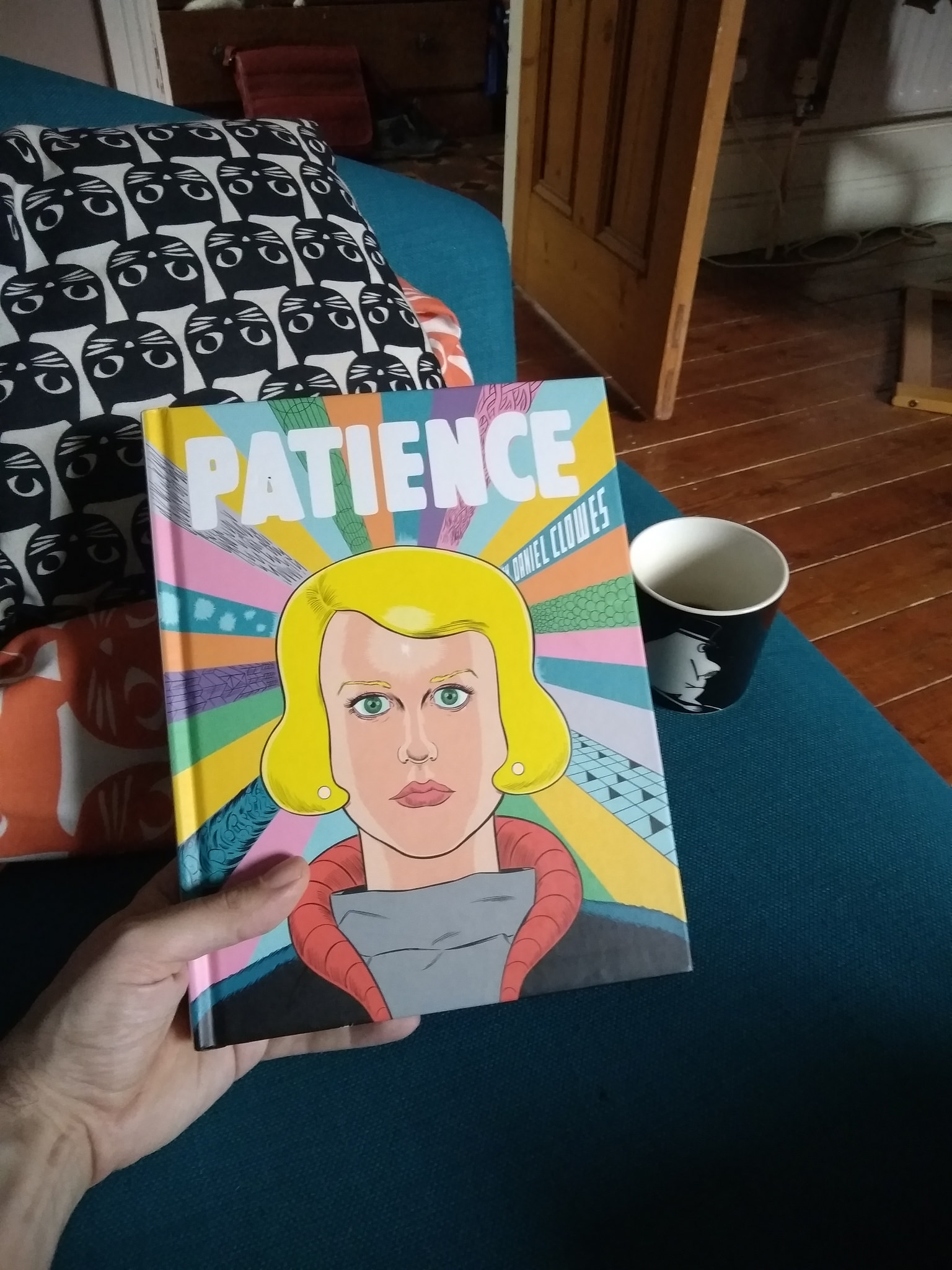 This was a great Xmas read, although nothing like what I was expecting