Even I get surprised by how often I dream about my Thinkpad x220. #dreamsaboutmyex 2018-01-12
Even I get surprised by how often I dream about my Thinkpad x220. #dreamsaboutmyex
tagged as
Even I get surprised by how often I dream about my Thinkpad x220. #dreamsaboutmyex
I am a fairly sanguine UK rail commuter. I do not understand why they schedule the annual price hike for exactly the same week the holiday maintenance work is likely to have overrun, affecting all the services. Surely it would make more sense to raise the price at the start of the financial year, in April?
Old Street station has a popup "Black Mirror" shop. I am not sure how I feel about this. I am fairly sure I know how Dan Ashcroft would feel about this.
Day one of no twitter feels very strange. This gives me some confidence that it is probably a useful exercise.
I've been writing a couple of things in hy again this week. What's Hy? It's a cute idea. It's a lisp that compiles? (transpiles? I never get the difference) to the Python AST. I guess the elevator pitch might be something like clojure but for python. So yeah, a rich, super stable class-tree sort of OO language, with enormous portablility and twenty-odd years of library support for everything you might want to do, but with a nice, dynamic, lispy language and a repl.
I've played with hy a little bit on and off over the years. Actually, when I was working at SMR, I actually deployed some in production. (Somehow, I doubt that's still a thing). Python is my go-to scripting language, because it's very plain, very portable, batteries included, somewhat modern, probably already installed everywhere I work. I try to use it for scripty things, rather than shell or perl or something. Lisps are my favourite programming language. I just like how it fits together. I know lots of people don't, and I'm fine with that, but I always enjoy it.
So over the holiday weekend I found myself wanting a couple of almost throwaway scripts, and I decided to reach back into the hy bucket, and give that another try. I wrote a script to grab my selfie tweets from a twitter archive, and a rough script to publish formatted micro-blog entries directly from the shell.
It was a fun exercise. Hy has moved on a bit since I last tried. (They seem to have removed let, and car, and cdr, and lambda which I feel funny about), but by and large it works really well.
I don't think I would choose to use it to build any complicated systems. (Typically this is true of Python as well to be fair). I'd love to see something like an idomatic web framework in it. I could imagine using it to build serverless workers over something like apex up or chalice perhaps. I should totally try that!
I am not really very good at it yet, so I doubt I'm writing optimal programs. My scripts often look like Dr. Moreau designs halfway between a python script and something more lispy. This could well improve as I understand the underlying sequence / itertools glue a bit more, I'm often routing around confusing sequenced things. I absolutely enjoy writing little scripts like this in it, and I think I maybe enjoy it more than I would if I was writing plain python. I gave some thought about why this might be and I think I figured it out.
It could just be as simple as being all about the code editing. Python, and it's whitespace delimited blocks, is fine, and super readable, but it's always slightly fiddly to edit. Some of this is my toolchain, I'm sure. There's a lot of bells and whistles you can glue over emacs for Python work, and they're pretty good, but I do always find it a slightly fiddly experience. Balanced expressions and sexprs though are obviously an absolute joy to edit in emacs, alongside an embedded inferior lisp repl, and although it's nowhere near as integrated an experience as using slime with a "real" lisp, it's closer to that than editing Python ever feels, and for me that's a significant productivity win. So I think it will stay in the toolbox.
I recommend Hy to anyone who is interested in interesting lightweight languages, especially scripting languages. Obviously it's particularly relevant to anyone who likes python or lisps, even if just as a curiosity. If you work with Python and like using emacs though, and like the sound of 'Python but with structured editing' I would strongly recommend you look at how it might integrate into your workflow.
One of the things I initially missed most, when shifting from emacs to zed was magit, which has been my main git interface for IDK, let's say about 20 years 🤷.
I'm a bit of a sloppy worker, but a meticulous git user, lots of atomic annotated commits, many linear branches, I'm cherry picking and rebasing, and stashing, and magit integrates all of this naturally into the normal flow.
Zed has git integration, obviously, but it's entirely basic - pull, push, commit, branch, diff, that's about it. It does let you stage incrementally, which is most of the problem solved, and of course, there is a terminal integration, so you can pop a shell and use git CLI (like a farmer 🤪).
It's OK, but clunky, obviously. A little bit of friction and dissonance in this slick world of modern native editors that were actually made this century. I think the kids are a lot looser with git than I am, and perhaps they have a point, but I like the discipline.
You probably figured out what's coming next, if you bothered to read this far.
I've been using the zed LLM integration to write commit messages for a while - it's pretty well suited to that, given a bit of context, you can generate a draft commit message that summarises the changes, and it's you tweak and approve them before you apply. It's a pretty good example of the kind of low-hanging, small improvement, you can achieve with even simple model, precisely applied to a narrow context that involves generating prose. Smoothing out busywork.
Obviously, zed is pretty agentic 🤢, because that stupid word is all the rage these days. I guess you can open a chat box and ask your editor to vibe code your whole application. (Good luck with that, if you do, I think that's liable to create more work in integration than it saves in writing, maybe that's just me)
I use the agents for a bit of boilerplate here and there - refactor this, replace these magic numbers with proper constants, redo this part to use an iterator, what is the type checker complaining about here, how do I configure the language server to disable a misfeature, again, it's not too bad at doing think kind of drone effort, and there is a small but appreciable productivity gain to be had.
This last week, I was suddenly inspired to cross the streams, and something interesting happened, surprising me enough to bother drafting a post on the topic. I don't really like to thought-leader, but occasionally something will delight me enough to want to share.
I wanted to tidy up a messy WIP branch that collected a couple of different ideas in progress, (and had also coincided with me correctly figuring out how to enable auto-linting in zed, so I suddenly had a lot of aesthetic formatting corrections dropped suddenly into an already untidy sandbox)
A minute or two fiddling with rebase in magit, but in zed...? Time to roll up my sleeves, and flex, and take out the ol' git pitchfork, or hitch up the rebase propagator to the reflog tractor (I do not really know what farmers do). But, wait. I wonder if...
So I pull up the agent and ask it "can you run an interactive rebase on this branch please, and group all the white-space only changes into one commit, the other formatting changes into another, and then separate the removal of the obsolete class from the other feature work?"
And, it kind of worked! It got stuck a couple of times, and I had to pop in and edit a couple of things, and I restarted it over with the order of the commits I wanted a little more explicitly instructed once I recognised where the conflicts were going to land, but I got the result I intended, certainly with no more fiddling about than I would have had to do if I'd been performing the task manually, maybe less? It's hard to measure, but I enjoyed the experience.
One thing I definitely realised. It was less irritating. I was able to complete a disruptive, yet necessary chore, while in the middle of doing something more interesting, with much less context switching than performing it manually. And that got me thinking about interfaces a bit more. Chat bots are unquestionably a very ergonomic interface.
Increasingly, I am starting to think that a key part of unlocking the value of LLMs, may be through thinking about them more as solutions for interface design problems.
Git is a classic case. Git's interface sucks space balls, everyone knows it. I mean I know a few people who like it, and I'm happy for them (but I think they are weirdos). It does allow for a bunch of studly machismo and nerd flexing, for anyone who has invested enough time in learning its arcana to impress people with stunt-git trick shots, and that can be fun. I have definitely enjoyed being the knuckle-cracking "stand back everyone and stop panicking, I know how to fix this" guy on a number of occasions, but that is a sideshow. You can do circus tricks with power tools, and some people do, but it's not the reason the tools were made.
Git has a compelling storage model, and a commit graph workflow that solves a bunch of annoying challenges with incremental and concurrent code editing and integration, efficiently and better than previous source code version systems. That's why it became a huge success.
Git's horrible ergonomics and implicit barriers to entry, but compelling powers of sharing and integration, allowed GitHub to spring into existence, as a multi trillion zillion company from out of nowhere, just by slapping a nicer set of user abstractions on top of git's ugly robotic core. (in the process accidentally inventing some other significant ergonomic problems, like pull request based workflows, and IDK, tag driven releases, but I guess that's a different blog post)
Git's foul ergonomics are what pulled me into learning magit, which has a reasonably steep learning curve of its own, but also follows the emacs way of having a lovely manual. It's a better thought out UI. It also leverages many common emacs behaviours, so when you're working in emacs already, which I typically was, again, you get this reduction of context switching.
Why is this so important? At this point, it's tempting to dive off into a side bar about "programmer flow state", a long held shibboleth of the developer community about which I don't have much truck, but many thousands of words can be found about it on the web already. - I don't like anything that reinforces programmer identity as a higher state of being, and I dislike how easily this concept is weaponised towards shunning collaboration and social work (e.g. "coders must not be interrupted during holy flow state") , again this is clearly a different adjacent blog post - but the notion is not fundamentally baseless.
Programming tasks often require holding a lot of accrued context about a chain of thought, and carefully expressing those in a narrow, precise domain, incrementally progressing towards a well defined future state. It's not easy for a human mind to do that, it takes a bit of effort. Effortlessly breaking out of one domain into another mode of expression isn't really possible. To do that even passably well, perhaps you would need a different kind of "mind", even?
I think version control is interesting here, precisely because it's liminal stuff. It's programming-adjacent work in a certain sense, it's a chore - any time you have to break thread to address some version control nonsense or busy work, you are in essence interrupting yourself. It makes a lot of sense to try and find a low friction simplified user interface to mediate these kind of tasks. Like GitHub, or magit. The ideal is to minimise the amount of disruption you face while working on these background or side channel threads of work. You can mitigate against this in two main ways I think. You can look for ways to simplify the UI to better suit a particular working context, as we have been discussing; alternatively you can divide the work and make the secondary context a first class task that's managed separately.
One way to do this is to structure the way you work so you can plan your version control stories a little ahead of time, and use discipline in your task management to make it better fit onto the VC, with strategies like formal branching and ticketing protocols, rigorous task mapping that accounts for tech debt, probably integrated into a project management system.
Another way you can do it is to make it literally someone's job and push the load out sideways - examples of this might be code review protocols, gatekeepers for merges (in the olden times, with less sophisticated version control software, I've often worked on teams where there was a nominated 'merge master', whose entire job, or a large portion of it would be to basically do the integration and harder version control work on behalf of the feature developers), also other adjacent roles like scrum masters, or DBAs.
That train of thought got me thinking about SQL. I think SQL is another interesting example of 'programming-adjacent work', although it might be a bit more subtle of an example than it first appears. Let's have another digression then. I really like SQL, although it's obviously covered in warts and sharp edges, I've always appreciated it's utility, and to a certain extent it's ergonomics. It does share some of the properties I've discussed with git - it's very often a boundary, and context shift away from the main thread of programming, and programmers tend to hate it, and like to avoid it, and make up nasty memes about it for slack, and that kind of thing - just like version control (or meetings 😘), it's essential and necessary work in a lot of software development, but it's another liminal place, where you have to get pulled out of the context of thinking about your feature work, and software architecture, and land in another place for a while with an annoying external syntax, and a lot of aggravating round trips into different tooling.
Indeed, over the years, a very common programming pattern is to try and slap a more program-ergonomic abstraction layer in front of the SQL, once again to try and minimise the friction and narrow the interface - I'm thinking of things like various ORMs, 'noSQL' database engines that bring the data modelling and querying closer to the application layer, all of them moderately successful, and yet SQL still hangs around everywhere, slightly annoying everyone, like a remote senior cousin inevitably invited to every wide social gathering, tolerated, rather than enthusiastically invited.
That's because SQL is already an ergonomic abstraction. It's kind of the ur-DSL. SQL is there because databases have a lot of inertia associated with them. All the data is often where the money is. Data is the raw stockpile of materials, the raw ingredients of the information that's necessary to run large information technology applications. Data tends to accrue value cumulatively, and you want to keep it all in a big lump in one place (this is why we have terms like 'data-mining' and 'data-warehousing'), so you can correlate it, and leverage sexy network effects from having it all integrated into one humongous data domain. Once you pass a certain critical data mass, you need to access it multi-modally , i.e. there will be many different use cases for the same information sets, different users and different applications will emerge from, or require access to, various intersectional pieces of that data blob. Now, reading and updating that data blob by hand, in your preferred programming stack would really sting. You'd still have to leave your application software context, but you'd now need to delve into a world of low level file systems, and data packing, and indexed data access, and write locking, and concurrent editing, and wire protocols, and cache invalidation, and the whole nine yards of that side of computer science.
I pause a little here, because I realise I'm probably making it sound kind of fun to a particular audience segment (amongst which I include myself, periodically), but let's not lose track of the core point. If your intended task is to make a cool dating app that helps your users get laid, low level storage systems coding is a horrible, high effort context switch away from the feature track you're working on. And of course, all this data access code you're having to do while you go will also need tracking in your version control system, more context switches. Instead, we SQL.
As an aside, I have found LLM coding assistants to be generally pretty bad at SQL writing. I have two hand-wavy personal theories about why this is the case
I'm tempted to infer something from those two sub-points about SQL requiring fundamentally different kinds of reasoning to other forms of writing, but I'm probably just seeing the face of Poseidon appearing in the patterns of my mental sea foam... I'll leave it there for now. (a third parallel blog post? This stuff is getting fractal). BTW - The name for that fascinating phenomenon is *pareidolia* , and it's something worth keeping in mind when discussing "AI" concepts...
Ahem... Another really interesting aside is to have a look back at the history of SQL. SQL is rather old. It's basically my age, and I've already pointed out I've been using emacs professionally for at least a few decades. SQL emerges from IBM in the 1970s, as a research project, greatly influenced by E.F. Codd's classic article 'A relational model of data for large shared data banks'
The primary designers of SQL were Don Chamberlin and Ray Boyce, part of IBM's system R research project, who were tasked with looking into ways to apply Codd's relational / mathematical principles of database modelling to IBM's database businesses. IBM's database business at this point was most of IBM's business, and IBM's database business was pretty huge. Prior to relational databases, the existing big iron database management systems were awkward weird transactional / hierarchical databases, like IMS/360 where you pretty much had to write a specific computer program to be batch executed from a queued transaction management system. Each 'query' was more akin to an independent program. In order to change the report, you'd develop a new program, and you would need appropriate programmer time and skill to do it, and your best turnaround for results would be several hours, probably more like days.
So the system R researchers wanted to make this more flexible, but their ambitions didn't end there. Chamberlin and Boyce wanted to make information retrieval accessible to non-programmers. Here's Chamberlin
"Ray and I hoped to design a relational language based on concepts that would be familiar to a wider population of users. We also hoped to extend the language to encompass database updates and administrative tasks such as the creation of new tables and views, which had traditionally been outside the scope of a query language.[...] What we thought we were doing was making it possible for non-programmers to interact with databases. We thought that this was going to open up access to data to a whole new class of people who could do things that were never possible before because they didn’t know how to program."
Can you see where I'm heading? SQL is a frantically successful example of what we used to call '4GLs', (fourth generation languages), when I was a school kid, (although by that point, the text books - and what we didn't yet call the hype cycle - were already breathlessly excited by the imminent arrival of the Fifth Generation Languages, and systems...). The terminology is dated, and stretchy, and marketing-fed, but the central gist is - 4GLs are languages that were operating at a higher abstraction level. Your inputs and controls would describe a program at an abstraction level much higher than the operation of the system, and the 4GL would write a program for you that ran at the lower level. All a bit hand-wavy, but SQL querying has some really interesting properties related to this delegation.
The query planner is worth a little thought - The query plan uses a bit of maths, and some heuristics and a bunch of information and sampled data about your system, and works out a series of reads and sorts and filters that produce the data structures your query is requesting. Crucially you don't tell it HOW to do it, just WHAT you want it to do. (sorry, the upper case is a bit addicting, I'll stop). Most of the time you don't think about it too much more than that. However, most SQL database systems will show you their plans if you ask them, typically by using the EXPLAIN keyword, which will show you what the planner thinks it should do to build the result set you wanted. If you don't like what it's decided you can't tell it to do things differently, but you may teach it to do things differently, typically by updating the available indexes and constraints, or maybe by re-balancing the statistics it uses to decide about cardinality and seek times, and that kind of thing.
Here again we have a division of labour - the idea is that the structural and statistical and optimising and runtime bits of maintaining the SQL system can be delegated to the programmer and technician classes, who can be more concerned with the implementation and operational parts, and the query writer (a non programmer, if you remember) can just get on with expressing their tasks in a lower friction, narrowed domain, where they don't have to context switch out as hard from their task at hand, writing lovely business reports for the sales and finance teams to make slide decks from.
Now I'm not saying that SQL writing is 1970s prompt engineering, but I'm also not not saying that, right?
Here's Don again, after the fact
"Ray and I were wrong about the predominant usage of SQL. Typically, SQL is embedded in a host programming language and used by professional programmers"
SQL was, as I have said, a spectacular success. It's still bloody everywhere, fifty years on. It was also an abject failure. The syntax is a mess of unaligned clauses with special cases everywhere (INSERT and UPDATE have such radically different approaches to clauses but sort of do the same thing. So does DELETE really). You need to understand maths to do it properly. You also need to understand the precise details of the database schema. The database schema is maintained in a separate dialect that's somehow intertwined with the querying DSL and uses the same interfaces, but again obeys a different syntax and semantics. Record locking is both implicit and explicit. The concurrency model is insane and nobody actually understands it properly. NULL breaks everything including query logic. And most damningly, it's never used as an interactive REPL by non-programmers. It's folded into programs mostly. In fact these days, an eye-wateringly huge number of applications bundle an entire SQLite embedded RDBMS inside their application deployment.
There's a pattern emerging here I think - querying and reporting wasn't quite entirely programming adjacent busywork, but it was business-adjacent drone work, and SQL was an attempt to narrow the interface with an ergonomic DSL that got out of the user's way and reduced the scope of the context switch needed to engage with the reporting system. It kind of failed at the interface, if you ask me (and most folks who have to use it), but it did succeed amazingly at reducing the complexity of the context switch. Using SQL to mediate data persistence inside your application is kind of like using magit to fold your git operations right inside your emacs workflow, they both serve to shrink down the cost of flipping out of your primary task domain, into some other essential, dependent domain.
Either reduce it to a tight DSL, or extract the work and organise it so it can be delegated to another worker. Sometimes, you put a DSL on top of a DSL, to tune it down even further. Sometimes you build a team to own the work in this domain. What if you build a DSL over a DSL but the DSL could sort of work like a team you can delegate tasks to? That's a compelling interface, that is.
When I look at it like this, using an agent REPL in zed to run git operations strongly reminds me of that (failed) SQL/4GL promise. I tell the thing the result I want from it, and it builds a plan of execution, and I can iterate on that, interactively. Only this time, I'm using literal English sentences to describe the narrow domain the system has trained itself on, not some bastard awful pidgin version of it, that somehow ends up with the worst features of both natural languages, and programming languages. Sorry SQL, it has to be said. And you know what, I kind of love you anyway.
I think this pattern can be found in several places of software development, if you squint right. Programming-adjacent work gets reduced with DSLs or narrow abstractions, which bring the benefits of reducing that tedious, expensive context switch. I guess we have lots of it in CI automation, pipeline building, that kind of thing. DevOps is built out of this stuff, infrastructure as code, deployment charts, meta deployment charts, run-books, playbooks. These domains are also places I've found LLM-based assistants super helpful - help me grind out some yaml please so I can add a pull request pipeline that does this thing I just thought of, without me having to spend quite so much time reading up the stupid YAML syntax for this weeks CI system, and spending hours sitting in a push/fail/edit/push loop on some git forge. GraphQL over REST apis - maybe? Unit test generation and test harness design is mostly busywork in a DSL following some declarable constraints. I think I already mentioned figuring out the precise type annotations for things. It makes me think that coding-assistants are perhaps more of a user interface paradigm than they are a coding one. More like a 4GL than a semantic IDE.
What's my point? I'm not completely sure (he says after several thousand words)
I'm sick of Twitter, folks. I've decided to do something both mild and drastic about it. For 2018, I have resolved to stop using it.
I am not sure what it is for anymore, it certainly doesn't feel like it is for me. I think I've been disengaging slowly for the last couple of years, and in 2017 I repeatedly found it too aggravating, and depressing to engage with. I think I would have already ragequit, had one of last year's resolutions not been that silly selfie thing. Thus a seed was planted about resolutions and exits. Brains often work that way. (Referendums are silly though)
I was late to twitter. I downloaded my twitter archive, whilst I was scraping out all of the 2017 selfies, and apparently my first tweet is from Dec 2007.
gearing up to watch new BSG
— cms the vampire queen (@colinstrickland) December 18, 2007
I was late to Battlestar Galactica as well.
I probably spent a little while reading twitter before registering, although I don't remember anything specific. I can't remember why I signed up in the first place. Looking at that first month of odd, stilted entirely quotidian status posts, I can tell I'm working on Logical Bee, mostly alone, babysitting that dog. It's winter. Maybe I'm lonely? I have a dim memory of thinking it was pretty dumb for a long while before getting involved at all. I remember fiddling about connecting it to things, and experimenting with SMS tweets and emails. I don't think it really clicked for the longest while. I remember a sense of a clique I wasn't ever going to be able to get into. That first wave of web-natives, younger than my generation. More entuned to a web of application services and APIs than hypertexts and data servers. I remember tweetups being a thing, and a Bristol one being announced, and spending an hour or two before deciding firmly I wasn't the kind of person that went to that kind of thing. I quite wish I had gone now. I didn't used to be a very good joiner-in of things. I'm not much better at that now. A little bit, perhaps. Now I know to try.
It took the longest while, but eventually it clicked. I liked the lightness of it. It was sort-of social networking, but social networking at arms length. Lots of irony, lots of whimsy. I just remembered the earliest phase of my binning Facebook was to convert my facebook to just echo my tweets back into it, for the muggles to read. I remember being very snobby and standoffish about things like hashtags and @replies. My first reply wasn't until August 2008.
@davehodg , also for consideration; twot, and perhaps twerped
— cms the vampire queen (@colinstrickland) August 12, 2008
To Daveh! Either I don't know how to reply yet, or the Twitter archive has incorrectly threaded that reply back together. Either seems plausible.
I didn't use a hashtag until May 2009. Even then I was repurposing "get off my lawn" meta-commentary. Amused to see that my next half dozen hashtags are complaining about moonfruit's use of them for viral marketing. Many years later I ended up working there for a season. Again we see the seeds are sown, and the fruit is reaped.
Still fascinated by how rapidly people have started to game twitter trends, and thoroughly amused by #theBNParetwats
— cms the vampire queen (@colinstrickland) May 12, 2009
Not too ashamed of that one. It's interesting looking back at tweets like that, I have a sense that the prevailing vibe of Twitter at the time was that the cool kids were beating out the idiots. I don't get that vibe off Twitter now.
By this point it was clearly very firmly entrenched in my daily desktop routine. Once I got hold of smartphones that could run twitter, I think my usage ramped up. I remember by the time I got to last.fm, I was tweeting all the things, curating a couple of hashtags (#fantasypeelsessions for serendipitous word groups that sounded like band names, #fisharecool for cool fish facts), running multiple joke twitter accounts, writing bots, and generally really enjoying it. I remember when I got to Makeshift, and twitter seemed to be used as the wiring behind at least half of everything there, it then seemed like a necessary internet plumbing for web apps. With hindsight I think that was the peak. It was downhill from there. I don't like it any more, I have detected an opportune moment, and I have decided to leave. At least for one year.
I'm not going to use this post for arguing about why I think it's broken. One of the largest problems I have with it is the sheer concentration of negativity. And one of the reasons I want to move away from it is to focus on building things that are more positive. It's not just Twitter. I'm pretty broken-hearted with the state of the web in 2017 - it's very far from what I signed on to help build as one of those idealistic Gen X web 1.0 types. And again, rather than just bemoan that, I'd rather start focusing on ways to think about fixing that. And for me, in 2018, this means I'm going to go small, and focus on building things and content I can own, in the sidelines. I expect I will be updating here more. I plan to double-down a bit harder on indieweb things, and federated stuff. POSSE all the things. Death to silos. I've been experimenting with micro.blogs and mastodon.social, and I want to play more with beaker and dat, and blockstack and IPFS and other idealistic p2p proto-webs. Maybe even frogans?. The real web looks more like that. Maybe I can help figure out how to make it a bit easier for everyone to clamber onboard.
First off, that's flattering, almost-certainly-entirely-imaginary-cms-fan, thanks! I like you too! Occasionally some of my tweets get as many as five or six engagements, and I do enjoy keeping up with some lovely people. Some of whom I met or perhaps only know through twitter. I'm sorry if this feels like a breakup; It's not you, it's me, as they say in the rom-coms. (Actually, I'm not dumping anyone.)
Something else I want to push for in 2018 is better quality, stronger, social engagement. I want to cultivate more real contact, more high bandwidth engagement and connection with all the good people. This can work two ways of course. If you only really interact with me on a tweet by tweet basis, and you think you're going to miss that, then do please reach out. We can have coffee, or get beers, or just go fish in a lake or something else entirely. And I'm going to be pushing myself to reach out to more people in turn myself, something I'm astronomically poor at. Please help me with this if you can!
IRL networking I plan to ramp up a bit. More meetups, tech and maybe otherwise. Maybe I'll rescind my conference ban. Maybe I'll start some of these things, or start helping to organise them more.
I'm not doing an *infocide*. As well as publishing things hanging from here, which has plenty of RSS feeds, if you can still figure out how to integrate those into your workflows then I'll probably never be very far away. Also, if you look at the home page, there's a list of dozens of other not-Twitter platforms you can stalk me on or connect to me via (maybe we are already!) - If my plan comes together, I hope to be syndicating and updating the useful ones of these more actively.
I don't intend to delete or remove my twitter account, and I will set things up so I still get notifications, so nobody gets ignored. I might even automate some notifications to my twitter feed about updates to things elsewhere. I'm just not going to be participating as a human. I expect I will remove all the apps, so my turnaround on mentions might slow right down.
If you're in the select category of people who only know how to contact me with twitter, there are many options. I haven't changed my phone number, should you know me well enough to have one of those. If you're looking for a way to DM to me, I cannot endorse keybase strongly enough. I think they're trying to do something really interesting, and could do with some more network effect. Sign up to keybase, and keybase message me, I love getting keybase messages, and I always respond. Invite me to your keybase groups! Also, please share your slacks and your newsletters and your mailing lists with me, if you think I'd like them, or they'd like me.
Email still works, and I still read it. My address is even on my website.
Finally, if you're reading this, and we've Twitter interacted in some way, let me say a goodbye for now. If I was annoying, or argumentative, I'm sorry, I can be hard work soemtimes. Maybe some of that might have been caused by the platform? If I was fun or charming or interesting, then let's work to stay in touch! If you don't really care, you're not even sure how you got here from off of twitter, that's cool too, maybe I'll see you again in a year from now.
With all this focus on RSS generation for micro blog, I've been optimising my engine. I've learned how to use SBCL's profiler, and I have shaved a third off the cost of generating indexes
You wait two and a bit years for a blog to show up and then all of a sudden there's two of them!? I seem to have accidentally started a new blog. OMG.LOL, a rather whimsical web service I've belonged to for a while, is dropping new features on it's members for the holiday season, in the form of a charming animated advent calendar. The theme of the season is 'blogging', and right there on day one, they gave us a weblog service, weblog.lol.
So I'm over there at cms.weblog.lol. And I appear to be attempting to post a review of a different christmas pie every day, in a fit of seasonal over-enthusiasm. It will never last. So far I'm three for three though, and having fun.
Do check out omg.lol btw. It's my favourite kind of internet thing really, user-focused, a paid service (no grotty ad trafficking), (it's cheap too, right now it costs $5 per year, although the price is rising in January, get in soon if you want to, you can buy several years in advance) For your money you get a cute namespace of your choosing. Obviously I am cms, and a bunch of other neat stuff. Weblogs! (we already mentioned these). A customisable home page. A DNS subdomain, to do what you like with. A nice short email address, with forwarding. A mastodon instance, an irc server for members, a pastebin, probably some other things I've forgotten. Keybase proofs!
It's cool! Loads of 'small web' vibes, a built in community, and a bunch of fun tools. Definitely gives me nice warm fuzzy 'early internet' feels. I've managed to convince two other people I know to sign up so far. You should too! But in the meantime. I'll be over there blogging. And also maybe over here blogging? I'm such a blogger these days.
Back again! Literally years since my last post. Is blogging back? It feels a bit like people are slightly more excited about self-hosting content again than they have been in a couple of years, it's true. The big incumbent social networks are feeling a bit less solid than they used to. Facebook has been laying people off and visibly throwing money away chasing a dorky-looking, implausible VR business that almost nobody (save for the investors) seems interested in. Twitter has gone private, rather publicly, and at the time of writing seems to be in the process of reinventing itself as Twitter 2.0, whatever that turns out to mean. Right now, it seems to mean far fewer people posting, looking at my logged in timeline. Mastodon is having a moment. Maybe blogging is back!
While I am mildly excited by these winds of change, none of this is really anything to do with my sudden return to posting. My motive is something considerably less idealistic. I've moved web-hosts again, putting this post clearly into the least exciting, yet most solipsistic form of personal blogging, namely, updates on infrastructure and apologies for lack of content, addressed to an almost entirely imaginary audience!
My motive for moving hosts is worth a minor note, and also feels very 2022. My hosting costs have shot up so much, primarily due to the dramatic surges in energy costs of the past six months, that it no longer seems economically viable to use even cheap commercial hosting to prop up a vanity website I barely make any use of. So I've taken the very retro step of bringing it all back in house. Literally in-house, this page is now running off a tiny low-power media PC repurposed as a basic Linux server, connected up to my home DSL connection, and sitting in the cupboard behind the television in my front room. I had fun doing it, but it was an extremely manual process, and as a result of that I'm quite sure there's a few bugs and glitches hanging around, and some stuff will be weird until the all of the DNS edits are fully propagated.

It's been a month now, and I ought to be used to it, and in many ways I am, but in surprisingly many ways I'm still not; I don't have a dog anymore. He got too old, and he got too sick, and tired, and uncomfortable, and he had to be put to sleep, back on the 28th of November. How does it feel? Terrible.
It was an enlarged heart that did for him. Poetically enough, his heart was just too large for him to carry on. The photo above is taken on the last morning, before I headed out to work. I knew there was very little chance he'd be coming back from the vet's appointment later that day. We had a little conversation and I carefully explained to him that he was a very good dog.
Of course he was actually a terrible dog. A brilliantly terrible one, as most dalmatians are born to be. He'd not really been himself for a couple of years, stumbling about and complaining about most things, but right up until the last couple of weeks he was coping mostly, and remained good company. In his prime though, that dog was an athlete, who used to literally fly, and if I open my mind's eye a little, that's what I can see, streaking around the Bristol countryside, barely controllable, raiding bins, and laughing at you, over his shoulder.
I don't really know what to write. I have to write something though. This website, which has been knocking around for fifteen years or more, only really took initial form as a rudimentary 'blog' so I could share dog photos with his burgeoning fanbase. Most of that has bitrotted now, but when I feel better I would like to clean it up some. So I can't really even let go of him without marking some notice here. I don't need to trot out all of the anecdotes, they're probably dull and too personal. After all, outside of my immediate circles, he's just some bloke on the internet's dog. To me, and to some of his internet fans though, he's the best dog in the world. Every single word of that is true.
Should you wear nice underpants when you feel ill, or 'I guess I don't care about anything' ones? These are the questions
They are still annoyingly hard to track down, but I finally sourced a breadmaker. And I have made some bread. And eaten some of it, and it was good. Astonishingly simple to use, just tip in some slop, select a program and then wait. Although the timer only goes up to 13, meaning I had to get up at 6:30 to release it. On the positive, this is exactly how real bakers do it and so I feel I am close to becoming a master baker.
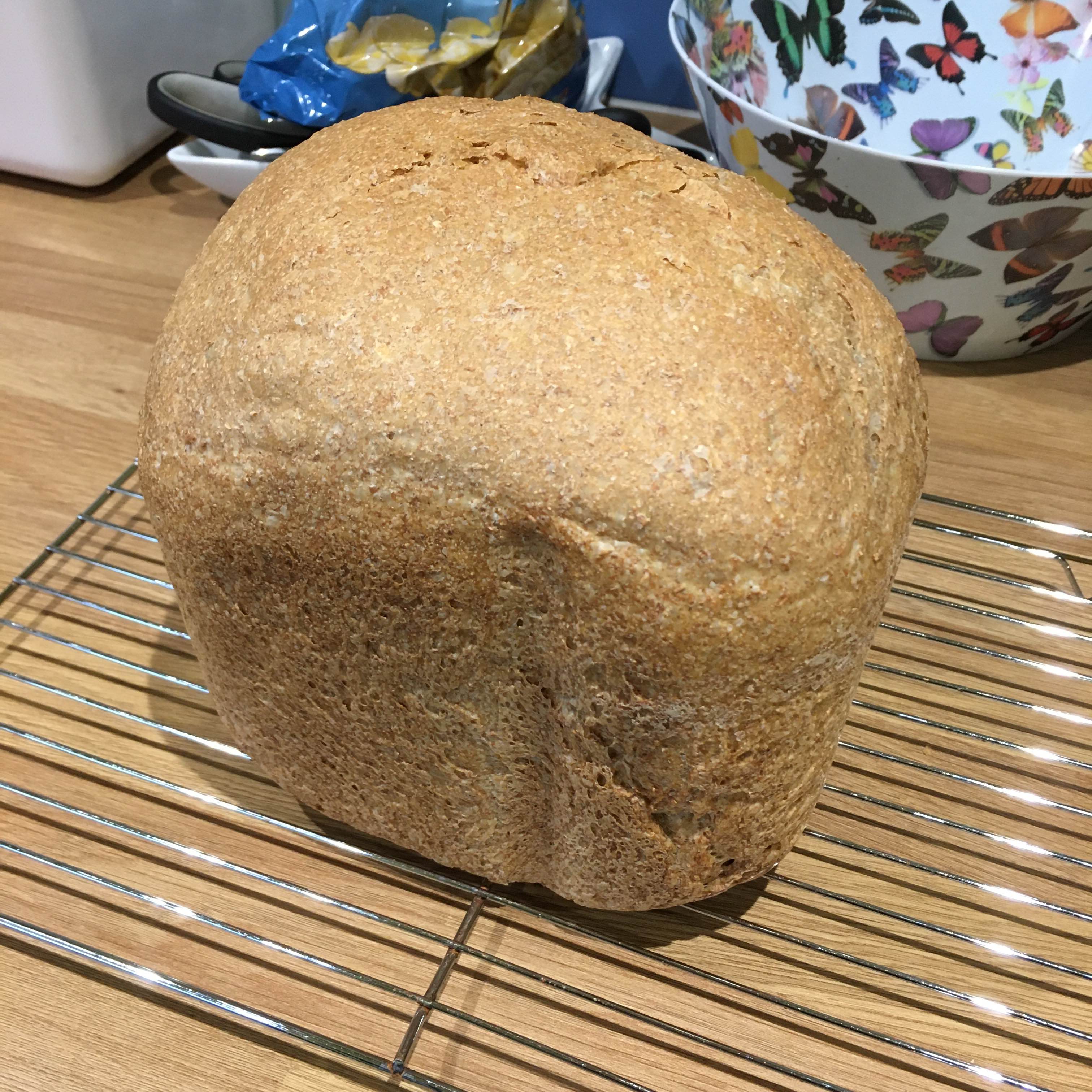
It is a Panasonic 2511-KXC I can't really offer an objective review. I have never used a bread maker before, and I chose it mainly because it was the only one available in SE England. It has a nut dispenser, although I have not yet put my nuts in it .
When you have, as I have, a race condition in posting that exists somewhere between systemd, rsync, bash, perl, and that's before you even get to the CMS, it is probably time for some refactoring
Tiny Pilot Kind of surprised that this works, but it's a neat idea if you have too many headless home servers (and I do).
Does anyone know if eating your own bodyweight in Stilton is a good way to clear up Xmas flu?
 I think she is smitten.
  introducing Snoop Dogg, a three year old Bedlington rehome
  This was a great Xmas read, although nothing like what I was expecting