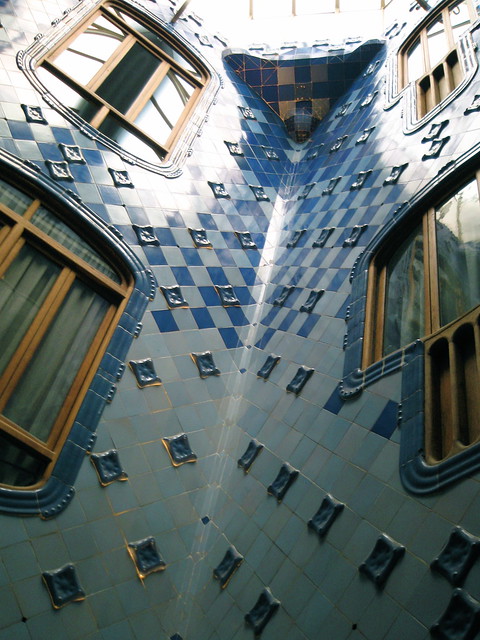
We arrived in Barcelona a few days ahead of Primavera, to give us a chance to see the sights and relax a little. It's a compact city, although larger than I thought it would be, with a wide variety of flavours to the various districts. The weather has been variable, but never unpleasant.
It is a very clean city, they seem to constantly empty the bins on a daily cycle, and there are recycling stations everywhere. The architecture is wonderful. Not just the Gaudi, which is as astonishing as you'd expect, but there's an adventurous sense to public space everywhere, interesting modern building nestling up against 14th century alleyways, and giant lumps of sculpture sprouting everywhere, in a manner you only rarely see in conservative old Britain.
We've mostly been rehearsing our body clocks for the ever so slightly mental 5pm-5am Primavera schedule, and so we've not done so much cultural sightseeing, or eating out. I figured it can wait until the now inevitable follow-up visit.
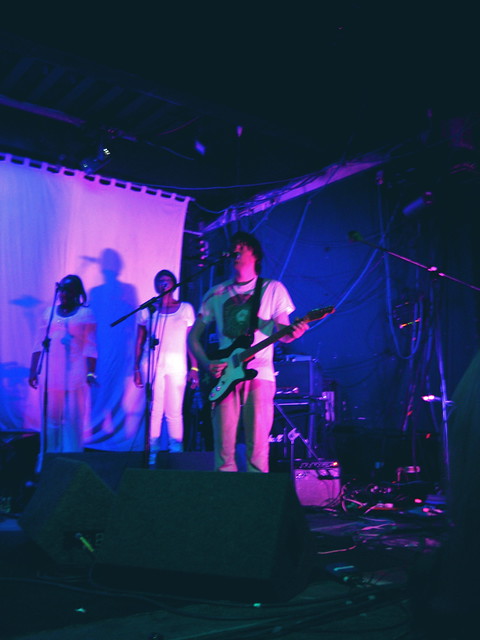
Appearing as part of Dot to Dot , an excellent city-wide music hullaballoo, spanning multiple venues. As the schedule didn't really sit very comfortably with my travel plans, flying out to Barcelona the next morning, I didn't really get a chance to see many sets, just some of Fight like Apes ( excellent ), Montreal's We are Wolves ( good stage moves ), Two Gallants ( dull enough to make me wander away and play Sonic the Hedgehog tennis on a nearby X-Box demo machine. Two thumbs up for Sonic Tennis, though ).
In fairness, the latter looked like they might be quite interesting, given enough familiarity with the material, and I'm tempted to chance an album, but I wasn't really feeling it. And the main reason I was actually in the Trinity, was to catch the headliners, Spiritualized, one of my all time favourites.
I thought they played a blinder. The Trinity is fast becoming one of my favourite Bristol venues, great sound, good bar, and it's incredibly handy to reach on foot. And they keep booking my favourite artists.
The band were really together, there's the welcome return of the gospel backing singers, excellent lightshow, and J. Spaceman is looking great and singing better than he ever has, at least to my ears. New album out now-ish.
You wait six months for a blog post and then I suddenly update all the things at once. Here we are. Site redesign. New Server. New software release. Lets tackle those in order
Redesign
I launched this version of my blog originally as 'in-progress' software before it was quite ready, after spending a few years faffing around with experiments intended to replace WordPress. One day I had something I wanted to publish, and WordPress was broken, and the thing was nearly working so I hit go. It wasn't feature complete, and there was completely minimal styling, but I thought it looked OK enough, until a friend pointed out it looked completely insane on a mobile. I felt pretty embarrassed, so I quickly cobbled together a mobile-first grid-oriented thing using zurb foundation 5 as a framework, because that was what we were using at work at the time, and it seemed like an excuse to learn a bit about how it worked. I subsequently reworked it to use foundation 6 with a slightly styled theme based on my old WordPress colours and there we are. Of late, the amount of gubbins needed to support the foundation classes has been a bit of an encumbrance, and so I decided to do away with it. This time I just hand-wrote the styles again, I think CSS has moved on a bit and hope browsers are generally a bit better behaved. Seeing as we were doing this, I did a new theme, it's based on my emacs colours. I don't care that you hate it, no.
New Server
I'm sure you all heard, ARM hardware is the new hotness now. As a natural contrarian, I was already hosting my site on an ARM server and so it's clearly time for me to move to AMD64. Not quite. For years I've been having fun hosting this place on one of scaleway's ARM C1 instances, which appealed to my quirky taste in alternative computers, as well as being super-cheap, and in many ways, offering far better raw performance than a VPS or a cheap cloud instance. Seriously. I was running about twelve services per instance, and my own hand-written site software, and performance was more than acceptable. I even hit the front page of the reddits and the orangenews a couple of times with my tech dithering, and soaked up big blog traffic spikes, no sweat. However, scaleway haven't offered any useful updates to their core platform since they experimented with, and withdrew a 64 bit ARM beta, and now seem to be moving more towards a VPS/Intel vision, and it was really becoming a bit limiting to be stuck on Debian 9 and 32 bit. So I moved house, installed some containers on an existing server I had sitting around and now we're live, in Belgium .
New software release
This is a little bit tied in with the last item there. The site engine here is written in common lisp, and for the longest time I just had it running out of an interactive repl attached to an emacs. Yes, including the #1 NackerYews story days. I moved it to a systemd service, for process supervision, and proper logging and things like that, and I wanted to get some kind of release management regime in place. So I had a fun time figuring out good ways to build standalone lisp apps, and how to package them up for Debian, and now I kind of have tagged release builds. I'm also running in my own cowboy cloud, sticker-ed together out of LXC, so the blog now can be deployed as a clean, ephemeral contained service any time I want to do a release. Particularly this part of things was becoming quite the aggravation, cross-building for ARM32 isn't really trivially feasible with common lisp, and although I had a lot of fun for a bit building debs on a raspberry Pi tucked under my desk, I eventually ran out of patience trying to keep ABI back-compatibility with older Debians.
Devops
My process probably seems a little bit archaic and convoluted to anyone used to thinking about this kind of thing in a modern context. It is true that there are lots of simpler abstractions and services for doing this kind of thing these days. Perhaps less intuitively, doing things the bale-of-twine and pencil sketch cowboy manner I've pitched for is also crazy easy compared to what I remember hand wrangling sites of old used to be. LXC is fairly straightforward to install on Debian stable OOTB. (unprivileged mode is still a bit of twerking, but if you follow the recipe exactly, straightforward enough). Debhelper vastly simplifies deb building (although I'll concede you do still have to do way too much) and gpb is simpler yet in some ways. Quicklisp, buildapp and quickproject make lisp dependencies and builds almost pleasurable. Cloudflare and certbot wildcards make swapping hosts around with full TLS almost disconcertingly straightforward compared to what I've been accustomed to in the past.
Of course this is still a rolling set of dependencies which may appear complex or unfamiliar, but in a lot of ways there's also a whole lot of faff and bookeeping overhead removed, no accounts or APIs, third-party apps and frameworks to keep up-to-date. Most of this task list was concerned with a full bootstrap from a naked host. For ongoing support I just have to compile debs using standard make, launch empty containers with standard templates, and write posts and maintain code with a straightforward text editor. And there's complete autonomy of hosting and running, I'm not really locked into anything, which is exactly where I prefer to keep things. The modern-day indieweb refuses to die!
It's been a few years now since I last went to Glastonbury, and the last few summers have been festival-free for me, save for local city-wide affairs like Venn . I came very close to attending the 'End of the Road' festival last September, tempted by a very me-friendly line up, but it wasn't very compatible with school term dates, and last summer's terrible run of weather just left me procrastinating about it until it was far too late to bother.
In the U.K. there's almost too many to choose from now, spread right across the summer, with something happening seemingly every single weekend from May to September. This means that it's now becoming something of a stadium tour circuit, and with a depressingly production-line feel to the majority, it's increasingly hard to differentiate them.
End of the Road didn't seem to have as many must-see bands this year, and so my attention wandered a little further afield. A couple of years ago, I noticed the Primavera Sound festival, in Barcelona had a line up of acts very much in tune with my way of thinking. I've wistfully looked at it every year since then, and this time around I've actually decided to go.
Like every festival, it's sure to be pointless attempting to programme any kind of strict itinerary. Events will indubitably conspire to wreck it. Given my estimate of at least 70% of the acts being the sort of thing I'd go and check out if they were playing locally, I think the best policy is to be mostly be guided by serendipity. Suggestions for things to check out are welcome!
The festival site is next to the sea , and just a couple of km out of Barcelona itself. We're going for the whole week, flying out on the 24th and returning on the 1st of June. I've rented an apartment, right on the waterfront in Barcelonetta , which looks like it ought to be within fair walking distance of the site. This gives us a few days preceding to acclimatise, relax and see the sights before the festival properly starts.
A party to celebrate Mrs S's impending 30th birthday.
Lots of fun. Lots of great costumes. The standard of costume was high, people really made an effort. Even Andy wore a vaguely 70s T-shirt.
I took plenty of photographs, but my tiny little Canon IXUS is tragically poor at indoor and low light photography. Here’s most of the ones that are worth sharing.
Ever wanted to combine multiple individual PDF files into a single PDF document? Say you were scanning a paper document, a page at a time, and wanted to collate the digital pages back into a single document. Or collect together a number of similar PDFs you'd generated via 'Print to PDF', perhaps to send via email.
You can do this incredibly simply in Leopard, without resorting to any additional software. PDF is such a fundamental component of Mac OS X, you can script operations like this using a very simple Automator workflow.
Just build the following sequence of actions.
1. Files & Folders: - Get Selected Finder Items 2. PDFs: - Combine PDF Pages 3. Files & Folders: - Open Finder Items
Select all the individual pages in a Finder window, and then run the workflow. After a short wait, while the actions are run, a multi-page PDF will open in Preview. Choose 'Save As', to create a new file. Notice the optional Quartz Filter operations you can apply to the new document when you save.
Another kind of iteration you often want to do when constructing programs, is to count things. Quartz composer provides the counter patch, which increments a running total when one of it's inputs switches from false to true. Similarly, it decrements the total whenever the signal to it's other input changes from false to true.
By generating a regular true/false alternating value, and connecting this up to the increment line, you could generate a regular count. This composition demonstrates one way to do this. Using the Patch Time patch, a count of time in seconds is passed through a modulo 2 operator to generate a regular sequence of alternate 1s and 0s. This is connected up to the increment line of the counter, which then counts upward in integers.
The counter value is used to govern the stripe width of a vertical stripe pattern. As the patch runs, the stripe width increases every other second. This is a very simple display, but the bit generator and accumulator demonstrated are useful in a variety of ways. You can download a copy of this patch here .
Quartz composer is a visual programming tool from Apple that ships as part of the Developer tools with Mac OS X 10.4 or later. It presents a visual object-oriented programming metaphor around Quartz and Core Graphics that allows you to simply compose graphical effects by connecting inputs and outputs of different objects together, graphically.
You can use QC to build pipelines that respond to a variety of inputs, local or via peripheral interfaces to construct visualisers for a variety of source signals, such as MIDI, audio from the built in mic, video signals from an iSight camera, or even networked events from computers on your internet or LAN. It also can be used to procedurally generate graphics, which you can use to build fancy displays or screen savers. Some of the system screen savers that ship with OS X, like the 'word of the day' or the 'rss visualiser', are actually simple Quartz Composer scripts.
It's an impressive tool, and ships with documentation and some examples of what you can do. You can achieve nice effects quite quickly, but there is still a learning curve to climb. As an example, a common thing you might want to do when constructing simple animating displays, is loop over a set of possible outcomes. Iterators are a common piece of the vocabulary of programming languages, but it took me a little while to figure out how to achieve this with the 'box and string' interface of this tool.
Here is a simplistic solution solution I came up with. This sample patch demonstrates cycling over a fixed set by rendering live video from an iSight onto the surfaces of a 3d spinning cube, applying a cycle of realtime video filter effects to the image.
You can follow the patch from left to right. The brains of the procedure is the multiplexer , which is a patch that selects one out of a set of possible numbered inputs, depending on the value fed into it's Source Index field. In order to generate a periodic iteration over the right integers, I'm employing a linear interpolator, with a range of 0 - 3 , over a duration of 20 seconds. Because this is generating floats, I'm plugging it through a Round patch, that grossly rounds it to the nearest integer, before feeding it to the multiplexer. To get an even rounded cycle, tweak the interpolater range down a step, -0.5 to 2.5. The rest of the sequence is simple - the video input is split through three filters, one of these paths is selected via the looping mechanism, and that output is connected to the Image property of the built-in cube patch.
Here is the 7.1Kb .qtz file . It's not a terribly pretty end result, but it is quite impressive considering that it's such a tiny source file. The looping construct it illustrates is very simple, but could be used to build up any sort of repeated cycle over a set of different input paths, such as image files, or colour tones that you could connect to other patches to build cyclic displays.
XCode has a nifty integrated debugger which is really a pretty wrapper around gdb . It lets you point and click, and drill down on things within the gui with ease, but still preserves access to the underlying raw gdb console and output. You can create breakpoints and watches, both literal and dynamic, step through your application as it runs, all the usual stuff.
I'm not the world's greatest user of debuggers. I'm more likely to trace through things until they make sense using some combination of logging, print statements, paper and pencil, or my absolute favourite, just explaining your mystery problem out loud to a nearby third party, embarrassing yourself by spotting the obvious bug mid-flow. That last one sometimes even works with the dog. Sometimes though, you're stumped, and you want to set some watchpoints, step through your program as it executes, or just generally prod things mid-run, and poke around under digital rocks.
Something I've been trying to practice recently is Test Driven Development . XCode 3 ships with support for the OCUnit testing framework built in. You can add a Testing target to your XCode project, and build up test case classes that use this framework, and the build tools know how to run these through the test harness. And so you progress, write a test for a feature, run the test harness, write code to pass the test harness, repeat. It's a great way of not only catching certain classes of bug before they happen, but perhaps more interestingly imposing a more minimal design focus on your application as you build it; you're automatically casting yourself more in the mind of a consumer of your application services, something I find really helps avoid over-design.
At some point though you are likely to run into some kind of hard to understand failure case within a unit test, and find yourself reaching for the debugger. And then finding that the debugger doesn't work. This is because the runtime of your unit testing target is actually the separate test harness framework, and not your application target. The test harness is a regular application that's dynamically loading your test classes and running them. In order to be able to use the IDE to debug your unit tests, you just need to do a little extra configuration within your XCode project, as follows.
The tool that runs the tests is called otest . You need to add this to your XCode Unit Test target as the executable. You can do this with the command ' New Custom Executable ' in the Project menu. Add /Developer/Tools/otest .
Once it is added, set it as the active executable for the Unit Testing target, using Set active executable , in the Project menu. A green tick badge appears over the active exectuable in the xcode source list.
The otest tool expects to be run with a certain environment, and arguments. There's a man page that describes them. You could run gdb against the otest executable from a shell in this fashion, but it means switching away from XCode. Alternatively, you can set up XCode to provide these when it runs your target by double clicking the otest executable in the source list to bring up it's inspector. The runtime settings you need to set are all on the Arguments tab.
Add two arguments -SenTest Self and the name of your Unit test bundle, which will be the name of the Unit Test target with a '.octest' suffix e.g. "My Unit Tests.octest" . The quotes are important, if you have whitespace in your bundle name. Make sure that the order in the inspector list has '-SenTest Self' as the first element, and the bundle name the second, so that when they are concatenated to a command line, the switches come before the bundle name.
You also need to set two environment variables, in the lower pane of the arguments inspector, so that the dynamic linker can resolve your test components. The lower pane of the Arguments tab covers variables. Add two items to this list, DYLDLIBRARYPATH and DYLDFRAMEWORKPATH . Set both of these to be $(BUILTPRODUCTSDIR) which is the variable xcode build will populate with the correct destination of your compiled test cases object code.
With all of this set, you can just use the debugger within XCode. Click to set break points within the editor as you write your test cases, and the debugger will spring into action appropriately, whenever you build and run the test target.
At the University of Tokyo, a professor is leading a research team working on building a paper aeroplane that can fly back to earth from a launch in orbit.
Once upon a time, I used to earn a living using awk to do neat things it shouldn't be used for. I never came up with anything as sexy as this though . These days, awk mostly stays in the toolbox, and I just use perl.
I can remember fairly clearly the first time I seriously tried to calculate the future . I was maybe ten years old, lying in bed and re-reading an issue of 2000 AD, and for the first time, I was puzzling over the idea that that title, intentionally and inherently futuristic, represented a real calendar date that would one day arrive, and somehow, calamitously render the name obsolete. I tried to figure out how old I would have to be by the time we reached this epoch, but as I recall, it was beyond my reckoning. It didn’t seem that likely I would live long enough for vengeful androids and routine interstellar travel, and yet even from 1977, the year 2000 seemed countable. And here I am, now, in 2020, A number that looks so impossibly, so implausibly of, from, and for the future my brain isnt really comfortable holding on to it. But first we must put away 2019. Here's my 2019 roundup, in something like 20 paragraphs.
I rejoined social media:
2018 I had a year off Twitter, feeling a bit exhausted by it all. It didn't really seem to make much difference. Now the Internet seemed to have invaded, occupied and consumed everything. Surveillance capitalism now so entrenched it was to be a regular part of mainstream think piece commentary. Network effects being what they are, It’s deluded and futile to make even token efforts to keep beyond these tracking networks, the reach is now such that secondary and tertiary associations will just link around you and pull you in anyway. So I bounced back onto Twitter, signed up for Instagram, and even rejoined Facebook-and rectivated Foursquare. I’m not particularly excited by any of them. At best, they represent a low friction way of posting light life updates, and it's nice to get reciprocal insights back about people I know, but don't see regularly. (And now I don't really see anyone regularly, so that’s a thing) It's fine, but we can do better. Ironically 2019 feels like the year everyone started to gently pull back from all this online sharing stuff. Ho hum.
Gene Wolfe died
Boo. Probably my favourite author, genre or otherwise. Age 87, which is by any account a splendid innings. A couple of personal resonances last year. I finally finished reading the “solar cycle”, which contains some of my most loved books. I started when I was fifteen, and I was just starting into the final volume when he died. And then the Folio Society issued a fairly exquisite luxury edition of his masterpiece, "The Book of the New Sun", signed, numbered and limited to 750 pieces, and which I somehow managed to discover and purchase before they sold out. I felt pretty decadent, and guilty about spending hundreds of pounds on a fancy copy of a book I already owned, but within weeks people were listing them on eBay for thousands, so maybe it was a wise investment? Anyway, Wolfe is amazing, and-if you havent read him, why not try? Start with the Fifth Head of Cerberus, I would.
A Haircut:
by the end of the year, I was bored of the hair, so it's all off again. I suspect the next time it grows back in may well be all white.
An ASD diagnosis:
No not me. We've basically known about it for a long time ourselves, and painfully been pursuing a diagnosis through the systems for literally years, but late in the year we obtained a professional diagnosis of ASD for number one child. Shock, relief, and lots to process for everybody, but a powerful sense of progress in a way that feels constructive and enabling, not reductive and labelling.
Weddings x2:
Here's a surprise ageing effect. Having got past "peer group wedding” season, and assuming weddings were all done I seem to have hit "generation below hits wedding season" season, and now weddings are a thing again. That's cool, I like weddings. This summer was two, both fancy AF. One in a cathedral, one in Cyprus. The latter was an Orthodox church service, which was quite unlike anything else I have previously experienced. Weddings are a pretty big deal in Cyprus.
Castles:
Throughout 2019 we held a family membership to English Heritage, and as a result spent a few weekends wading around ancient English castles. There are quite a few spectacular examples In this part of the county, closest to the mainland (we can see France very with the naked eye most days). Dover is particularly astonishing. Pretty middle-aged, I guess. National Trust next?
Photography:
I've been getting gently back into using actual cameras for photography. Maybe inspired by instagram? Possibly just because my predilection for "alternative" smartphone operating systems lumbers me with dreadful quality camera software? Regardless, I have been having fun shooting things with real glass - on my much loved power shot GX9-2, which sadly caught some water damage on a recent trip to Malta and is still drying out four months later - but this gave me an excuse to upgrade it to a slightly larger slightly more posh Canon M100, which is more cumbersome and not quite as fun to use, but easily compensates for that in image quality and lower light performance. I don't even muck about with much manual selection, mostly plain automatic shooting, but I really enjoy something about the deliberation, and the ceremony, and having to actively curate, triage and extract the images off the camera in order to use them for anything. Mindfulness? Contrarianism? Whatever, Fun.
Still in Folkestone:
Yup. After quitting London to work remotely, we sold the big house, and shifted even further south to Folkestone, where I remain, the most mundane kind of digital nomad imaginable. I like it a lot. I was born by the sea, I grew up by, in and on the sea, and now, once again, I walk, with god, alongside the actual sea, most days. I've even gone in it to swim. Folkestone is my kind of town really - collapsing Victorian splendour, a harbour, vague touches of bohemia, light gentrification, that isn't trying too hard, and you can clearly see France most days, without effort, and that is something I will never not find mind-bendingly magical.. It does rain a bit too much, mind you.
Dental surgery:
2019 Was the year I finally gave up pretending I could largely ignore the pitifully untended state of my teeth. Actually, it was the teeth that made the decision for themselves. I have a pretty strong dental phobia (Maltese dentistry in the 1970's was not great), but by the middle of the year something was painfully not right in an area that had been slightly bothersome for years, and pain was escalating alarmingly. I still couldn't manage the appointment making myself, so thanks to my lovely wife, I ended up enrolled with a local private practice, and with a fairly gruesome diagnosis : -an impacted wisdom tooth had grown down into my jaw and accessed, destroying two molars, and threatening jaw damage. Surgical intervention was required, and due to my panic-stricken inability to co-operate, it was to be done under a still fairly Terrifyingly named process of "conscious sedation". That meant a referral, three months of waiting for a slot at a specialist clinic, and an almost constant diet of pain-killers in the interim (as well as two very uncomfortable, and strictly speaking forbidden, international flights) but eventually I got through it. The conscious sedative was one of the most surprising experiences I have ever had. Strapped into a chair in a small theatre, and attached to a drip, I remember a brief chat about consent, and then the next thing I remember I was in the passenger seat of the car on the way home, a mouth full of wadding, having entirely lost a couple of hours and a couple of teeth! I am left wondering if I was out for the operation, or if I have simply retained no memory of it, and what precisely is the dittoed between those two anyway? I find the very existence of this kind of instant blackout drugs and astonishing and implausible marvel. If It were a plot device in a fiction, I'd have scoffed at how completely unrealistic it was. So now I have a dentist, a treatment plan, no headaches, and two Fewer teeth. Lots more work needed, but it feels achievable. And I’ve experienced time-travel.
Common Lisp@work:
Love this one. My day job is still working at platform.sh, where we have a home grown container runtime that powers our "cloud" project. Cloud engineering is my team, and literally my first act in the job was to port one of my existing lisp web apps to the runtime as an experiment. Well, it turns out our VP of engineering is also a lisper, and we have ended up extending these experiments to building a couple of internal tools in SBCL, which are of course hosted on the platform. These proved useful enough to keep, and at that point, it started to make sense to productionize the lisp containers, so we can have a first class and maintainable build, rather than shoehorn a lisp install into a capable enough container. At which point there was no reason to not make this publicly available for customer projects, which we announced with a blog post, which was well recieved on the social platforms. I only had a tiny part in all of the above processes, but it is still one of the coolest things I have ever been involved with at work and remains a woeful reminder that I have a pretty cool job and work with a great team.
A-Rank in Splatoon!:
I adore Splatoon, Nintendo’s gloriously styled paint-em-up, online FPS. I’ve been playing it quite regularly since launch on the Wii U, and through into it's subsequent re-packaging as Splatoon 2 on the Switch. I love everything about the game, from the mechanics, which are well-considered and balanced, all the way through to the world-building and the whole skate-tween-punk cartoon fish aesthetic. I mostly play ranked, and although I wouldn't claim to be particularly good, 2019 was the year I finally sneaked A rank after years of trying. And not just once, but in a couple of categories (zones, tower, and rainmaker) Yes I realize this is because fewer people are still playing. What of it. I have a badge.
TV:
I watch a lot of TV. and I'm not ashamed of it. I know we're living through peak TV, but for me 2019 was a less than stellar year. Plenty of things, I probably should like, I just didn't. I dont have much appetite for "The Apprentice" anymore, although it can still deliver hilariously awful situations from its contrived casting. “Fleabag” annoyed me almost as much as it charmed. Star Trek regularly sent me to sleep (love the art direction still). The concluding series or Mr Robot was great, I've thoroughly enjoyed that whole run, but it was time to sign off. "Homecoming" wasn't quite so great, but it worked. I think my favorite show from last year would have to be discovering “Crazy Ex-Girlfriend” on Netflix (awful title. do try to get past the title) - Super-smart, subversive , unpredictable, bingeable, engaging, and great music. I was already a huge Adam Schlesinger fan, and now I guess I'm a Rachel Bloom fan too. So many earworms. Bring back old Greg!
Books:
I suck at reading, these days I know it's a common modern Iffliction. I have been trying to make an effort. I finished the Gene Wolfe Solar books, as I mentioned earlier, but otherwise 2019 was not so great. According to my Goodreads account (doesn't capture everything but it's fairly accurate) , I only managed nineteen books, some of which I can't even remember reading. Aside from Wolfe, I think my high points would have to be "The Peripheral" and "Ingenious Pain" . 2020 we have a sequel to "The Peripheral" due, as well as the final installment of Hilary Mantel's Cromwell books and I'm going to do better. Im trying to do ten minutes entirely focused reading a day this year. Going well so far (2 books finished already)
Movies:
I'm still struggling here as well, although we do a weekly family movie night, I still rarely get to the cinema. I did make it to see “Rise of Skywalker" and this I did manage to see every Star Wars movie on initial cinema release. I'm afraid the most enthusiasm I can find about that is that I’m glad it's done. Similarly, on the other franchise I finally got up to date with Marvel by reaching “Avengers: Endgame" on streaming, and I'm mostly happy to be able to say “OK, this can stop”. The kids got into Harry Potter, having reached that sort of age, and so I also belatedly got to the end of those, and my goodness they're bad. Things, I actively liked- “Lady Bird”, Netflix's "Annihilation" was superb, and my favourite was probably "Sword of Trust". And on Xmas Eve I decided to watch an ancient favourite, "Lair of the White Worm" which I enjoyed revisiting so much, I may make it into a Xmas tradition from now on. Ken Russell(I) is my man.
A New kitchen:
Our kitchen seemed to be in relatively good shape when we bought the house, but it had a conservatory attached to where the back door ought to be, which although it made for a lovely sense of light and space was punishingly cold in the winter. So we decided to get a glazed back door fitted between. And then we found rotting wallpaper trapped behind the kitchen units over damp plaster, and decided to get a nicer fitted kitchen while addressing that. And then we discovered a water leak running down the back wall. And then a cascade of horrors, including a lintel-free window, a removed chimney being held up by what looked like a nail through an old chair leg, three layers of wall cladding, and perhaps most excitingly, several rotten joists not doing the greatest job of keeping the upstairs upstairs. Cue months of no kitchen, stripping everything back to brick, jacking up the roof, replacing beams, dry lining everything. and then potting in a kitchen back on top. And now we have a back door. And quite a nice kitchen. And far less money.
Malta & Cyprus:
Two Foreign holidays? I already mentioned my friend's magical destination wedding earlier, but by way of attending we got to spend almost a Week, without children, (thanks, Grandma!) in a pretty swanky hotel in Limassol. Cyprus is hot in the summer, and I say that as someone quite used to heat. So I ended up doing something I have never done before, and just hung out poolside, reading, and swimming and being waited on. And that was just great. And Despo came by to visit, which was a lovely coincidence. Then, a couple of months later we all went to hang out in another resort hotel, but this time in Qawra , in a Family oriented holiday complex. That's the first time we've done significant overseas travel as a family, also the first time I've been back in Malta in almost a decade. I enjoyed the opportunity to show the girls a little of the sense of what Malta is like, and I stole away for a poignant solo visit back to my old home town, my last opportunity to do it as a full EU citizen.
Softwares:
I am feeling quite out of love with computers and software, and especially the flipping internet and the incessant noise bubble of the tech industry. At the moment, I'm afraid to say, outside of work (work is cool, as mentioned already) I’m not really indulging in very much computering. A brief spurt of activity on a secret, not yet abandoned, but not yet revisited project, at the start of the year, and then nothing really - a few isolated sessions of hacking on the software for this site which only really focused on infra things and build chains - I guess I have a useable flow for generating 32 bit ARM debs from Common Lisp applications, but that's more bureaucracy and housekeeping than hacking, and even I don’t find it that enthralling. And most of my infrastructure is still a mess after moving. Maybe 2020 I'll find a way to relight the spark. Maybe I'm done ? Seems unlikely, but I’m not inspired.
I love my new shaver:
On a more positive technology note, I did fall severely in love with a piece of consumer electronics. I finally lost patience with my Philips rotary head shaver, after years of dissatisfaction and overspending on replacement foils and cutting heads that never really helped much. Not really knowing where to turn to for advice, I tried the wire cutter, something I’m a little wary of trusting and I picked up a Braun series 7 during Black Friday month at amazon.co.uk, and no exaggeration, It has COMPLETELY CHANGED MY LIFE. I am competely astonished at the ease of use, enthralled by the consistency of the result, and enraptured by the sense of considered Germanic engineering that exudes from every aspect. I love this thing and it makes me happy while I am using it.
No music:
I am barely listening to anything. Some of it is because I've barely strung my music library infrastructure back together after relocating. Some of it’s because I'm too old and boring and middle aged. Some of it's because I still don't have a subscription to a streaming service, and some of it's just because I think I have just lost the habit of it. I have been playing guitar much more in the past 12 months than in previous years, and l am flirting with writing and recording a little bit more again. 2019 though, is a solid musical wash-out.
iOS WTF:
I know! I'm back on (an) iPhone after YEARS away. Actually, I jumped via an iPad first. I’ve been enjoying this fanciful idea of multiple, task-specific devices, and I wondered about splitting the non-coding, computer things away from my laptop and I thought I'd give an iPad mini a try-out as a general-purpose 'personal' computing device; Apps, email, browsing, etc. It was a mixed success- I use it for some things way more than I expected I would, it is basically the only way I do email now, I have used it to write the entirety of this blog post. (by hand, with a pencil!), and a bit less for others (I had a quixotic notion that I'd finally get everything organised into digital calendaring but I still remain a barely calendared human) Overall though, I likes it. It’s very reliable, I’d say it’s a slightly more useful thing than it appears to be on the surface, and a slightly less capable thing than it appears in the advertisements. I'm quite happily onboarded now though, to the point that I feel comfortable treating it as the primary device / silo for certain categories of things. So much so that when I hit a patch of phone trouble with my Sony Xperia 2 running /e/ (This year I have bounced between Lineage, /e/ and SailfishOS in my continuing adventures in alternative phone systems) I decided to dust off an almost dead iPhone 6S and give it a try. And, it's fine. Fine enough that I refurbished the battery myself, which cost fifteen pounds, and was surprisingly straightforward and kept going. Several months on, I'm still using it. Although not all that much. I think one of the side effects of moving more of my "app stuff" over to the iPad is that I'm not really using my phone for anything much these days beyond light social networking, messaging and podcasts. Oh yeah , and Apple Pay everywhere! I love Apple Pay almost as much as I love my electric Shaver. It is quite peaceful not having to care about whether my phone is working or not when I need to take a call.
Imagine the fun you could have sneaking round your local technology emporium and judiciously applying one of these labels to anything you think deserves it.
Generate PDF pages of specifically dimensioned graph paper suitable for printing. There are companion generators for posting labels and various calendars.
I am typing this onto a phone, on a station platform, squinting at the early morning light. It is damp on the ground. Many birds, still excited enough by the recent dawn, and cheered on by the imminent Spring, are loudly singing in their particular competitions.I have been awake since stupid o' clock. I am a commuter, I have a headache, and I have a back-ache, and I am tired.
I have been doing this routine, or a near variation of it for the last seven or eight years. It's been very useful. I have been privileged enough to afford to maintain a whacking great family home, in a comfortable part of Kent, and shuttle back and forth to the big smoke, and taken my parts, minor and significant, in various start-up and scale-up companies, some doomed, some successful, almost all of them great fun, inside London's burgeoning 'tech scene'.
As of today, I am done. Today is my last commute.
Now on the train, speeding toward Cannon Street. By some miracle of kindness, this train, frequently delayed, often truncated, usually rammed to the gunwales with the pissed-off, the late, the drooling snorers, the dextrous make-up applicators, the slightly terrifying morning Stella drinkers, arrived on time, and half-empty, and I have a seat, with a half-table. Airline seating, but nobody is pinning me in with an arse much larger than the mean spirited seating budget. Somebody up there likes me.
"When a man is tired of London, he's tired of life", as the hoary old paraphrased proverb would have it. I'm not tired of life. I don't even think I'm tired of London. I haven't finished exploring it yet. I would like to do a bit more life, and a bit less dull routine. Recently, it's all been feeling a bit repetitive, and formulaic, and stale, and not really me. It feels like the right time to make some changes.
I suppose 2018 seems to be my year for quitting things, from the outside. Over here I'm less sure of that. Change can be healthy, and constructive. A chaos wizard binds disorder and fluid energies into tools of power, after all. I don't believe in mid-life crises. I do believe in making the most you can from out of what you have. That's how the magic works.
We're bang in the middle of selling the house. Planning to move further out, to the coast. I shall miss London, but only in the way I missed it when I left before, twenty-five years ago, perhaps more. That was opening a chapter onto great and marvellous things. This time will also. I'm sure I will be back. Meanwhile, I'm saying goodbye, at least for now.
Now just pulling in to London Bridge. I like the Shard. It wasn't even a thing when we first moved here. Scenes change, always. Exciting.
Cannon Street. One last day in the office. That's the end of my first, and probably last, ever live-blogged commute. A great run. That could not have gone better. I call that a perfect ending.
I stumbled across a reference to the RMS Mülheim, and ended up in a wiki-hole. This German cargo ship was wrecked at Land's End in 2003, in apparently bizarre circumstances.
On investigation, it was discovered that the chief officer—who had been on watch at the time—had caught his trousers in the lever of his chair when trying to get up, causing him to fall and rendering him unconscious."
This brings to mind those periodic surveys about accidents in the home, wherein you learn that something inauspicious, like the toothbrush, is a significant factor in a majority of domestic fatalities. When I looked into it a little more, I did notice that trousers are involved in a surprising number of domestic incidents. In this article from 2001, they get the blame for 6000 accidents a year.
It shows how infrequently I use it these days, but I yesterday found myself using a remote X client on my Macbook, and to put it bluntly, the X11.app as shipped with leopard is fucked. When I was working for IMDb, this would have scuppered my world. I can't decide if I even need it enough now to make it worth trying to fix.
Update:
Of course I had to try! Installing the latest community developed packages seems to fix most of the immediate problems, giving a useable X11. And the new code base, and launchd integration bring real improvements over Tiger. Now quartz-wm is open source, X11 on the Macintosh can be synchronised with X.org. It would be even better if Apple folded some of these fixes into official updates.
posted by cms on
Project 'get off the main web and back onto the indieweb' has been a little bit derailed by 'life events', some of which I should probably blog more about, in the truest spirit of that community. I am still plugging away at it over here in the corner, quietly.
/me waves
In addition to refocusing on self-hosting, some of my other goals were to play better with the "fediverse", experiment with a couple of p2p alternative Internets, and do a few more real-life networking. So tonight there's an opportunity to combine a couple of those, as tonight I am attending the London Mastodon Meetup, in the guise of one of my many secret identities, '[email protected]'.
I'm not sure that disappointed is quite the right word to use, but part of me thinks it's a shame that it isn't
mjd presents an interesting perl module ; works as a catalogue of interesting features from perl's module loading and object system. All my favourite stunt perl is here, AUTOLOAD, UNIVERSAL, walking the symbol table, the magic goto - but also several tricks I've never thought of.