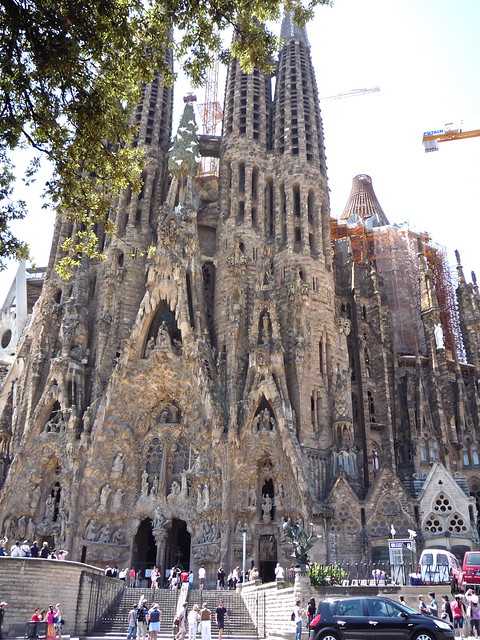
Back at the start of the summer, I went back to Barcelona, for a second visit to the very wonderful Primavera Sound festival. I travelled with the rather pregnant Mrs S., and (Uncle) Danny came along for the latter half of the stay, and also joined us for the festival.
Barcelona is still a marvellous city, and Primavera is still my favourite rock festival. While we were out there, Barcelona FC won the champions league . I can't pretend that I have any sympathy, interest, or even understanding of football, but I really enjoyed the electric city-wide atmosphere on the day; silent, tense and concentrating, as countless viewers watched the televised match, suddenly punctuated by sighs and unison cheers as chances were missed, and goals won; culminating in the riot of celebration erupting from every door and window onto the streets when the final victory was realised.
The festival was another success. The personal highlight, for me was the chance to finally see Lightning Bolt , unusually for them, an on-stage performance, that was one of the most exhilarating live shows I have ever seen. Shellac , playing again on the same ATP stage as last year, as good value as always, another chance to see Oneida , and sample some of the "heritage" acts, giving it some legend, like Sonic Youth , Throwing Muses , and Neil Young . A suprisingly energetic Michael Nyman band set in the indoor auditori was an unexpected highlight, as were a couple of new-to-me performances from Andrew Bird , and Gang Gang Dance . I was amused by Sunn O))) , but sadly unable to persuade either of my companions to stay and watch more than ten minutes of their set.
More disappointing were Marnie Stern , who I'd been looking forward to seeing again, seemed to be suffering from terrible sound and equipment problems, Deerhunter transforming a great album into a weak coldplay-lite live experience, an uninspired and frankly routine Art Brut performance, and a generically dull Jarvis set.
It turns out that I edited and uploaded my photos to flickr shortly after returning to the UK, but what with all the busying and rushing around re-organising and home renovating, I seem to have forgotten to switch the set to public, at least until now.
Dodgem Logic : Alan Moore is preparing to launch a new "underground magazine", with a mixture of content, including comics, and an intriguing sounding eight-page swappable insert for "local content"
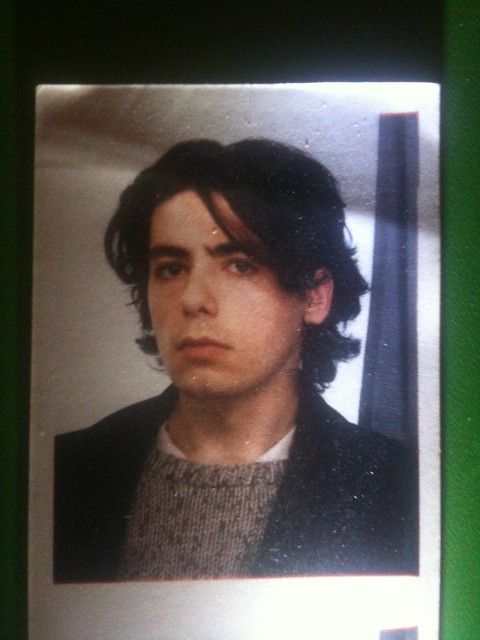
I was clearing out a box in the office, and a strip of passport-sized photos fell out, with one missing. Here is one of the remaining shots from this strip.
Apparently this is what I looked like, fifteen-plus years ago. I had no idea booth-photos were so indestructable. I think it's because the booth was pre-digital. I subsequently found a few other strips, in the same box which were taken a handful of years later, in a booth that used a digital process; they've blurred, bled, and run quite noticeably
jwz hands-on user support : Another one gone. I'm only just starting to realise that all this time, I've been blessed to live in the time of the giants.
We have recently had a wood-burning stove installed. With a baby on the way, I understand it's traditional to frantically embark on home improvement. Our house is old and draughty, as homes built around open fireplaces, one in every room, must be. The current central heating isn't very optimised for heat delivery, especially since we removed a good portion of the internal doors, and have yet to get around to replacing them.
The chimney breast, in what has become the main living room needed some attention, having suffered some water damage long ago, due to leaking. The leaks are gone, but the brickwork and surface plaster were left saturated and continued to deteriorate. Rounding it all off, it was mounted with a bulky, mantelpiece of slate, with ugly pseudo-wood veneer, and filled with garish orange ceramic tiles.
Installing the stove was a way of addressing these issues simultaneously. When fired up, it should produce a generous heat in the centre of the house, well suited to the original building design and airflow. As part of the installation, we've had the chimney lined, the fireplace and hearth reconstructed, and the chimney breast re-surfaced. We ordered the stove from Kindle in Bristol , and they also managed all the installation work, which only took a couple of days.
The stove is a ClearView Pioneer 400 . A clean-burn design, and the installation is certified for use in smokeless zones, such as Bristol. It's a multi-fuel configuration, which can be used to burn (smokeless) coal as well as firewood. We've built a small log store in the back yard, and filled it with a metre-cubed of sawn firewood.
Due to the unseasonably hot weather, I've not had too much of a chance to get it up and running, aside from a few test sessions. I'm not yet sure what our practical fuel consumption will resolve to. In my tests, I've so far determined that it is capable of generating a startling amount of heat after just a few hours of operation.
On a less practical note, it is simply enormous fun having a large burning fire you can fiddle about with, sitting within easy reach. It's very easy to get hypnotised by the thing, when it's burning. I find it considerably more interesting to watch than most things that are on the television.
Beehaus : Urban dwellers are being encouraged to keep bees by Natural England , with the launch of the Beehaus, an new user-friendly urban beehouse design from the firm Omlet .
Electric suicide ants : Colonies of lasius neglectus , the poison-resistant "Asian super ant", whose magnetic compulsion for electricity sources is so strong they can represent a fire hazard, have been identified in the UK for the first time.
Mr. David Hepworth , of the lovely Word Magazine (I subscribe !), a usually reliable, and always interesting cultural commentator just blogged a piece about the reactions to the untimely passing of ex-Apple CEO Steve Jobs . I think his assessment of Mr Jobs' cultural impact is wrong. I was going to present my reaction in place on his blog, although it did seem to grow a little too long for the commentary section, and I subsequently found out that his blogger site seems to be set up disallow comments from people who aren't logged in to a Google account, which I object to, somewhat dogmatically. So I decided to post my piece here, and link back to his , which is more in keeping with my own views about how the Web ought to run.
I don't disagree fundamentally with the tone of the piece. I do share his unease over the now seemingly mandatory broadcast grief marathons that accompany any death in the public eye, and I find an unpleasant hint of infantile narcissim in the fetish relationship between the user and product celebrated with the mass parades of public Apple evangelists and their iDevices, which might be a cousin to the sentiments he expresses about toys and proportional responses.
This attempt to sum up Mr. Jobs as a super-skilled marketer I think underestimates the scale, and perhaps also the nature of Mr. Jobs' contributions, some of which are subtle, many of which may look obvious, but usually only by hindsight. Even if his role was solely as a provoker, and curator of works; and I doubt it was, the truth is rarely that neat - he seems to have his fingerprints near the genesis of a string of transformational products, which do seem to fulfill the cliche of yes, changing the world.
Start at the beginning: His role in realising the portable microcomputer as a packaged appliance, something like a food processor, that people could be taught to directly integrate into their homes and offices. The Apple II barnstormed this market. I am not so sure as most other commentators that this idea was an obvious, archetypal product simply waiting to happen. Putting computers in your house, I think, is a fundamentally odd idea, albeit one that we have now fully naturalised. In 1976 it must have been almost schizophrenic.
Refining this idea into the Macintosh and Lisa, a specifically pioneering further insight was that a then unusual square pixel bitmapped display would better lend itself to curve plotting. This gave us the WYSIWYG relationship between the graphical computer and the laser printer , computer typography and thereby re-shaped the primary means of production for print and graphics.
The post-Apple "wilderness years" are particularly interesting. At NeXT they pioneered software controlled automated computer assembly and production, I've heard it said maybe a decade ahead of everyone else. I think they made a lot of mistakes, but I also think these lessons learned were invaluable later on. More significantly, the NeXT system software placed an elegant emphasis on "object-oriented programming", carefully enveloping the tedious nuts and bolts of interfacing with electrical computer hardware with well chosen software 'components'; tidy abstractions that lead to a system that was significantly easier to port to new hardware configurations, and simultaneously could be more-easily programmed at a higher level, without resorting to so much specialist understanding of specific hardware.
The significance of the work at NeXT will not be fully realised until later in his career, but as an intriguing footnote, it is on a NeXT workstation that a British scientist called Tim Berners-Lee develops some applications and protocols he calls the "World Wide Web". Mr Berners-Lee is on the record noting that the unique NeXT development tools allowed him to easily connect abstract layers to form useful application prototypes in the space of a couple of months.
Steve's other business during those years was Pixar . You don't have to study the history of cinema over the last two decades too hard to detect just how fundamentally Pixar shaped mainstream family movie making.
Then he returns to Apple and begins that now over-documented turnaround from prodigal son and failing company, to pin-up CEO and spectacular media and financial success. It's worth pointing out that the portablility of the NeXT system software allows them to insinuate it into Macintosh entirely. Next the iPod, and then we get iTunes, and the 'iTunes Store'. And then the same elegant software evolves to pocket phones, where the relative ease of programming buoys up the freshly invented 'App market'. And a finely edged production control builds an on-demand production, supply and retail operation that is the envy of the rest of the industry.
I'm not a professional writer as Mr. Hepworth is. I hope I don't read like I'm elegising him mawkishly like some Princess Di or Jade Goody for the "Facebook generation", or lionising him in super-human terms as though he's some over-egged digital Da Vinci, or Newton. I never met him. I'm not laying flowers anywhere. I'm sure that a huge part of his success was through fortunate timing, and developing good taste and keeping good company, but this is surely true of many whom history accounts amongst the Great, perhaps even of most. What a C.V. though!
These things are not a competition you can score, and yet I don't think most Word Magazine readers would rush to disagree with the suggestion that Steve's musical idols like Dylan or the Beatles "changed the world". I'm comfortable suggesting that to a subsequent generation, with it's own new media of choice, Steven P. Jobs influenced and changed the world to an arguably similar degree.
3. On a nearby OS X Leopard notebook, setup a new bluetooth serial port, type RS232. ( System preferences -> Bluetooth -> Advanced ). Call it something like 'Bluetooth-console'. Ensure the Mac is paired with the phone.
4. In a terminal, run ' screen /dev/tty.Bluetooth-console '
5. Set your Mac's bluetooth to 'discoverable'
6. Launch the Python application you've just installed on your phone. Select Options -> Bluetooth Console -> Other. Choose your Mac, and then select the Bluetooth-console serial port as the device.
7. Meanwhile, back on the Mac: a python shell will start in your screen session after a small delay.
8. In the python session, " import audio "
9. In the python session, " audio.say('I never realised my phone had a built-in speech synthesizer') "
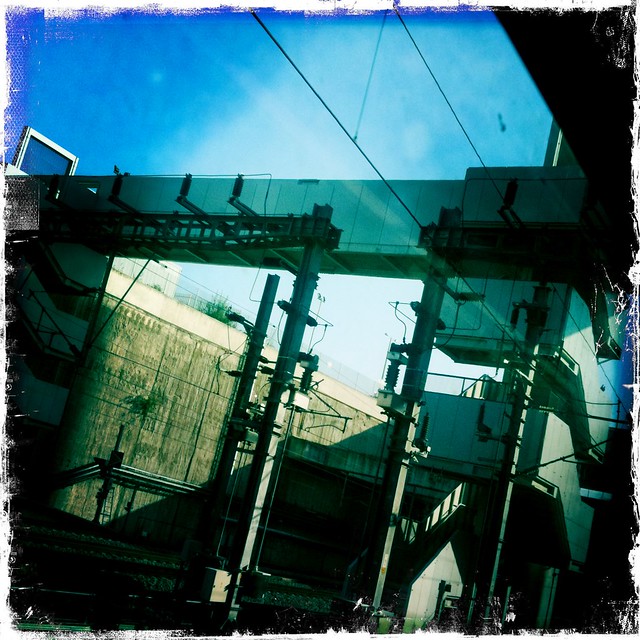
Since moving to Rochester a couple of weeks ago, I'm enjoying the commute into the city on the high speed train . Every morning we wait a minute or two at the perplexingly named Stratford International for a Eurostar to overtake us. Stratford is a weird conglomeration of pylons and glass astride a raw concrete gash. I like the way it looks.
Surprisingly Sensible : Obviously, there's a book to flog, and he's making an attempt at a Jamie , but I found plenty to nod at in this Guardian piece.
I've not posted a gig write up in a long time. One day I might get around to post-documenting some of the backlog. However, here's something very fresh.
Last night I went to see Fever Ray . Fever Ray is the assumed band name of Karin Dreijer Andersson, one half of the strange and compelling Swedish brother-sister art-electronica duo, The Knife .
The ticket price for this one was fairly steep. Seventeen pounds is a lot to ask for an debut act, on a Bristol weekday evening. Knowing the Knife to have something of a penchant for staginess and performance statements , I figured that the cost of admission might indicate a more elaborate performance spectacle than the routine Academy show. It wasn't a terribly full crowd, which may have also had something to do with the ticket price. Luckily my expectations of an interesting presentation were met, more than satisfactorily.
A stage swathed in as much machine-made fog as I've seen since I last watched the Sisters Of Mercy, decades ago. For readers unfamiliar with the Sisters' stage ouevre, let me clarify; this means a lot of fog . The five-piece band only identifiable as bizarre silhouettes suggestive of a dark circus. Improbably tall hats, shadowy pierrot faces, frock coats, hunched shoulders. Karin, stage center shrouded in an enormous cowled cloak , the headress simultaneously suggesting fur and antlers and briar-hedge basketwork, her peculiar outline only really humanised by oversized white gloved hands. During the second song, she cleverly unfurled her cloak a little, a sudden backlight creating a surprising stained-glass panel effect that seemed to shine from inside her.
The whole performance was a meticulously staged progression, slowly opening up the initial murk. At the start the overhead fog was scissored dramatically by a pair of slow moving laser beams. By the second song, they'd each expanded to a pair of fan shapes. Later on these picked up oscillating movement, and eventually traced out colour shifts in the waves of fog. Within the on-stage gloom, the odd sight of a dozen or so standard-lamps, pulsing away in time to the beats through thick lampshades. I didn't have my camera with me, although I expect it would have struggled to capture any of this well. Quite a few people have submitted photos of previous shows to flickr .
As the show progressed, the stage was slowly up-lit from the back with soft blue and yellow glows. The cloak was shed, placed on a stand just behind front of stage, it still loomed, like some kind of shadowy spirit-familiar. Gradually we could see a little more of the performers, jigging around, wildly shaking shamanistic totem-sticks, pounding away on congas and toms, yet still the lighting and smoke effects kept them essentially obscured and anonymous.
The short set stuck solidly to the album, without encores, which was fine by me. My attention didn't wander, nor did I tire of standing in place. My only complaints would be with the slightly murky sound, which isn't that unusual for the Academy, and that the music didn't really connect as terribly live, aside from the vocals; pitch-shifted, yet weirdly still human and very real. I think this was probably down to a combination of the very programmed sounds, and the distancing effect of the theatrics. It was something more like watching a stage-show display set to a musical playback, than a rock music show. I took it as an opportunity to watch something a little out of the ordinary, and enjoyed myself.
The album is ace, and I recommend it to anyone. You can find it on spotify .
The video for "Triangle Walks" gives an impression quite close to the live show. There are some other videos available on the band site which give a good sense of the Fever Ray aesthetic.