The girls are pretty keen on this one right now. It's pretty catchy, and I have had it lodged in my mind's ear for a few days. It is a few years old, so sorry if it was a big meme and I missed it, what can you do. News travels slow out here on the indieweb.
The Bitch, the Stud and the Prawn: " It was a film called Crust. It told the story of a pub landlord who finds a giant seven foot mutant shrimp on a beach. The landlord then decides to teach the shrimp to box - and believes this will make his fortune. "
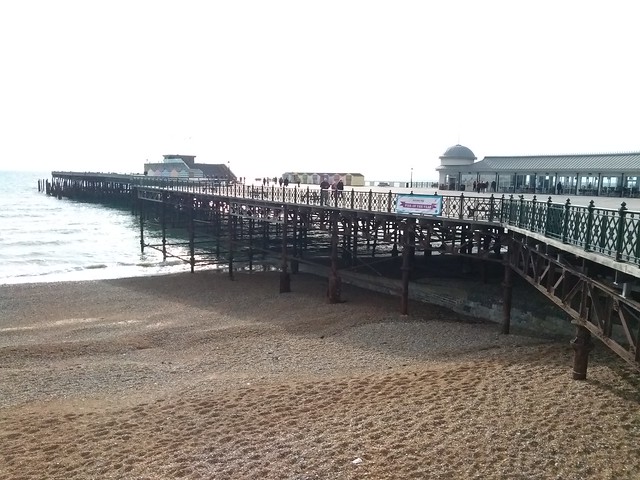
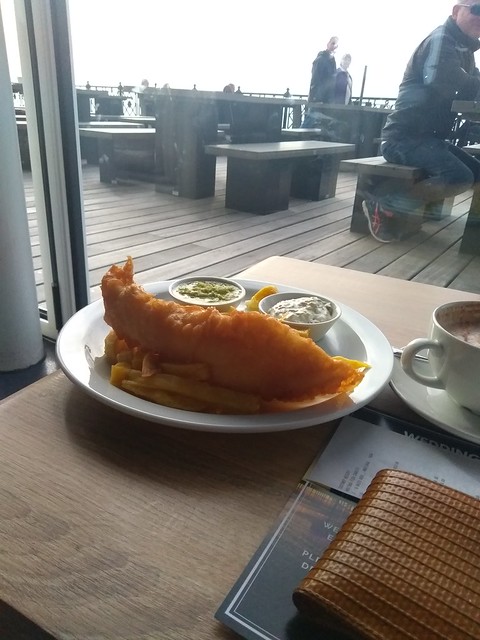
I do like a pier. Hastings pier is sort of, kind of, maybe my literal favourite place on earth. I've written about it before (back in 2006! My goodness). I was born in that town, for some unlikely reason, my folks were passing through, ostensibly visiting relatives. Locals say if you're born there you can't ever leave. Indeed, perhaps I never completely did. I have lots of childhood memories of that pier, flying visits to stay with unfamiliar relatives, whereupon a visit to the pier would inevitably be bestowed upon we whinging children. It seemed a pretty magical place for a child, in the seventies, with it's fading halls of entertainments, and tat shops, and all the usual coin-operated novelties, and lights and mirrors, and cheap confectionery, and sea-angling platforms, and peeking through the floorboards straight down to the murky brown-blue depths.
Many years later, as a confused, transplanted teenager, half-foreign, I returned there to live, adding a little more weight to the local prophesy. I have tons of memories of the place from this era. I seemingly spent the entirety of my sullen late teens sitting underneath it, reading WATCHMEN, with The Sisters of Mercy glued to my ears on my panasonic RQ-KJ1. You could freely move beneath it in those days, before health and safety became too muddled with political correctness. There were a few safety signs, but everyone ignored them.
One summer, I worked for a season on the construction team recasting the sea defence barriers and groynes in modern reinforced concrete. Often took a builder's lunch break in the cafe at the shore end, fried food and sweet tea. I celebrated my 19th birthday in the 'Pub on the Pier' with a handful of acquaintances; I had a self-conscious affection for the notion of a (fairly dreadful) pub that you had to pay a 20p toll before you could even enter. It was in the same pub a couple of years later, on a bright Saturday afternoon, I remember a specific moment of clarity; realising I really wasn't from this town any more, and perhaps the time had come to properly leave. The locals may of course think otherwise.
A grab bag of other memories and images. Raves on the pier during the rave years. Storm waves breaking right over it. A nonsensical shop that only sold products made from garlic attempting a world record for the longest string of garlic. Oldest functional Galaxian machine in the town for many years.
While I was gone it slipped into dereliction, after first bouncing between a couple of murky sounding new ownership schemes. There were organised efforts to reclaim it via compulsory purchase, that seemed to be getting somewhere. Then came fire, well timed, suspicious. And that seemed to be the story end. Another English seaside town with a wrecked and burned dead pier. I was too sad to visit the corpse.
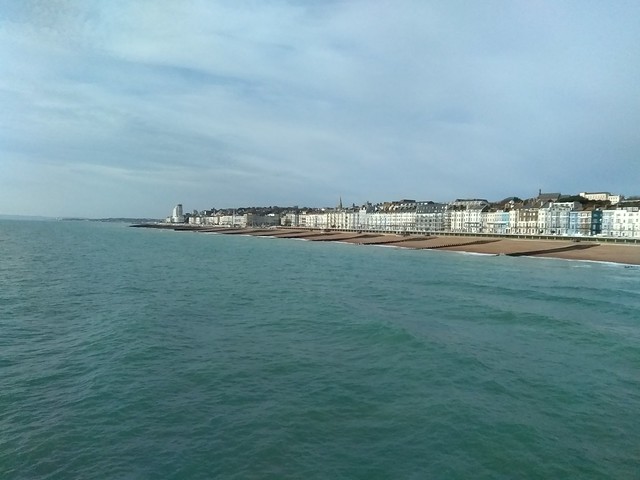
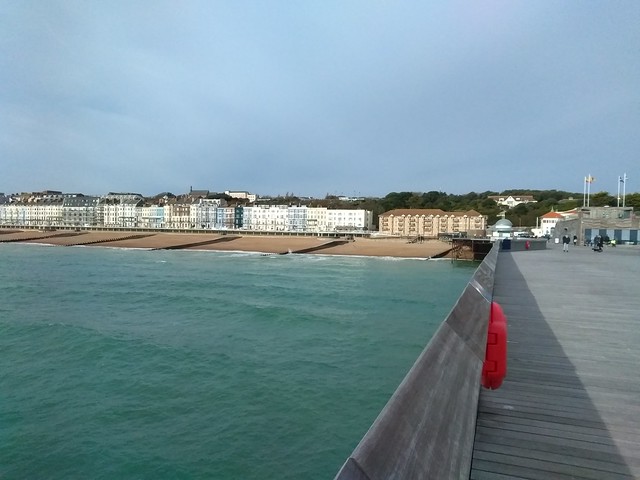
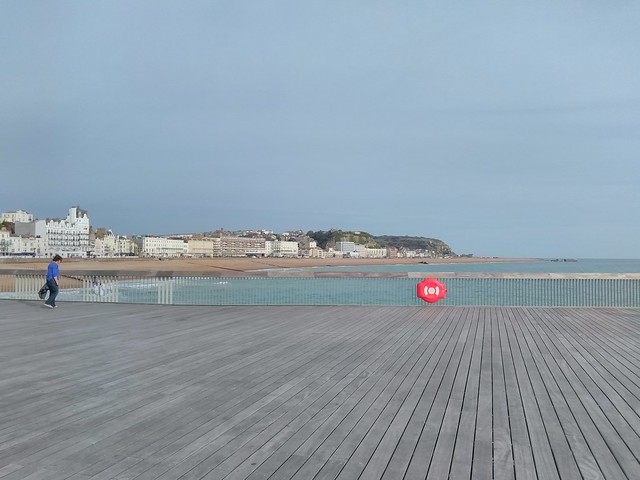
I still saw the news stories that started filtering through about fundraising campaigns, and charity organisation to rebuild it. This all seemed well-intentioned, and positive, but I thought probably doomed to failure, like so many of the town regeneration schemes and stories over the years. To my astonishment they did it. The "people's pier", of all things. Lots of people love it as much as I do, maybe more. Lottery funding was secured, and it reopened, a couple of years ago, in an entirely more modern and re-imagined form. They haven't just reached backward for the easy goal of nostalgia and austerity-years retro kitsch. A tiny visitor center clad with original reclaimed timbers, some beach hut styled pop ups, a viewing platform, and a modest restaurant. The lines from the promenade look fantastic, with the horizon line bisecting the old frames and rigging, from the new planes above. Once you're on it, it's all about the space, and those views; Hastings Old town to your right, Burton's St. Leonards sweeping back away to your left. It's a dramatic and beautiful new public space, more versatile than a traditional pier, but still aware of its past forms and history.
And now this bolder approach has been rewarded with the prestigious RIBA Stirling prize for excellence in architecture. This is pretty astonishing news for Hastings. I feel weirdly proud. It's well worth a visit. The entire town has clearly had a bit of a lift. I've been enjoying the recent moves toward revitalisation of the English seaside town, and we've recently been quite seriously pricing up a move to the coast. I wonder how the Hastings house prices are doing. The locals know what's happening here.
My friend Jim won 15 quid by solving the New Scientist Enigma Puzzle. The really neat thing is he did it 32 years after the fact. Read all about it here , in his own words.
Would anybody with a working BBC like to contribute a real world run time for his BBC BASIC based solution?
Jim runs the Enigmatic Code blog about his hobby of solving New Scientist's Enigma puzzles using short python programs, which anyone can play along with at home.
Anthea Bell Interview: I stumbled across an interview with the English translator of Asterix. I grew up reading these, but it was not until I was older that I could fully appreciate the sophistication of the translation work. Peerless.
L'Inconnue de la Seine : The death mask of this unidentified Parisian teenage suicide became a popular early-20th century objet d'art , eventually the model for the face of the standard CPR training mannequin.
This old blog post about the contrasting approaches to programming to solve a particular problem shot past my RSS reader recently. It's a lovely read about a dialogue-by-article that occured between Donald Knuth and Doug McIlroy, as guest columnists in Communications of the ACM back in the day.
The post is short, wonderfully written, and serves as something of a meta-commentary about the nature of writing about code, and how to communicate the intent and the implementation of a computer program by way of documenting it. It has a wonderful flavour of a parable from the ages, because it's re-telling a story of how the giants from the old days solved a problem in a witty and entertaining way.
You could easily read this as a clash of ancient demigods with the victor being the last man standing, but I think that's probably a mistake. 'What problem are you trying to solve?' is one of my favourite pat-rules about program design, and I don't think the two authors here are trying to solve exactly the same problem.
What problem is literate programming trying to solve? Did it solve it? Are there any better ways to solve that? Wasn't UNIX designed for use in interactive text-processing?
It makes me think about man vs horse races . What problem are they trying to solve?
It is quiet again in the house, in the small hours of the morning, since I rediscovered the time locks in the kids kindle profile. 05:00 Minecraft is noisy
I was churlishly unimpressed by the iTunes "12 days" Christmas promotion this year. However whilst subsequently browsing the iTunes Store home page I did find one app that impressed me enough to blog about.
There's a store section called " Apps Starter Kit " which lists a dozen or so applications that Apple are promoting as "must have" installs for new iOS users. I installed a handful of these to my iPhone 3GS, but the one that has most impressed me so far is the iOS edition of DragonDictate .
It's a "split brain" app, by which I mean it uses "the cloud" to perform the text-to-speech conversion. So far I have been quite impressed with the accuracy of the process, in fact I have created this blog post by dictating while walking the dog, with just a little editing afterwards for tidy up and to add hyperlinks. I suppose it is a little like a poor man's edition of Siri, minus the pretend A.I. and the search and reminders integration.
You can get text by dictating into a text box within the application and there is a quick menu of options that allow you to create an SMS or an e-mail or copy the text to the system clipboard easily for use in other applications. This collaboration isn't too clunky and although dictating text into your phone is a little stilted it doesn't seem to be significantly less effective than my relatively crappy typing on the iPhone on-screen keyboard.
The app was free, presumably it's intended as a promotional device to introduce users to the Dragon family of software applications. Obviously there are some privacy concerns raised by having the voice processing performed on a remote server, but the terms and conditions include a privacy policy which guarantees to preserve your anonymity and keep your data private. The application did even prompted me to ask if I wanted all of my contact names uploaded to the remote service for greater the use of name recognition, and took pains to explain that this would only include name fields from my contacts database and no other personally identifying information or contact details.
I am not sure I would make a habit of using it for writing long articles or even blog posts like this but I think it could prove to be quite useful for such purposes as short e-mail replies or even sending SMS messages in situations where it's inconvenient to type.
Now I can post short updates from the most basic client possible, which is pretty low friction. I should be able to extend this all the way to full articles eventually
Further work at hooking into micro.blog. If I extend my slightly moribund 'linkblog' special case formatting to a new 'short post' class, and then generalize this to cover indieweb 'notes' style posting, then I should be able to build a dedicated feed for notes that fits in better with micro.blog. These short updates will just appear inline on the blog site as de-emphasised text, without article formatting.
According to wikipedia, the term " Churnalism " was first coined by a BBC journalist. I think they may still have journalists working there.
See how many items of product placement you can see in this proud piece of presumably PR-led "pop sci" about smart vending machines . I found it, prominently linked, on the BBC news home page on Boxing Day. The entire notion has a whiff that classic of white elephant puffery from the old school the internet fridge about it.
I don't know if I'm alone in finding this sort of thing repellant. The motivation to whip up this kind of nearly content-free guff into page length pieces must come from somewhere, which means a degree of specific intent. There's the skeleton of an interesting piece on mechanical learning and commercial interests buried in there somewhere, but I find it difficult to read when I keep being stabbed in the eyes by blatant marketing copy, much of which I uncharitably suspect of being pasted in directly from the source press-release. The focus of the piece ought to be on the science, perhaps some of the biometrics and algorithms supporting the interesting sounding audience impression metric (AIM) software , but that's given a throwaway mention; instead the article's centre of gravity seems distorted to orbit around some recently launched consumer products, with little depth of story. Weird details leave unanswered questions hanging. In what way is a new Jell-O SKU "Just for adults" to the extent that it requires a screening interview by femputer ? Titillating teaser questions like this are familiar marketing devices used to capture and exploit base curiosity, but seem out of place in a news piece without any resolution. How does the system handle adults whose body shape diverges strongly from their defined four age brackets? What the merry heck is a general manager of personal solutions anyway?
I gave up counting the product placement incidents after the first couple of paragraphs. Only someone with intimate knowledge of the BBC house style rules would know just how many direct repetitions of the properly capitalized brand names Kraft and Intel are strictly necessary, but there seem to be an awful lot of them littering the piece. There's a lovely Intel i7 box graphic three-quarters of the way down the piece; it seems to me only tangentally related to the story, yet conveniently re-uses the branding iconography supporting their current consumer-targetted CPU line.
Like many a British license-fee payer, I have a peculiar, combative slightly proprietorial relationship with the BBC; being in some weird sense a stake-holder in this unique broadcasting organisation; pride mingles with a misplace sense of ownership, disappointment tangles with admiration. Once upon a time I viewed their web initiatives as exemplary, inspirational and essential. These days they seem increasingly overcooked, irrelevant, and misguided.
I realise, in a sense, I'm a grumpy old man ranting at the telly, but I think this tapering off of content quality provided by BBC online is a real thing. If so, a really worrying trend; added to this we have an effectively Conservative administration, who I'm sure would love to see the BBC, already in retreat, broken up further. Spreading out the more lucrative parts of the special quasi-monopoly, to their chums in commercial broadcasting whilst binning even more of the less lucrative parts in the name of austerity would fit in well with their principles of government.<p>
posted by cms on
I finally wired up micro.blogs! I have a micro blog. I'm not really sure what it is for but it's there. I like it anyway, because it's called cms. In order to get it working, I had to make RSS work slightly better than 'barely', and so now I have an RSS 2.0 feed. The 00's are back! It's all about microformats and POSSE and syndication and decentralization, and taking back the web.
I appreciate it's an outside chance, but should you have a micro.blog account you can follow me on there, and reply back, and be friends, and stuff. Should you not have a micro.blog account, but think you might like one, HMU, I probably have some invites or something The indie web can never die!
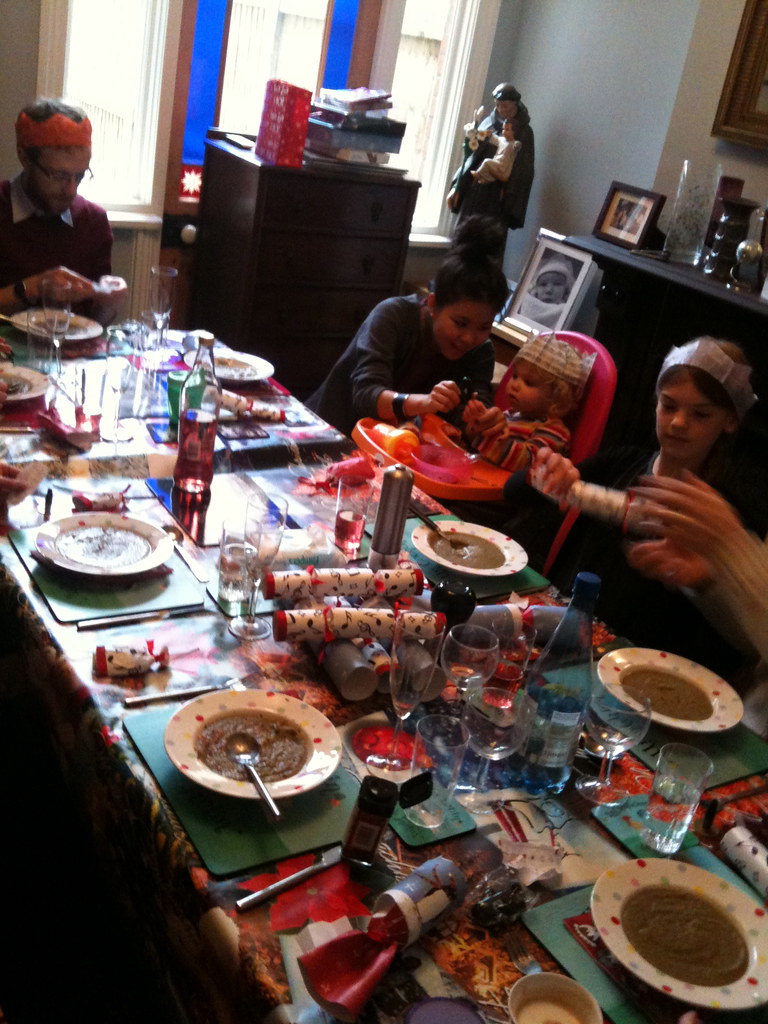
This year scheduling means our turn for hosting the big family meal falls on Christmas eve. Mrs S. did the lion's share of the cooking, facilitated by a new kitchen, more commodious than the postage stamp sized galley we've had for the past couple of years. Champagne, ice-cream,CBeebies pantomime on a loop, nut-roast, sprout and chestnut soup, mechanical penguins, musical crackers, roasted vegetables, and plenty of early presents for young Ada May to open and get over-excited about. Merry Christmas to all four of my readers!
I love making New Year's resolutions. I'm not sure I am good at them, but I enjoy the tradition. Every year, I tend to set at least a small handful. Sometimes they're entirely private, sometimes I publicise them. I don't know that they ever tend to be that successfully realised, but to me that's part of the system. I like to think there's much that is useful to learn from how I fail to achieve them, and maybe that's some part of the benefit. Sometimes I pull them off with aplomb, and that always feels pretty good.
This year I set myself an extraordiary reading challenge. A couple of years ago, on some kind of whim, I think prompted by a positive review in either The Guardian, or Word Magazine (RIP), I purchased, and read Lives of the Novelists by John Sutherland. This is an engaging biographical chronology of the English novel. It covers 294 novelists of significance in historical sequence. The format is readable, there's a 3-4 page potted biography of each author, and then a short summary. So you end up with a sort of illuminated canon starting in the seventeeth century, and leading you up to the roughly present day. The author choices are not always obvious, but neither are they deliberately obscure, and the tone is light, cheeky and erudite, and it works as an entertainment just as much as a reference piece, I unreservedly recommend it.
Part of the summary notes at the end of each chapter, suggests a Must Read Tome, for each writer. These themselves are not always the most obvious work, and carry a little paragraph of justification alongside the choice. So for 2017, in a fit of optimism, alongside a grab-bag of other self-improvement goals, I decreed I would attempt to read every MRT in sequence. Clearly this was an overreach going in. 294 books is approaching a novel a day, and I was unlikely to chew through all of them in the year, but I figured I could keep going with it and see how well I did.
We've passed the halfway mark now, and I'm happy to report it's going awfully. I have managed four books. The most recent one is not even half-finshed. I guess I kind of suck at this. I think there are a couple of mistakes I made on the surface. One I have already skirted around - it's too big a target. Factor into that the fact that I have relatively little spare time for reading fiction, and I also decided to take on a pile of other resolutions that demand daily hobby time (I'm teaching myself a foreign language! Badly!) and it's even more daunting a target. One book a month would be quite a feat, if I'm honest.
I think I might organised little potted reviews as I finish each book, to try and gee myself along a bit. Also, I made a resolution to do more blogging in 2017. That's right, does it show? Book reports seem like easy-reach fruit. Watch this space.
Perhaps the most egregious error though, was to fix myself to the chronology. Whilst this means that I am starting out firmly in the lands of the copyright expired public domain, which makes legal book aquistion very economical, it also means that I've front-loaded the material with tough going books. We start out with challenging archaic language, and structure, and this makes an already sluggish project a little more slower going. I don't believe in changing the rules midstream, however, and I intend to persist.
I thought I'd broken the back of the slightly-too-hard-to-read-comfortably years, when I got through to Defoe, but I hadn't taken into account another pitfall of the early romantic novel. Verbiage. After Defoe I get Samuel Richardson. And the MRT is Clarissa. That's nine fricking volumes of epistolary marriage plot. It might be the longest novel published in the English language. I've nearly finished book one, and it's taken me three months. I sincerely doubt I'll get through this bugger before 2018. It's fascinating, heady stuff though, I am enjoying it. Many tribulations, and archaic mores. A terrifying insight into the political lot of even the priviliged eighteenth century englishwomen. Also, much swoon.
Could this be a ten year project? I'm not quitting.
Of course, I bought and read the Jobsography , Kindle edition, naturally. While I'm not sure I identify with all the howling fanboys' anguished reviews, given my role as super-NEXTSTEP-fanboy I was a bit disappointed, although not particularly surprised, at the relative lack of NeXT content. So I was overjoyed when this 1986 PBS documentary , featuring NeXT in it's pre-launch startup guise, popped up in it's wake. The linked blog post also contains the NeXT stevenote, from the eventual product launch.
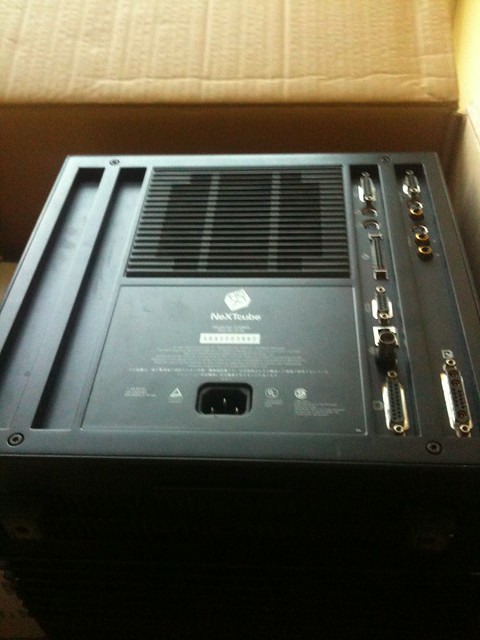
Of course it's not actually running NEXTSTEP. Of course, in a sense it is. Just like your phone.
Thanks to ebay. I like the fact that the sticker arrived with a little template indicating the correct 28° of jaunt. I ignored it of course, and just lined it up by eye.
Things that Turbo Pascal 3 is smaller than : The Turbo Pascal 3.02 IDE and compiler, for MS-DOS, was an executable slightly less than 40KB in size. Here's a list of computery things that are larger than that.
As if finding young me in a box wasn't enough of a memo from Father Time, I've had the "circle of life" message underlined firmly this weekend, by throwing my back out. I mean, properly out, like a sit-com old man, or a Dad from the pages of the Beano. Lifting hurts, walking hurts, sitting mostly hurts, breathing hurts, and bending over is right out. It's one of those marvellous hysterical systems, as the slightest twinge of pain induces all sorts of involuntary tensing in the frantically overcompensating muscle superstructure of my back. The lower nervous system is clear in it's mission. No harm must befall the spine. I strongly suspect that the resultant freezing and spasm makes everything significantly more painful than the original twinge would have managed on it's own, but I am not a doctor. Even though I often assure people that I am, this is actually a well-practiced lie, serving the purposes of antique stock-comedy forms.
The generational aspect of this calamity draws from the fact that I triggered the strain whilst throwing young Ada May ceilingward, in response to her requests to "play flying". Unluckily for me, the initial spasm occurred at the point of release of a throw, meaning that despite my attention being drawn to all sorts of immediate and novel spinal trauma, I still had an falling two year old to catch safely before I could collapse sobbing to the floor with my honour and dignity intact. Two year old children, I must say, are quite a bit heavier than their one year old incarnation.
The thing with back trouble, most sources assure me, is to try and persevere through it. Grit one's teeth, and carry on as much of your normal routine as you can manage. On no account admit defeat and flee to your bed rest. Rest will relax and weaken your back, and exacerbate the problem, or if you're unlucky, invent some new ones. And so I struggle forwards in embittered mimicry of my daily routine, gasping and wheezing and moaning every couple of steps, frozen in place with involuntary grimacing stuck to my face. It has taken me nearly twice as long to get to work as it ordinarily might. Negotiating St. Pancras, I find myself flooded with sympathy for anybody with genuine mobility problems. The place is a nightmare, and it's supposed to be one of London's newest, most accessible hubs. I inch my way towards the office. All my hope is invested in my fancy orthopaedic stool . Please, mighty German engineering, please do your work.
Twenty-five year old me pouts condescendingly from my home page as I update my blog. He's got nothing but contempt for broken backed old men. He's too vain and pre-occupied to worry himself with mundane things like exercise and posture. I'm starting to hate that guy a bit.