barley 2018-01-04
Old Street station has a popup "Black Mirror" shop. I am not sure how I feel about this. I am fairly sure I know how Dan Ashcroft would feel about this.
tagged as
Old Street station has a popup "Black Mirror" shop. I am not sure how I feel about this. I am fairly sure I know how Dan Ashcroft would feel about this.
Fake Jenny : Disappointing, and yet perhaps appropriate, @jennyholzer is not the work of the artist, although they use her words.
Day one of no twitter feels very strange. This gives me some confidence that it is probably a useful exercise.
One thing I wasn't expecting, from last month's new Apple hardware announcements, was the new MagSafe 2 power connector . The new Retina MacBook Pro, along with the 2012 " Ivy Bridge " MacBook Airs, have a new MagSafe port, physically incompatible with the previous generation, unless you use a little adaptor widget , which was luckily introduced for sale on the very same day.
MagSafe is Apple's name for their clever system of attaching the power line to their laptops to charge. Some say too clever by half. The cable has two pins, arranged as two symmetrical pairs , so you don't need to worry about orientation when you connect it up. The pins live in a little oblong recess, surrounded by a thicker shiny metal lip, which is magnetized. The power socket has the complementary inverse shape and magnet, meaning that they eagerly cup together to form a snug charging connection when introduced. The other significant benefit of this arrangement is the ease of disconnection, nice in itself, with the additional blessing that if some clumsy person, perhaps a passing dalmatian , blunders through your cable while you're tethered to the mains, your computer doesn't fly from the desk and shatter, the magnet just snaps free. I'm a big fan.
And so, on to MagSafe 2. Essentially it's the same thing, but in a different shape. The pin configuration and spacing seems to be the same, but the magnetic lozenge, and the companion socket have been reshaped to be longer in the lateral plane, and slightly shorter in height. The shape of the connecting plug has returned a the symmetrical rectangular nub, with embedded charge indicator. Reminiscent of the first generations of MagSafe, but Aluminium, rather than white plastic, and slightly longer, making it perhaps a bit more finger friendly.
Most commentary I've seen about this form change has settled on the Retina MacBook Pro as the motivation for this change, speculating that the move to thinner unibody laptops requires a thinner connector. I'm pretty unconvinced by that argument. The MagSafe 2 is only a millimetre or so thinner than the previous design. I think that if your design constraint was to shrink the connector, you could make it smaller. Furthermore, the traditional Magsafe port is almost the same height as a USB or HDMI socket, and the Retina laptop case houses these ports, without compromise. I have a different theory about the reasoning behind this new shape.
I think the most significant change is that the contact area of the magnetic surface has now nearly doubled. It's a lot more grippy than it's ancestor. Anecdotally, over the lifespan of the MagSafe, I've heard complaints from other users about the reliability of the chargers, particularly about cable and connector failure. Having never experienced similar problems with the half-dozen plus MagSafe chargers I've owned, I've puzzled about this. I wonder how many people might be disconnecting their chargers by yanking on the cable. This works as a method of disconnection, but it's not a very sensible approach, it puts a lot of mechanical stress on the junction between the cable and the plug. Do it enough, and you'll eventually break it. The magnetic coupling is most efficient in the horizontal plane. What you ought to do is flick the plug out, by hooking a finger underneath the connector plug, and angling it up away from the socket.
Apple certainly seemed to recognise that there was a UI problem here. Perhaps an expensive one, if enough customers were returning broken chargers to stores. They even produced a technote about the correct way to disconnect a MagSafe. Then MagSafe plug connectors changed shape over time . The strain relief on the cable junction lengthened, and then the plug changed from the original stubby T-shape, to a longer L-shape, itself subsequently re-inforced with additional strain relief. This connector shape encourages a lower-stress detatchment, but spoils the nice symmetrical property of the plug, because you can now connect it facing forwards, where it will obscure your other ports. MagSafe 2 returns this helpful feature.
So is reliability a plausible motive for this redesign? I think so. The increased contact area of the magnet in MagSafe 2 makes it quite a bit harder to disconnect by cable-tugging. The larger plug housing is easier to grip with the fingers and angle out. The connector is a sufficiently different shape to visibly distinguish it from it's predecessor. It will be interesting to see if the reliability reports from users improve.
Martin Amis Invents Britpop : Wonderful diatribe from Alex Niven in the Quietus
Monolithic : it turns out that a prototype transparent monolith prop from the film 2001 is on display near Tower Bridge.
I've been writing a couple of things in hy again this week. What's Hy? It's a cute idea. It's a lisp that compiles? (transpiles? I never get the difference) to the Python AST. I guess the elevator pitch might be something like clojure but for python. So yeah, a rich, super stable class-tree sort of OO language, with enormous portablility and twenty-odd years of library support for everything you might want to do, but with a nice, dynamic, lispy language and a repl.
I've played with hy a little bit on and off over the years. Actually, when I was working at SMR, I actually deployed some in production. (Somehow, I doubt that's still a thing). Python is my go-to scripting language, because it's very plain, very portable, batteries included, somewhat modern, probably already installed everywhere I work. I try to use it for scripty things, rather than shell or perl or something. Lisps are my favourite programming language. I just like how it fits together. I know lots of people don't, and I'm fine with that, but I always enjoy it.
So over the holiday weekend I found myself wanting a couple of almost throwaway scripts, and I decided to reach back into the hy bucket, and give that another try. I wrote a script to grab my selfie tweets from a twitter archive, and a rough script to publish formatted micro-blog entries directly from the shell.
It was a fun exercise. Hy has moved on a bit since I last tried. (They seem to have removed let, and car, and cdr, and lambda which I feel funny about), but by and large it works really well.
I don't think I would choose to use it to build any complicated systems. (Typically this is true of Python as well to be fair). I'd love to see something like an idomatic web framework in it. I could imagine using it to build serverless workers over something like apex up or chalice perhaps. I should totally try that!
I am not really very good at it yet, so I doubt I'm writing optimal programs. My scripts often look like Dr. Moreau designs halfway between a python script and something more lispy. This could well improve as I understand the underlying sequence / itertools glue a bit more, I'm often routing around confusing sequenced things. I absolutely enjoy writing little scripts like this in it, and I think I maybe enjoy it more than I would if I was writing plain python. I gave some thought about why this might be and I think I figured it out.
It could just be as simple as being all about the code editing. Python, and it's whitespace delimited blocks, is fine, and super readable, but it's always slightly fiddly to edit. Some of this is my toolchain, I'm sure. There's a lot of bells and whistles you can glue over emacs for Python work, and they're pretty good, but I do always find it a slightly fiddly experience. Balanced expressions and sexprs though are obviously an absolute joy to edit in emacs, alongside an embedded inferior lisp repl, and although it's nowhere near as integrated an experience as using slime with a "real" lisp, it's closer to that than editing Python ever feels, and for me that's a significant productivity win. So I think it will stay in the toolbox.
I recommend Hy to anyone who is interested in interesting lightweight languages, especially scripting languages. Obviously it's particularly relevant to anyone who likes python or lisps, even if just as a curiosity. If you work with Python and like using emacs though, and like the sound of 'Python but with structured editing' I would strongly recommend you look at how it might integrate into your workflow.
Chevalier d'Eon : 18th century cross-dressing French diplomat recently identified as subject of a painting in the National Portrait Gallery.
It seems like I've been waiting all my computing life for VDUs to exceed 200 DPI . Well, that's an exaggeration. I've been waiting for it for about as long as I was first exposed to system-wide vector-based type rendering, in the late 1980s. So I'm understandably excited about Apple's new "retina" MacBook Pro , with it's display of ~220 DPI.
Why care so much about DPI? It's all about the text, in particular the inherent problems with clearly scaling non-rectilinear strokes. Text is the fundamental component of everything I do with computers. It always has been, and it seems likely that it will long continue to be. As a floppy haired, slack-wristed aesthete, I really care that the text, which I will be staring into for hours, is clear and beautiful.
The LCD screens used for most modern displays are constructed from a mesh of tiny discrete transparent shutters , which work in combination to make up pixels, which are the smallest visual element that can be addressed on a bitmap display. Typically these pixels are nearly square, and they are arranged in a 2D matrix of perhaps a few million elements. That may sound like a lot, but it's coarse enough to introduce perceptible distortion into lines that are not perfectly rectilinear.
One of my favourite things about Mac OS X, and it's upstart little brother, iOS, is the respect their type-generating software applies to letterform. Typefaces render very faithfully, regardless of scale, and pains are taken to smooth out the curves, using anti-aliasing techniques, that detect the staircasing edges of lines, and soften them into their background with gradual shading. This works very well, but it's not un-noticeable; there's a soft-focus effect that gives a fringey halo to certain text shapes; you become inured to it over time. Other GUI systems tend to adjust the letterform to make the text better align to the pixel grid, it's common for people who aren't habituated to the Mac to comment about the degree of blur.
Things are much better than they used to be. Way back in the day, when outline curved rendering was just too computationally expensive to be routine, everything on-screen was painted as a copy of a pre-drawn bitmap , and blocky graphics were everywhere, particularly once scaling and translation was applied. We peered at them on our tiny goldfish-bowl CRT monitors. Outline font rendering was a specialist feature of certain software packages or dedicated computer systems, perhaps not even rendered online. The fanciest workstation computers had gigantic 20" CRTs , and all vector graphical engines like Display PostScript . It seemed reasonable then to expect the exponential improvements in technology to scale this up to at least print-quality DPI, and the costs to come down.
The costs did come down, and the computers continued their frantic pace of improvement, but something appeared to lock mainstream display rendering at somewhere around 100 DPI for over a decade. I think it was a combination of factors.
There was the move away bulky from beam scanning phosphor dot CRT monitors, which are theoretically capable of precise drawing at a perfectly graduated range of resolutions, over to the more space and power efficient LCD displays, with the aforementioned discrete physical pixel elements. Fifteen years ago I had a 19" ADI multisync CRT monitor, and the effective resolution of my computer display crept up as I upgraded my graphics card and display, and the monitor kept pace. For the last ten years, I've been using a nice 23" HP widescreen LCD , and my desktop resolution has been locked at 1920x1200 that corresponds to the mechanical pixel array of my screen.
LCD screen technology manufacturing is closely tied to flatscreen television production, where the standard vertical resolution has settled on 1080 pixels, which is marketed as ' High Definition ' which is actually pretty low definition if you stop to think that cheap desktop computers were routinely rendering higher than that years before its roll-out.
The system software used on desktop computers, made optimisations and took short-cuts based on the average dot pitch, using fixed bitmaps for painting GUI elements, making assumptions about proportions and spacing of on-screen elements that entrenched and subsequently proved remarkably hard to shift.
The turning point seems to have come with the iPhone 4 , and it's "Retina" display, with a DPI count of 326 - close to that of low-grade print - on it's highly saturated backlit LCD screen. Text looks fantastic on this generation of iPhone, still to me the nicest display of this type I've seen. This was followed up by the slightly coarser (264 DPI) Retina iPad model a couple of years later, with a and as of last week, the still slightly astonishing Retina MacBook Pro. Seems like the high DPI era I've been waiting for is here!
And yet I'm not going to buy a Retina MacBook Pro. I did give it some excited thought. I rushed right out to Apple Covent Garden after the announcement, and fondled one for a little bit, and decided it's not really for me. Experience has taught me to steer wide of a 1st iteration Mac Platform, especially one where Apple seems to be pushing the hardware design into some advanced new shape. There's often early adopter trouble. A couple of early warning signals jump out at me from the start. Pushing that many pixels around is really going to need some grunt work. I have my suspicions about cooling; why the big air vents down the side, why devote five minutes of the keynote describing a cunning new fan design? It's a Mac, I want no fans. Steve always wanted No Fans . It's too big and heavy for me, and yes of course, it's really expensive.
I ordered a new generation 13" MacBook Air . It will replace my current laptop, a last generation 13" MacBook Air. Which replaced my previous laptop, a 13" MacBook Air from the year before. Seems I have a MacBook Air habit .
The wedge-shaped MacBook Air is iterating rapidly to converge upon my ideal computer. Light enough to move around without becoming a burden. A full scale keyboard that I enjoy typing upon, as an emacs -wedded touch typist prone to RSI. Enough pixels on the screen to productively juggle the magical 3 window pattern I tend to adopt for work (an editing window, a reference window, and a command shell). Enough power that I don't need to worry about where my next charge point is. And the 13" display has fairly small pixels (~128 DPI). Smaller text isn't as legible as I'd like, mind you, and some of the GUI elements are a bit small. It would be nice to have more CPU cores. Like I say, iterating rapidly...
200+ DPI displays are clearly here to stay. Where Apple plant their flag, all the OEM PC hardware makers ineveitably follow. Microsoft Windows , which to me increasingly looks like it's playing catch-up, seems to me, looking from the outside, to be more completely resolution independent than either of Apple's operating systems at this point in time, so that shouldn't be a hold-up to broader deployment any more. Production will simplify. Costs will fall with scale.
I had been planning on buying a nice external display, probably an Apple Thunderbolt , because they make lovely docking stations for Thunderbolt-equipped laptops, but that's a foolish idea now. It seems sensible to bet that there will be a high-DPI equivalent along within a couple of years, and monitors are a long term investment. I can wait.
We seem to be at something of a transitional phase for the personal computer at the moment. It seems likely that the future of the Mac is some kind of convergence point between the iPad, the retina MacBook Pro and the MacBook Air, but I can't quite figure out what shape that thing will take. I am typing this final sentence on my box-fresh, just powered up, 2012 MacBook Air, with it's new Mac smell, and it's LCD screen cleaner than I will ever be able to polish it; already I am day-dreaming about it's replacement.
I'm sick of Twitter, folks. I've decided to do something both mild and drastic about it. For 2018, I have resolved to stop using it.
I am not sure what it is for anymore, it certainly doesn't feel like it is for me. I think I've been disengaging slowly for the last couple of years, and in 2017 I repeatedly found it too aggravating, and depressing to engage with. I think I would have already ragequit, had one of last year's resolutions not been that silly selfie thing. Thus a seed was planted about resolutions and exits. Brains often work that way. (Referendums are silly though)
I was late to twitter. I downloaded my twitter archive, whilst I was scraping out all of the 2017 selfies, and apparently my first tweet is from Dec 2007.
gearing up to watch new BSG
— cms the vampire queen (@colinstrickland) December 18, 2007
I was late to Battlestar Galactica as well.
I probably spent a little while reading twitter before registering, although I don't remember anything specific. I can't remember why I signed up in the first place. Looking at that first month of odd, stilted entirely quotidian status posts, I can tell I'm working on Logical Bee, mostly alone, babysitting that dog. It's winter. Maybe I'm lonely? I have a dim memory of thinking it was pretty dumb for a long while before getting involved at all. I remember fiddling about connecting it to things, and experimenting with SMS tweets and emails. I don't think it really clicked for the longest while. I remember a sense of a clique I wasn't ever going to be able to get into. That first wave of web-natives, younger than my generation. More entuned to a web of application services and APIs than hypertexts and data servers. I remember tweetups being a thing, and a Bristol one being announced, and spending an hour or two before deciding firmly I wasn't the kind of person that went to that kind of thing. I quite wish I had gone now. I didn't used to be a very good joiner-in of things. I'm not much better at that now. A little bit, perhaps. Now I know to try.
It took the longest while, but eventually it clicked. I liked the lightness of it. It was sort-of social networking, but social networking at arms length. Lots of irony, lots of whimsy. I just remembered the earliest phase of my binning Facebook was to convert my facebook to just echo my tweets back into it, for the muggles to read. I remember being very snobby and standoffish about things like hashtags and @replies. My first reply wasn't until August 2008.
@davehodg , also for consideration; twot, and perhaps twerped
— cms the vampire queen (@colinstrickland) August 12, 2008
To Daveh! Either I don't know how to reply yet, or the Twitter archive has incorrectly threaded that reply back together. Either seems plausible.
I didn't use a hashtag until May 2009. Even then I was repurposing "get off my lawn" meta-commentary. Amused to see that my next half dozen hashtags are complaining about moonfruit's use of them for viral marketing. Many years later I ended up working there for a season. Again we see the seeds are sown, and the fruit is reaped.
Still fascinated by how rapidly people have started to game twitter trends, and thoroughly amused by #theBNParetwats
— cms the vampire queen (@colinstrickland) May 12, 2009
Not too ashamed of that one. It's interesting looking back at tweets like that, I have a sense that the prevailing vibe of Twitter at the time was that the cool kids were beating out the idiots. I don't get that vibe off Twitter now.
By this point it was clearly very firmly entrenched in my daily desktop routine. Once I got hold of smartphones that could run twitter, I think my usage ramped up. I remember by the time I got to last.fm, I was tweeting all the things, curating a couple of hashtags (#fantasypeelsessions for serendipitous word groups that sounded like band names, #fisharecool for cool fish facts), running multiple joke twitter accounts, writing bots, and generally really enjoying it. I remember when I got to Makeshift, and twitter seemed to be used as the wiring behind at least half of everything there, it then seemed like a necessary internet plumbing for web apps. With hindsight I think that was the peak. It was downhill from there. I don't like it any more, I have detected an opportune moment, and I have decided to leave. At least for one year.
I'm not going to use this post for arguing about why I think it's broken. One of the largest problems I have with it is the sheer concentration of negativity. And one of the reasons I want to move away from it is to focus on building things that are more positive. It's not just Twitter. I'm pretty broken-hearted with the state of the web in 2017 - it's very far from what I signed on to help build as one of those idealistic Gen X web 1.0 types. And again, rather than just bemoan that, I'd rather start focusing on ways to think about fixing that. And for me, in 2018, this means I'm going to go small, and focus on building things and content I can own, in the sidelines. I expect I will be updating here more. I plan to double-down a bit harder on indieweb things, and federated stuff. POSSE all the things. Death to silos. I've been experimenting with micro.blogs and mastodon.social, and I want to play more with beaker and dat, and blockstack and IPFS and other idealistic p2p proto-webs. Maybe even frogans?. The real web looks more like that. Maybe I can help figure out how to make it a bit easier for everyone to clamber onboard.
First off, that's flattering, almost-certainly-entirely-imaginary-cms-fan, thanks! I like you too! Occasionally some of my tweets get as many as five or six engagements, and I do enjoy keeping up with some lovely people. Some of whom I met or perhaps only know through twitter. I'm sorry if this feels like a breakup; It's not you, it's me, as they say in the rom-coms. (Actually, I'm not dumping anyone.)
Something else I want to push for in 2018 is better quality, stronger, social engagement. I want to cultivate more real contact, more high bandwidth engagement and connection with all the good people. This can work two ways of course. If you only really interact with me on a tweet by tweet basis, and you think you're going to miss that, then do please reach out. We can have coffee, or get beers, or just go fish in a lake or something else entirely. And I'm going to be pushing myself to reach out to more people in turn myself, something I'm astronomically poor at. Please help me with this if you can!
IRL networking I plan to ramp up a bit. More meetups, tech and maybe otherwise. Maybe I'll rescind my conference ban. Maybe I'll start some of these things, or start helping to organise them more.
I'm not doing an *infocide*. As well as publishing things hanging from here, which has plenty of RSS feeds, if you can still figure out how to integrate those into your workflows then I'll probably never be very far away. Also, if you look at the home page, there's a list of dozens of other not-Twitter platforms you can stalk me on or connect to me via (maybe we are already!) - If my plan comes together, I hope to be syndicating and updating the useful ones of these more actively.
I don't intend to delete or remove my twitter account, and I will set things up so I still get notifications, so nobody gets ignored. I might even automate some notifications to my twitter feed about updates to things elsewhere. I'm just not going to be participating as a human. I expect I will remove all the apps, so my turnaround on mentions might slow right down.
If you're in the select category of people who only know how to contact me with twitter, there are many options. I haven't changed my phone number, should you know me well enough to have one of those. If you're looking for a way to DM to me, I cannot endorse keybase strongly enough. I think they're trying to do something really interesting, and could do with some more network effect. Sign up to keybase, and keybase message me, I love getting keybase messages, and I always respond. Invite me to your keybase groups! Also, please share your slacks and your newsletters and your mailing lists with me, if you think I'd like them, or they'd like me.
Email still works, and I still read it. My address is even on my website.
Finally, if you're reading this, and we've Twitter interacted in some way, let me say a goodbye for now. If I was annoying, or argumentative, I'm sorry, I can be hard work soemtimes. Maybe some of that might have been caused by the platform? If I was fun or charming or interesting, then let's work to stay in touch! If you don't really care, you're not even sure how you got here from off of twitter, that's cool too, maybe I'll see you again in a year from now.
Octopus hitches lift on Dolphin's genitals : I once had an octopus attached to my forearm for ten minutes. Harder to shift than melted chewing-gum.
With all this focus on RSS generation for micro blog, I've been optimising my engine. I've learned how to use SBCL's profiler, and I have shaved a third off the cost of generating indexes
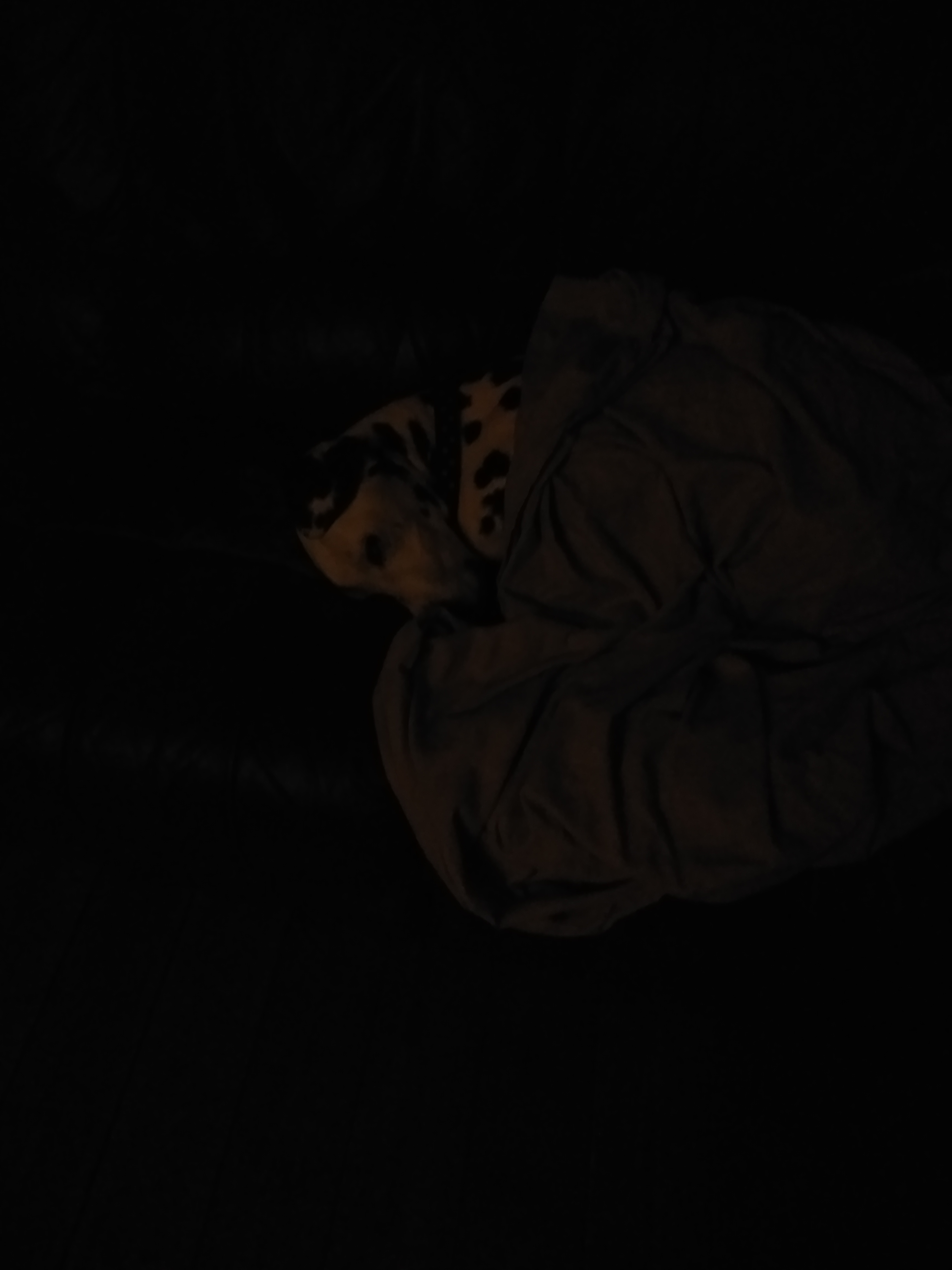
It's been a month now, and I ought to be used to it, and in many ways I am, but in surprisingly many ways I'm still not; I don't have a dog anymore. He got too old, and he got too sick, and tired, and uncomfortable, and he had to be put to sleep, back on the 28th of November. How does it feel? Terrible.
It was an enlarged heart that did for him. Poetically enough, his heart was just too large for him to carry on. The photo above is taken on the last morning, before I headed out to work. I knew there was very little chance he'd be coming back from the vet's appointment later that day. We had a little conversation and I carefully explained to him that he was a very good dog.
Of course he was actually a terrible dog. A brilliantly terrible one, as most dalmatians are born to be. He'd not really been himself for a couple of years, stumbling about and complaining about most things, but right up until the last couple of weeks he was coping mostly, and remained good company. In his prime though, that dog was an athlete, who used to literally fly, and if I open my mind's eye a little, that's what I can see, streaking around the Bristol countryside, barely controllable, raiding bins, and laughing at you, over his shoulder.
I don't really know what to write. I have to write something though. This website, which has been knocking around for fifteen years or more, only really took initial form as a rudimentary 'blog' so I could share dog photos with his burgeoning fanbase. Most of that has bitrotted now, but when I feel better I would like to clean it up some. So I can't really even let go of him without marking some notice here. I don't need to trot out all of the anecdotes, they're probably dull and too personal. After all, outside of my immediate circles, he's just some bloke on the internet's dog. To me, and to some of his internet fans though, he's the best dog in the world. Every single word of that is true.
Should you wear nice underpants when you feel ill, or 'I guess I don't care about anything' ones? These are the questions
When you have, as I have, a race condition in posting that exists somewhere between systemd, rsync, bash, perl, and that's before you even get to the CMS, it is probably time for some refactoring
If it's the last weekend in May, then it must be time for me to go to Primavera Sound ! Barcelona's premier eclectic music festival, or as I like to call it, only semi-jokingly, my annual trip to Spain to watch Shellac. It seems like I've been going forever now, but when I tally up, I think this year is only my sixth visit. Enough for the memories to blur together somewhat; I'm starting to find navigating around the site confusing; each year there is a gradual migration of stage locations, and a subtle shuffling of stage names.
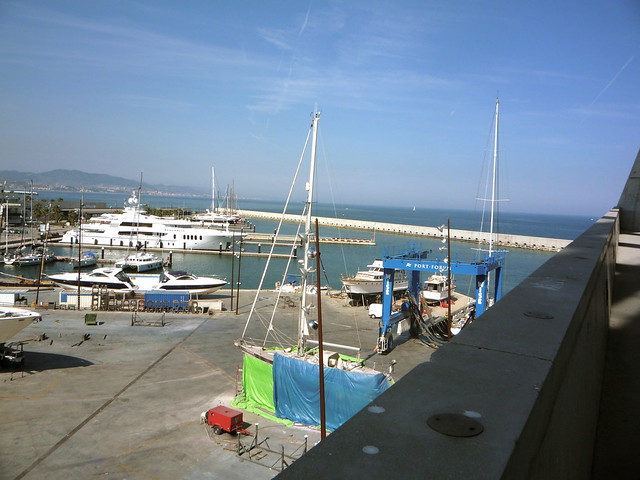
You can buy early-bird VIP passes shortly after they confirm the dates for the festival, which is far in advance of any lineup announcement. These sell for around the same price as the eventual full festival pass, but confer various privileges to reward the faithful. This year, I was finally smart and planned ahead. and I got us a pair back in July. Ah, hubris. Subsequently we fell pregnant, and had a baby just four weeks before the festival, making a mockery of my forward planning, and invalidating our usual routine of attending as part of an extended family holiday. I ended up scaling my visit right back down to a quick in-and-out just across the festival days, and after a couple of potential takers for my second ticket fell through, I ended up attending on my own.
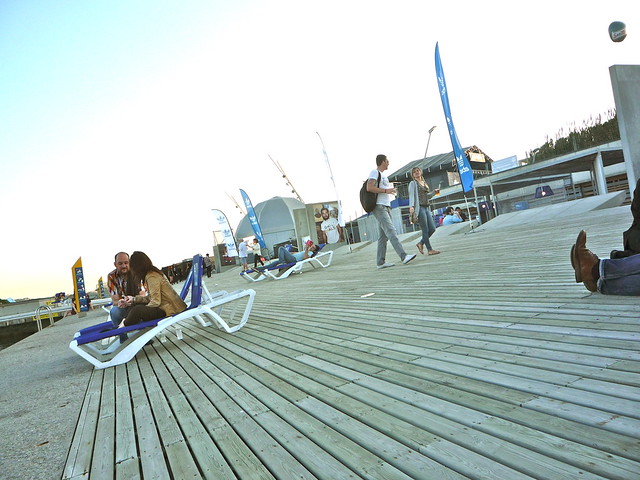
It turns out Barcelona is still pretty much my favourite place on earth. In a break from the usual routine, I was staying in a hotel out close to the festival site, at the far end of the Avinguda Diagonal , rather than an apartment somewhere more central. The facilities nearby are pretty excellent, if a little characterless, with the large modern Mall development el Diagonal Mar providing pretty much every consumer amenity you might need, including free Wi-Fi. It's still easy to reach central Barcelona on transit during the sociable hours of day, and it solves the problems associated with picking a time to leave the Festival, and locating a means of transport home, once you hit the small hours of the morning on the weekdays. Door to door from the festival to my hotel was a leisurely ten minute walk.
Once again I had a really good time. I had a few reservations heading in. Last year was a bit crowded, and occasionally hard work. Being on my own was is a bit weird. I've done stints working away from home, but they aren't like this. Luckily I did find some people to talk to at Festival; I enjoyed the chance to spend some time with Matt and Anne , and I also bumped into a few friendly groups by chance; Mike and the Canadian islanders, and those nice chaps from Leicester from the Jeff Mangum queue. Hello to any of you who find your way to reading this!
The upside of attending on my own, it meant I was able to watch lots of bands. I overdid things a little on the Thusday, watching upwards of twenty acts in a session stretching from 4pm through to 4am. I subsequently found myself flagging a little through the middle of the session on the Friday, and finally found a happy balance for Saturday. Weather was excellent, probably the hottest Primavera I've attended. I even managed a mild sunburning on the elbows on Thursday, and I rarely sunburn. The VIP passes turned out to be a good bet - subsidised bars, segregated rest and food areas, and easy access to the indoor concert hall for the posh gigs.
Shellac completely owned it, once again. Year after year, always different, always the same. My other musical highlights were Kleenex Girl Wonder, Spiritualized pulling "Electric Mainline" out of the back catalogue in the middle of a perfect festival setlist, the pro-celebrity karaoke festival of the Big Star's 3rd tribute ( Mike Mills! Norman Blake! Ira and Georgia! Alexis from Hot Chip! ), and I need to pass out a special mention for the marathon Cure set. A bedrock foundation act from my indie disco days, they played a 30-odd song set of old fanservice and hit singles, and I nodded along from the VIP lounge, surprised by how much of it I recognised, given that I own precisely one Cure LP ( Disintegration , naturally ), and one single ( Inbetween Days, I'm predictable like that)
Here's everything I saw, replete with aribitrary ratings :
Baxter Dury ★★ Afghan Whigs ★★ Wilco ★★ Franz Ferdinand ★★ Death Cab For Cutie ★ The xx ★★ Spiritualized ★★ La Estrella De David ★★ Pegasvs ★★ Iceage ★ Grimes ★★ Danny Brown ★ A$AP Rocky ★★ Peter Wolf Crier ★★ Field Music ★★★ Kleenex Girl Wonder ★★★ Dominant Legs ★★ Bombino ★★ Lovely Bad Things ★★ Other Lives ★★ The Cure ★★ Afrocubism ★★ I break horses ★★ Dirty Beaches ★ Sleigh Bells ★★★ Nick Garrie (plays "The Nightmare of J.B. Stanistlas") ★★ Jeff Mangum ★★ Big Star's Third ★★★ Picore ★ Orthodox ★★ Sharon Van Etten ★ Justice (live) ★★★ Beach House ★★ Neon Indian ★ Demdike Stare ★★★ Shellac ★★★ The Pop Group ★ Atlas Sound ★★ Michael Gira ★★ Milagres ★★ Jenn Grant ★★ Cadence Weapon ★★
There weren't too many low-lights. Occasional bar queues. The subsidy at the VIP bars meant that the occasional drink bought outside of those enclosures had a costly sting. A couple of occasions of queuing; to collect the passes, and to get a ticket for, and then gain access to the limited entry Jeff Mangum show. Aggravating cancellations , Björk, Death Grips, Sleep and Melvins - acts I wanted to see, and in the case of Sleep, probably my ideal of the biggest single draw of the festival. Luckily I'm a veteran, pragmatic festival-goer, I don't place too much weight on being able to see individual acts. If I hadn't already seen Sleep at ATP vs Fans:2, I might perhaps think differently.
Leading up to the festival I had been wondering if it was going to be my last year at Primavera. Logistically it's growing more awkward to arrange, I've been a serial attendee for years, and sooner or later the charm should wear off. The inaugural edition of the Portugese sister festival had been catching my eye, And then everything worked it's usual magic. I plan to head back to Barcelona for 2013 if I can. Maybe I'll see you there.
Restore Bounce Mail : Mail.app lost it's "Bounce Message" command in Lion. Restore it via AppleScript.
Does anyone know if eating your own bodyweight in Stilton is a good way to clear up Xmas flu?
 I think she is smitten.
 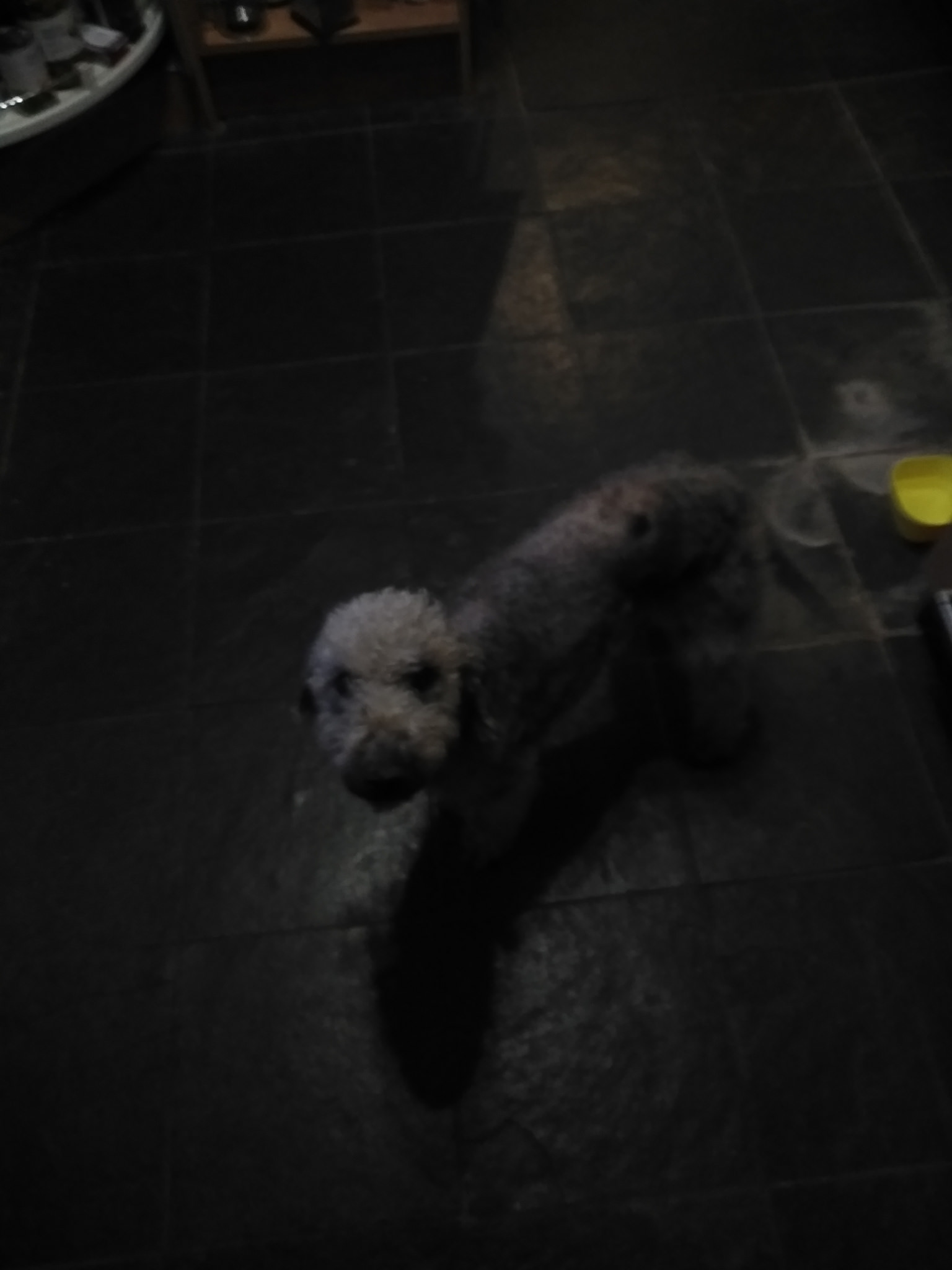 introducing Snoop Dogg, a three year old Bedlington rehome
 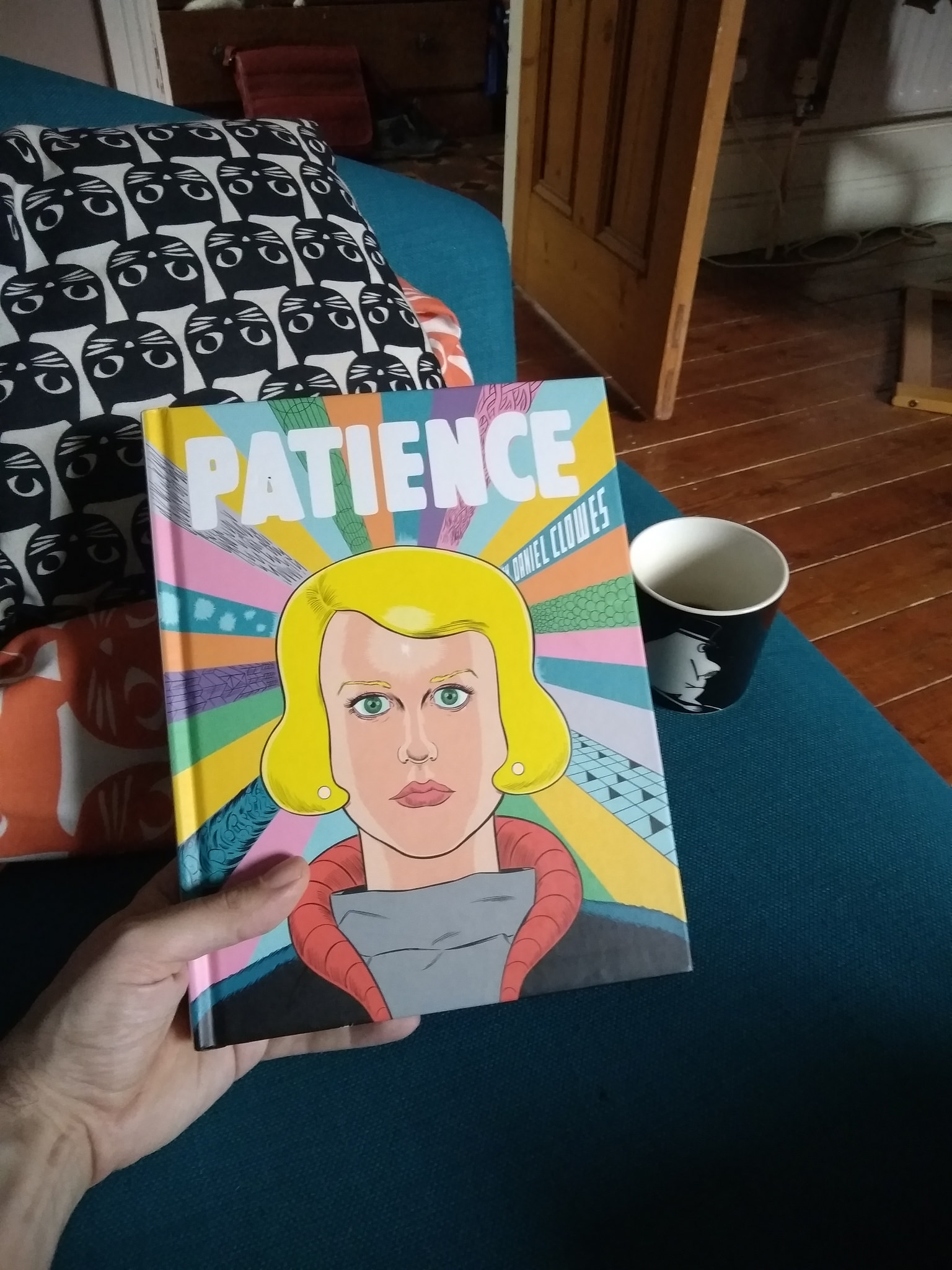 This was a great Xmas read, although nothing like what I was expecting